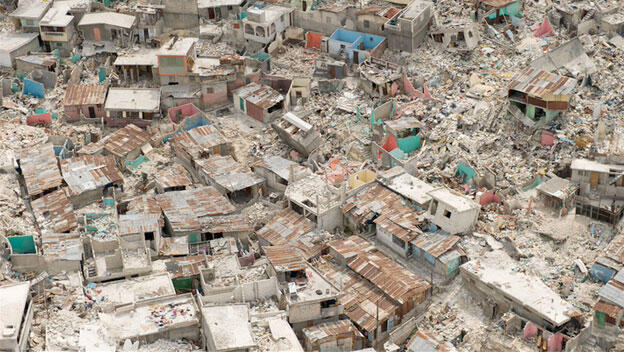
Aerial Photography Aids Haiti Quake Victims
After a 7.0-magnitude earthquake struck Haiti on January 12, 2010, the National Oceanic and Atmospheric Administration (NOAA) sent aircraft on an aerial photography mission. In a report on February 3, NOAA describes how the photographs are used to map transportation routes through the rubble.
Related Speeches & Audio (10)
-
Aerial Photography Aids Haiti Quake Victims
Aerial Photography Aids Haiti Quake VictimsAudio Clip (0:50)
Audio Clip (0:50)
After a 7.0-magnitude earthquake struck Haiti on January 12, 2010, the National Oceanic and Atmospheric Administration (NOAA) sent aircraft on an aerial photography mission. In a report on February 3, NOAA describes how the photographs are used to map transportation routes through the rubble.
-
Haiti Earthquake Aftermath
Haiti Earthquake AftermathAudio Clip (0:47)
Audio Clip (0:47)
As Haiti copes with the aftermath of a 7.0-magnitude earthquake that struck its capital of Port-au-Prince on January 12, 2010, a report from the U.S. Geological Survey on January 15 details the scope of the devastation.
-
Magnitude 7.0 Quake Strikes Haiti
Magnitude 7.0 Quake Strikes HaitiAudio Clip (0:39)
Audio Clip (0:39)
Shortly after a 7.0-magnitude earthquake struck near Haiti’s capital, Port-au-Prince, on January 12, 2010, the U.S. Geological Survey provides an update on the situation.
-
Major Earthquake and Tsunami Hit Japan
Major Earthquake and Tsunami Hit JapanAudio Clip (0:44)
Audio Clip (0:44)
On March 11, 2011, an 8.9-magnitude earthquake struck the coast of Japan, rattling a 500-mile region and setting off a tsunami. A report from the U.S. Geological Survey describes the massive quake as one of the largest ever recorded.
-
China Earthquake Devastates Region
China Earthquake Devastates RegionAudio Clip (1:07)
Audio Clip (1:07)
On May 12, 2008, a 7.9-magnitude earthquake shook eastern Sichuan, China, killing thousands. It was the country’s worst natural disaster in three decades. A report from the National Earthquake Information Center moments after the quake describes the situation as preliminary news rolls in. The quake, originally thought to be a 7.8, was later upgraded.
-
Iceland Volcano Erupts
Iceland Volcano EruptsAudio Clip (0:19)
Audio Clip (0:19)
When the Icelandic volcano Eyjafjallajökul erupted on April 14, 2010, it produced a large cloud of steam and volcanic ash that grounded air traffic in Northern Europe for several days. A news report following the eruption describes the resulting air travel chaos.
-
George W. Bush on the Space Shuttle Columbia Disaster
George W. Bush on the Space Shuttle Columbia DisasterAudio Clip (3:15)
Audio Clip (3:15)
On February 1, 2003, the space shuttle Columbia was 16 minutes away from touchdown after completing its 28th mission when a damaged heat protection tile caused the shuttle to incinerate, killing all seven crew members. Later that day, President George W. Bush informs the nation about the terrible disaster.
-
Ozone Hole Recovery
Ozone Hole RecoveryAudio Clip (0:26)
Audio Clip (0:26)
A 1986 study of the South Pole determined the cause of a hole in the ozone layer and led to an international treaty banning the production of chlorofluorocarbons (CFCs). Twenty years later, in an August 23, 2006, report, a scientist from the original expedition discusses the ozone’s slow recovery.
-
Hurricane Katrina Destruction
Hurricane Katrina DestructionAudio Clip (0:16)
Audio Clip (0:16)
One year after Hurricane Katrina landed on the Gulf Coast, a member of the National Oceanic and Atmospheric Administration’s helicopter crew remembers the swath of destruction he viewed from above on August 29, 2005.
-
Columbia Space Shuttle Disaster
Columbia Space Shuttle DisasterAudio Clip (0:31)
Audio Clip (0:31)
On February 1, 2003, the space shuttle Columbia was returning from its 28th mission when, 16 minutes to touchdown, the shuttle incinerated and broke apart over Texas. Communication between the Columbia crew and Mission Control captures the last moments of the flight.
Related Videos (2)
-
Exxon Valdez Oil Spill
Exxon Valdez Oil SpillVideo Clip (3:38)
Video Clip (3:38)
Shortly after midnight on March 24, 1989, the oil tanker Exxon Valdez struck Bligh Reef just off the coast of Alaska, dumping more than 11 million gallons of crude oil into the pristine environment.
-
How the Earth Was Made: America's Ice Age
How the Earth Was Made: America's Ice AgeVideo Clip (44:12)
Video Clip (44:12)
Chart the progress of the ice ages throughout Earth's history, from the planet’s original icy state millions of years ago to the more recent ice ages.
Most Popular Videos on History.com
-
America Divided
(3:54)
-
Caroline Dries: NYU Dorm
(3:26)
Newest Videos on History.com
-
Vietnam in HD Preview
(2:00)
-
Two For the Road
(1:48)
-
HISTORY says Thanks
(2:47)
Shop HISTORY
-
Titanic: The Complete Story DVD Set
TITANIC: THE COMPLETE STORY charts the fateful history of the ship and its passengers as well as providing an overview on the popular culture phenomenon that this tragedy has become.
$19.95
Buy Now -
How the Earth Was Made DVD
In gripping detail, understand just how our world came to be.
$19.99
Buy Now
Email Updates
Keep up with the latest History shows, online features, special offers and more.
Sign up


