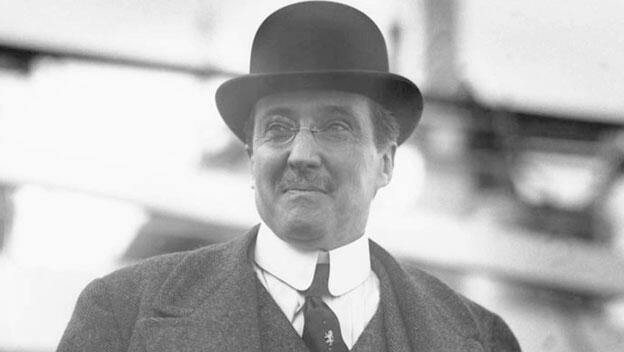
Ambassador Demands Loyalty From German Americans
James Watson Gerard, American ambassador to Germany during World War I, gives a notorious speech to the Ladies Aid Society of St. Mary's Hospital in New York in November 1917, calling for German Americans to be loyal to the United States or risk being shipped back to the Fatherland.
Related Speeches & Audio (10)
-
Ambassador Demands Loyalty From German Americans
Ambassador Demands Loyalty From German AmericansAudio Clip (2:53)
Audio Clip (2:53)
James Watson Gerard, American ambassador to Germany during World War I, gives a notorious speech to the Ladies Aid Society of St. Mary's Hospital in New York in November 1917, calling for German Americans to be loyal to the United States or risk being shipped back to the Fatherland.
-
Gompers Pledges Labor's Support for World War I
Gompers Pledges Labor's Support for World War IAudio Clip (1:11)
Audio Clip (1:11)
Samuel Gompers, founder of the American Federation of Labor (AFL), discusses the effects of World War I on the United States.
-
General Pershing Rallies Support for World War I
General Pershing Rallies Support for World War IAudio Clip (0:32)
Audio Clip (0:32)
In a speech recorded from the battlefield in France on April 4, 1918, Gen. John J. "Black Jack" Pershing, commander of the American Expeditionary Forces during World War I, rallies American support with a patriotic message.
-
Reaction to North Korean Surprise Attack
Reaction to North Korean Surprise AttackAudio Clip (1:57)
Audio Clip (1:57)
On July 10, 1950, at a meeting of the United Nations Security Council, Ambassador Warren R. Austin reports on North Korea's refusal to retreat from its armed invasion of the Republic of Korea. By the end of the session, the U.N. officially supported sending U.S. forces into Korea.
-
Franklin Roosevelt Returns From Yalta
Franklin Roosevelt Returns From YaltaAudio Clip (3:41)
Audio Clip (3:41)
In February 1945, "Big Three" leaders, Franklin D. Roosevelt, Winston Churchill and Joseph Stalin, met at Yalta to discuss the reorganization of post-war Europe. In an address to Congress on March 1, 1945, President Roosevelt reports the achievements of the gathering.
-
J. Edgar Hoover on War Preparedness
J. Edgar Hoover on War PreparednessAudio Clip (2:06)
Audio Clip (2:06)
In a September 1940 address to the American Legion, J. Edgar Hoover, the director of the FBI, warns of the growing threat of subversive forces in the United States.
-
Cordell Hull on Need for Strong National Defense
Cordell Hull on Need for Strong National DefenseAudio Clip (2:14)
Audio Clip (2:14)
In an address delivered on October 26, 1940, U.S. Secretary of State Cordell Hull emphasizes the need to prepare for the threat of Nazi and Japanese aggression.
-
Kennedy on the Buildup of Arms in Cuba
Kennedy on the Buildup of Arms in CubaAudio Clip (7:35)
Audio Clip (7:35)
On October 22, 1962, in a national statement, President John F. Kennedy discloses that U.S. spy planes discovered the placement of Soviet offensive missiles in Cuba.
-
JFK on Korean War Armistice Talks
JFK on Korean War Armistice TalksAudio Clip (1:11)
Audio Clip (1:11)
In July 1951, John F. Kennedy, a promising young Democrat from Massachusetts, offers his views on the terms the United States should seek at the Korean War armistice talks in Kaesong.
-
Henry Cabot Lodge Urges U.N. Action on Hungary
Henry Cabot Lodge Urges U.N. Action on HungaryAudio Clip (0:22)
Audio Clip (0:22)
U.S. Ambassador Henry Cabot Lodge Jr. calls an emergency meeting of the U.N. General Assembly after Hungarians begin revolting against communist rule in October 1956.
Related Videos (4)
-
Nixon Addresses "Silent Majority"
Nixon Addresses "Silent Majority"Video Clip (1:53)
Video Clip (1:53)
On the heels of a major nationwide protest against the Vietnam War in October 1969, President Richard Nixon delivers a speech on November 3, laying out his plans for ending the war through diplomatic negotiations and asking for the support of the "great silent majority" of Americans.
-
Treaty of Versailles Ends World War I
Treaty of Versailles Ends World War IVideo Clip (1:56)
Video Clip (1:56)
German resentment over harsh peace terms leads to a rise in nationalist sentiment and the eventual rise to power of Adolf Hitler.
-
Causes of World War I
Causes of World War IVideo Clip (2:17)
Video Clip (2:17)
By 1914, military tensions and a series of alliances have Europe on the edge of war. In August, the fuse is lit by an assassination in Sarajevo. By war's end, more than 100 countries would be involved in the conflict.
-
Rwanda: Background to Genocide
Rwanda: Background to GenocideVideo Clip (3:14)
Video Clip (3:14)
Years of ethnic hostility brings the African nation to the brink.
Most Popular Videos on History.com
-
America Divided
(3:54)
-
Caroline Dries: NYU Dorm
(3:26)
Newest Videos on History.com
-
Vietnam in HD Preview
(2:00)
-
Two For the Road
(1:48)
-
HISTORY says Thanks
(2:47)
Shop HISTORY
-
The American Civil War DVD Set
Experience for yourself the historical and personal impact of the Civil War.
$61.15
Buy Now -
History Channel Presents: The War of 1812 DVD Set
Follow a seemingly disastrous decision to declare war to the glory of the stars and stripes.
$14.98
Buy Now -
Civil War: Rebellion to Reconstruction DVD Set
Experience the turbulent events that ignited the bloodiest, most divisive war this country has known.
$53.99
Buy Now
Email Updates
Keep up with the latest History shows, online features, special offers and more.
Sign up


