
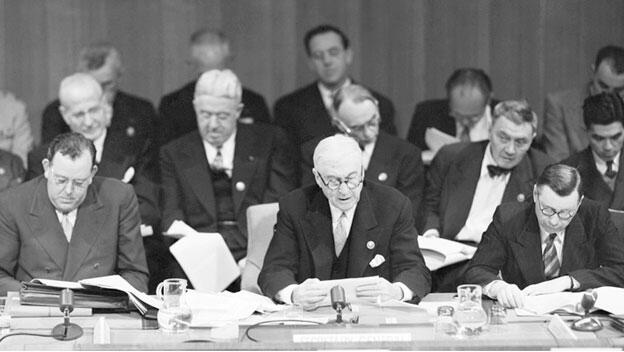
Baruch Calls for Control of Nukes and related media

Baruch Calls for Control of Nukes

Bernard Baruch, an American statesman spoke about the continuing struggle of unity in the west. He was an important advisor on many international issues including being the U.S. Representative to the United Nations Atomic Energy Commission. He proposed a plan that would give the United Nations strict control over atomic weapons, but the Soviet Union was opposed to the Baruch Plan.

Listen to Similar Speeches & Audio

Your Parental Control settings do not allow you to view thiscontent.

Related Speeches & Audio (10)

  • Baruch Calls for Control of Nukes
    Baruch Calls for Control of Nukes

    Audio Clip (1:37)

    Bernard Baruch, an American statesman spoke about the continuing struggle of unity in the west. He was an important advisor on many international issues including being the U.S. Representative to the United Nations Atomic Energy Commission. He proposed a plan that would give the United Nations strict control over atomic weapons, but the Soviet Union was opposed to the Baruch Plan.

    Audio Clip (1:37)
  • Carter Calls for Boycott of 1980 Moscow Olympics
    Carter Calls for Boycott of 1980 Moscow Olympics

    Audio Clip (1:39)

    President Jimmy Carter announces that U.S. athletes will not attend the Summer Olympic Games in Moscow unless the Soviets withdraw from Afghanistan by the stated deadline of February 20, 1980.

    Audio Clip (1:39)
  • Pakistan's Benazir Bhutto on Afghanistan
    Pakistan's Benazir Bhutto on Afghanistan

    Audio Clip (0:45)

    A news report highlights Pakistan's Prime Minister Benazir Bhutto's speech delivered to the U.S. House of Representatives on June 7, 1989, in which she calls for America's continued support for the rebels in Afghanistan.

    Audio Clip (0:45)
  • U.S. Boycotts 1980 Moscow Olympics
    U.S. Boycotts 1980 Moscow Olympics

    Audio Clip (1:46)

    In protest against the Soviet invasion of Afghanistan, President Jimmy Carter decided that the United States would not participate in the 1980 Summer Olympics in Moscow. In a news report, the would-be U.S. athletes voice their opinions on the boycott.

    Audio Clip (1:46)
  • Britain Recognizes People's Republic of China
    Britain Recognizes People's Republic of China

    Audio Clip (0:22)

    On January 6, 1950, the British government under Prime Minister Clement Attlee followed the USSR and several other nations in recognizing the new communist government of China. A news report provides details.

    Audio Clip (0:22)
  • Carter Opens Poland Press Conference
    Carter Opens Poland Press Conference

    Audio Clip (2:22)

    On December 30, 1977, at a stop along his seven-nation tour of Europe, the Middle East and India, President Jimmy Carter spoke at a news conference in Warsaw. The conference, carried live on U.S. television and aired later in Poland, was the first ever conducted by an American president.

    Audio Clip (2:22)
  • Hong Kong Turnover Ceremony
    Hong Kong Turnover Ceremony

    Audio Clip (2:48)

    Live coverage of the ceremony proceedings on July, 1, 1997, captures the moment when British soldiers lower the Union Jack and the Hong Kong flag to the strains of "God Save the Queen," followed by the raising of China's red banner with five gold stars as the national anthem plays.

    Audio Clip (2:48)
  • Eisenhower Proclaims Alaska the 49th State
    Eisenhower Proclaims Alaska the 49th State

    Audio Clip (1:04)

    On January 3, 1959, President Eisenhower presides over the ceremony welcoming the territory of Alaska into the Union as the 49th and largest state.

    Audio Clip (1:04)
  • Eisenhower Proclaims Hawaii the 50th state
    Eisenhower Proclaims Hawaii the 50th state

    Audio Clip (0:26)

    Eight months after Alaska became a U.S. state, President Eisenhower signs the official proclamation on August 21, 1959, admitting Hawaii into the Union as the 50th state and delivers a welcoming speech.

    Audio Clip (0:26)
  • Eisenhower Returns From Cancelled Summit Meeting
    Eisenhower Returns From Cancelled Summit Meeting

    Audio Clip (4:19)

    On May 1, 1960, an American U-2 high-altitude reconnaissance aircraft was shot down over central Russia. As a result, the Paris Summit Conference, scheduled 13 days later, collapsed. Upon his return from the failed conference on May 20, President Eisenhower addresses the welcoming crowd at Andrews Air Force Base.

    Audio Clip (4:19)

Related Videos (10)

  • John F. Kennedy and the TVA
    John F. Kennedy and the TVA

    Video Clip (1:24)

    President Kennedy is forced to improvise a stump speech in Tennessee, after discovering that his speech didn't make the trip.

    Video Clip (1:24)
  • Eisenhower Defeats Stevenson
    Eisenhower Defeats Stevenson

    Video Clip (1:51)

    Eisenhower defeats Adlai Stevenson to become the 33rd President.

    Video Clip (1:51)
  • Republicans Nominate Eisenhower
    Republicans Nominate Eisenhower

    Video Clip (2:18)

    Watch as General Dwight D. Eisenhower becomes the Republican nominee for President, in this History Channel video. He adds Richard Nixon as his running mate in this presidential race. Nixon was the youngest VP candidate in history.

    Video Clip (2:18)
  • Kennedy's Summation
    Kennedy's Summation

    Video Clip (2:48)

    This John F. Kennedy vs. Richard Nixon 1960 presidential debate History Channel video shows Senator Kennedy speaking about the importance of the Social Security Act of 1935 and now was the time to do something for elderly medical care.

    Video Clip (2:48)
  • Kennedy on His Qualifications
    Kennedy on His Qualifications

    Video Clip (1:17)

    See President John F. Kennedy respond to Richard Nixon's accusations that he is immature and ill-qualified to be President of the United States in this debate video. Kennedy explains how they both came to Congress in 1946.

    Video Clip (1:17)
  • Kennedy: Teachers' Salaries
    Kennedy: Teachers' Salaries

    Video Clip (1:32)

    John F. Kennedy answers back to Nixon's accusation of supporting federal control of teacher salaries. Kennedy explains that was not the question before the Senate in February, the issue was whether to give federal aid to the state to support education.

    Video Clip (1:32)
  • Kennedy on 'Extreme' Bills
    Kennedy on 'Extreme' Bills

    Video Clip (1:24)

    Senator John F. Kennedy debates that none of the bills proposed by Nixon were extreme like Nixon was suggesting. Kennedy uses Nixon's proposals of $1.25 an hour plan, federal aid to education, and medical care for the aged to prove his point.

    Video Clip (1:24)
  • Kennedy: Communism within the U.S.
    Kennedy: Communism within the U.S.

    Video Clip (0:50)

    Senator John F. Kennedy talks about the internal threat that communism poses to national security. Kennedy describes that these internal factions are serious and should be taken care of by supporting laws that the U.S. has already passed.

    Video Clip (0:50)
  • Nixon's Opening Statement
    Nixon's Opening Statement

    Video Clip (2:34)

    In his opening statement during the first of four "Great Debates" between the two candidates in 1960, Richard Nixon agrees with John F. Kennedy's view of international affairs but disputes the notion that the country's growth has been stagnant.

    Video Clip (2:34)
  • Nixon: Communism within the U.S.
    Nixon: Communism within the U.S.

    Video Clip (1:38)

    The Cold War was a serious issue that engulfed the United States. Coupled with this war was the fear of communism in the United States. This fear became a central issue between Kennedy and Nixon. Hear their debate in this History Channel video.

    Video Clip (1:38)

Related Photo Galleries (1)

  • Gandhi
    Gandhi

    6 Photos

    Mohandas Karamchand Gandhi is remembered for his nonviolent methods of effecting social and political change.

    (6 Photos)

Shop HISTORY