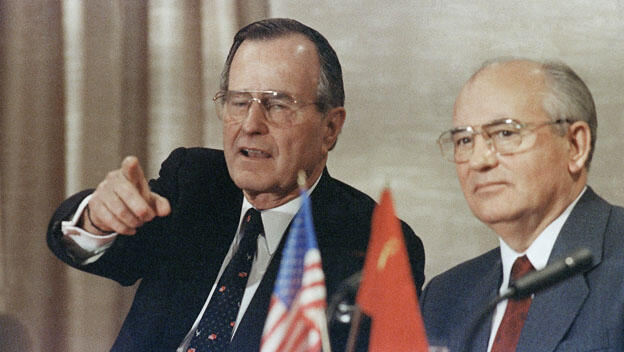
Bush and Gorbachev Declare End of Cold War
President George H. W. Bush and Soviet leader Mikhail Gorbachev declared an end to the Cold War at the Malta Summit on December 3, 1989. At a joint press conference aboard the Soviet passenger liner Maxim Gorky in Marsaxlokk Harbor, President Bush speaks about his hopes for a cooperative U.S.-Soviet relationship.
Related Speeches & Audio (10)
-
Bush and Gorbachev Declare End of Cold War
Bush and Gorbachev Declare End of Cold WarAudio Clip (1:45)
Audio Clip (1:45)
President George H. W. Bush and Soviet leader Mikhail Gorbachev declared an end to the Cold War at the Malta Summit on December 3, 1989. At a joint press conference aboard the Soviet passenger liner Maxim Gorky in Marsaxlokk Harbor, President Bush speaks about his hopes for a cooperative U.S.-Soviet relationship.
-
Ford's Address at the Helsinki Conference
Ford's Address at the Helsinki ConferenceAudio Clip (1:54)
Audio Clip (1:54)
On August 1, 1975, at the Helsinki Accords, a major diplomatic agreement was signed by 35 nations, including the United States and the Soviet Union, in an attempt to secure peace between the eastern and western blocs. In a speech delivered at the Finland conference, President Gerald Ford promises to do his part for the good of all nations.
-
Bush and Gorbachev Sign the START I Treaty
Bush and Gorbachev Sign the START I TreatyAudio Clip (2:25)
Audio Clip (2:25)
On July 31, 1991, the Strategic Arms Reduction Treaty was signed in Moscow by U.S. President George H.W. Bush and Soviet President Mikhail Gorbachev, committing each superpower to reducing nuclear arms by a third. In a press conference held at the Kremlin, President Bush discusses the economic cooperation implicit in the peace negotiations.
-
Reagan Addresses British Parliament
Reagan Addresses British ParliamentAudio Clip (0:17)
Audio Clip (0:17)
On June 8, 1982, in the first speech by an American president to a meeting of both houses of the British Parliament, President Ronald Reagan presents his hope for a future that would "leave Marxism-Leninism on the ash heap of history."
-
Eisenhower Weighs Chance for Peace in the Cold War
Eisenhower Weighs Chance for Peace in the Cold WarAudio Clip (3:40)
Audio Clip (3:40)
On April 16, 1953, after the death of Russian Premier Joseph Stalin, President Dwight D. Eisenhower delivers what is known as his “Cross of Iron” speech before the American Society for Newspaper Editors, contrasting the philosophies of the Soviet Union and the United States.
-
The Eisenhower Doctrine
The Eisenhower DoctrineAudio Clip (1:01)
Audio Clip (1:01)
In order to suppress growing Soviet influence in the Middle East following the Suez Crisis of 1956, President Dwight D. Eisenhower appears before a joint session of Congress on January 5, 1957, to present a policy that will become known as the Eisenhower Doctrine. It holds that the United States would be authorized to provide military assistance "to secure and protect the territorial integrity" of any nations threatened by international communism.
-
Reagan Announces "Star Wars"
Reagan Announces "Star Wars"Audio Clip (1:39)
Audio Clip (1:39)
On March 23, 1983, in what later became known as his "Star Wars" speech, President Ronald Reagan announces his plans to develop an anti-missile capability to counter the threat of Soviet ballistic missiles and to make these nuclear weapons "impotent and obsolete."
-
Reagan Demands Fall of Berlin Wall
Reagan Demands Fall of Berlin WallAudio Clip (1:08)
Audio Clip (1:08)
On June 12, 1987, in a speech delivered from the Brandenburg Gate in West Germany, President Ronald Reagan makes one of his most famous statements when he calls on Mikhail Gorbachev to tear down the Berlin Wall.
-
Clinton Remarks on the Dayton Peace Accords
Clinton Remarks on the Dayton Peace AccordsAudio Clip (2:02)
Audio Clip (2:02)
On November 27, 1995, President Bill Clinton announces the end of years of ethnic warfare in Serbia, Bosnia-Herzegovina and Croatia. The leaders of the three warring factions met in Dayton, Ohio, and signed an agreement known as the Dayton Peace Accords, which created two new sovereign states: Bosnia and Herzegovina.
-
Reagan’s Evil Empire
Reagan’s Evil EmpireAudio Clip (0:28)
Audio Clip (0:28)
In a speech delivered to the National Association of Evangelicals in Orlando, Florida, on March 8, 1983, President Ronald Reagan criticizes the Soviet Union’s lack of religious faith.
Related Videos (10)
-
Franklin D. Roosevelt at the Moscow Conference
Franklin D. Roosevelt at the Moscow ConferenceVideo Clip (1:15)
Video Clip (1:15)
Watch the speech given by Franklin D. Roosevelt at the Moscow Conference during World War II.
-
Kennedy's Summation
Kennedy's SummationVideo Clip (2:48)
Video Clip (2:48)
This John F. Kennedy vs. Richard Nixon 1960 presidential debate History Channel video shows Senator Kennedy speaking about the importance of the Social Security Act of 1935 and now was the time to do something for elderly medical care.
-
Franklin D. Roosevelt Warns of Difficult War
Franklin D. Roosevelt Warns of Difficult WarVideo Clip (0:57)
Video Clip (0:57)
Watch as Franklin D. Roosevelt declares war on Japan in the wake of Pearl Harbor and warns the American public to steel themselves for the difficulties that lie ahead.
-
Franklin D. Roosevelt's First Fireside Chat
Franklin D. Roosevelt's First Fireside ChatVideo Clip
-
The Great Communicator
The Great CommunicatorVideo Clip (4:18)
Video Clip (4:18)
Ronald Reagan galvanized the American public through his famous speeches that helped redefine American politics in the 1980s.
-
Nixon's Summation
Nixon's SummationVideo Clip (3:19)
Video Clip (3:19)
Listen to the important issues in 1960 in this History Channel video of one of the first televised debates, which took place between Richard Nixon and John F. Kennedy. The video shows Nixon stating his views from the Soviet Union to health insurance.
-
National Recovery Administration Created
National Recovery Administration CreatedVideo Clip (2:06)
Video Clip (2:06)
Established in 1933, the National Recovery Administration (NRA) was a key component of President Franklin Roosevelt's New Deal program designed to combat the effects of the Great Depression.
-
Nixon Announces His Resignation
Nixon Announces His ResignationVideo Clip (2:38)
Video Clip (2:38)
View and listen to President Nixon's resignation speech in its entirety from the White House.
-
Cold War
Cold WarVideo Clip (2:31)
Video Clip (2:31)
The Cold War is over, but what it left behind may surprise you.
-
Kennedy and the Cuban Missile Crisis
Kennedy and the Cuban Missile CrisisVideo Clip (2:38)
Video Clip (2:38)
President Kennedy avoided nuclear war during the Cuban Missile Crisis and gained the trust of the nation.
Related Photo Galleries (2)
-
Space Race
Space Race(13 Photos)
13 Photos
-
Communist Leaders
Communist Leaders(12 Photos)
12 Photos
During the 20th century, the worldwide spread of communism took many different forms under the direction of each country's leadership.
Most Popular Videos on History.com
-
America Divided
(3:54)
-
Caroline Dries: NYU Dorm
(3:26)
Newest Videos on History.com
-
Vietnam in HD Preview
(2:00)
-
Two For the Road
(1:48)
-
HISTORY says Thanks
(2:47)
Shop HISTORY
-
The White House: Behind Closed Doors DVD
Learn the secrets of America's most recognizable residence.
$17.47
Buy Now -
The Korean War: Fire and Ice DVD
Historians, battle veterans and archival footage reveal the pain, glory, and pathos of the war.
$19.33
Buy Now -
The Doomsday Clock
Learn the history of the clock - developed in 1947 as an image to symbolize urgency in the Cold War and the threat of nuclear disaster.
$19.99
Buy Now
Email Updates
Keep up with the latest History shows, online features, special offers and more.
Sign up


