
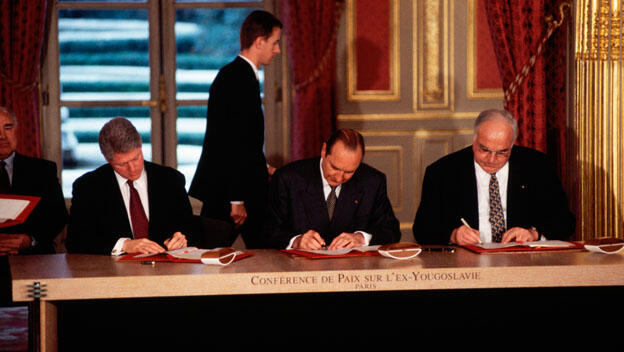
Clinton Remarks on the Dayton Peace Accords
On November 27, 1995, President Bill Clinton announces the end of years of ethnic warfare in Serbia, Bosnia-Herzegovina and Croatia. The leaders of the three warring factions met in Dayton, Ohio, and signed an agreement known as the Dayton Peace Accords, which created two new sovereign states: Bosnia and Herzegovina.
Related Speeches & Audio (10)
-
Clinton Remarks on the Dayton Peace Accords
Clinton Remarks on the Dayton Peace AccordsAudio Clip (2:02)
Audio Clip (2:02)
On November 27, 1995, President Bill Clinton announces the end of years of ethnic warfare in Serbia, Bosnia-Herzegovina and Croatia. The leaders of the three warring factions met in Dayton, Ohio, and signed an agreement known as the Dayton Peace Accords, which created two new sovereign states: Bosnia and Herzegovina.
-
Bush and Gorbachev Declare End of Cold War
Bush and Gorbachev Declare End of Cold WarAudio Clip (1:45)
Audio Clip (1:45)
President George H. W. Bush and Soviet leader Mikhail Gorbachev declared an end to the Cold War at the Malta Summit on December 3, 1989. At a joint press conference aboard the Soviet passenger liner Maxim Gorky in Marsaxlokk Harbor, President Bush speaks about his hopes for a cooperative U.S.-Soviet relationship.
-
Ford's Address at the Helsinki Conference
Ford's Address at the Helsinki ConferenceAudio Clip (1:54)
Audio Clip (1:54)
On August 1, 1975, at the Helsinki Accords, a major diplomatic agreement was signed by 35 nations, including the United States and the Soviet Union, in an attempt to secure peace between the eastern and western blocs. In a speech delivered at the Finland conference, President Gerald Ford promises to do his part for the good of all nations.
-
Truman Announces Japan's Surrender
Truman Announces Japan's SurrenderAudio Clip (1:57)
Audio Clip (1:57)
On September 1, 1945, in a radio address to the American people, President Harry Truman announces the unconditional surrender of Japan, formalized aboard the U.S.S. Missouri.
-
Franklin D. Roosevelt's "Stab in the Back" Speech
Franklin D. Roosevelt's "Stab in the Back" SpeechAudio Clip (3:07)
Audio Clip (3:07)
On June 10, 1940, as President Franklin D. Roosevelt prepares to deliver the commencement address at the University of Virginia where his son is graduating with a law degree, Italy declares war on France and Great Britain. Rather than deliver his prepared speech, Roosevelt instead expresses his opposition to Mussolini's move and calls on America to end its isolationism.
-
Truman Announces Germany's Surrender
Truman Announces Germany's SurrenderAudio Clip (2:04)
Audio Clip (2:04)
In a May 8, 1945, radio broadcast, President Harry Truman announces the unconditional surrender of Germany, but reminds Americans that the war wages on in the Far East.
-
Franklin D. Roosevelt's War Progress Report
Franklin D. Roosevelt's War Progress ReportAudio Clip (0:57)
Audio Clip (0:57)
In his progress report on World War II on July 28, 1943, President Franklin D. Roosevelt informs the nation that "the first crack in the Axis has come" as Italian Premier Mussolini falls from power.
-
Clinton Brokers Israeli-PLO Peace Accords
Clinton Brokers Israeli-PLO Peace AccordsAudio Clip (1:50)
Audio Clip (1:50)
In a ceremony held at the White House on September 13, 1993, Israeli leader Yitzhak Rabin and Yasser Arafat, leader of the Palestine Liberation Organization, signed an agreement to help resolve the Israeli-Palestinian conflict. President Bill Clinton pledges U.S. support in the work that lies ahead.
-
Bush and Gorbachev Sign the START I Treaty
Bush and Gorbachev Sign the START I TreatyAudio Clip (2:25)
Audio Clip (2:25)
On July 31, 1991, the Strategic Arms Reduction Treaty was signed in Moscow by U.S. President George H.W. Bush and Soviet President Mikhail Gorbachev, committing each superpower to reducing nuclear arms by a third. In a press conference held at the Kremlin, President Bush discusses the economic cooperation implicit in the peace negotiations.
-
Franklin D. Roosevelt's Fourth Inaugural Address
Franklin D. Roosevelt's Fourth Inaugural AddressAudio Clip (6:22)
Audio Clip (6:22)
With the country at war at the start of his unprecedented fourth term as president of the United States, Franklin D. Roosevelt delivers a short and somber inaugural address at a simple ceremony without a parade or ball on January 20, 1945.
Related Videos (10)
-
Franklin D. Roosevelt at the Moscow Conference
Franklin D. Roosevelt at the Moscow ConferenceVideo Clip (1:15)
Video Clip (1:15)
Watch the speech given by Franklin D. Roosevelt at the Moscow Conference during World War II.
-
Franklin D. Roosevelt Warns of Difficult War
Franklin D. Roosevelt Warns of Difficult WarVideo Clip (0:57)
Video Clip (0:57)
Watch as Franklin D. Roosevelt declares war on Japan in the wake of Pearl Harbor and warns the American public to steel themselves for the difficulties that lie ahead.
-
Franklin D. Roosevelt's First Fireside Chat
Franklin D. Roosevelt's First Fireside ChatVideo Clip
-
National Recovery Administration Created
National Recovery Administration CreatedVideo Clip (2:06)
Video Clip (2:06)
Established in 1933, the National Recovery Administration (NRA) was a key component of President Franklin Roosevelt's New Deal program designed to combat the effects of the Great Depression.
-
Nixon Announces His Resignation
Nixon Announces His ResignationVideo Clip (2:38)
Video Clip (2:38)
View and listen to President Nixon's resignation speech in its entirety from the White House.
-
Kennedy's Summation
Kennedy's SummationVideo Clip (2:48)
Video Clip (2:48)
This John F. Kennedy vs. Richard Nixon 1960 presidential debate History Channel video shows Senator Kennedy speaking about the importance of the Social Security Act of 1935 and now was the time to do something for elderly medical care.
-
Kennedy on His Qualifications
Kennedy on His QualificationsVideo Clip (1:17)
Video Clip (1:17)
See President John F. Kennedy respond to Richard Nixon's accusations that he is immature and ill-qualified to be President of the United States in this debate video. Kennedy explains how they both came to Congress in 1946.
-
Kennedy: Teachers' Salaries
Kennedy: Teachers' SalariesVideo Clip (1:32)
Video Clip (1:32)
John F. Kennedy answers back to Nixon's accusation of supporting federal control of teacher salaries. Kennedy explains that was not the question before the Senate in February, the issue was whether to give federal aid to the state to support education.
-
Nixon's Opening Statement
Nixon's Opening StatementVideo Clip (2:34)
Video Clip (2:34)
In his opening statement during the first of four "Great Debates" between the two candidates in 1960, Richard Nixon agrees with John F. Kennedy's view of international affairs but disputes the notion that the country's growth has been stagnant.
-
Nixon's Secret Plan to End the Vietnam War
Nixon's Secret Plan to End the Vietnam WarVideo Clip (3:36)
Video Clip (3:36)
In 1968, Richard Nixon ran on a platform for presidency that included a "secret plan" to end the war in Vietnam.
Most Popular Videos on History.com
-
D-Day Invasion
(3:07)
-
Hitler's Military Blunders
(3:27)
Newest Videos on History.com
-
Vietnam in HD Preview
(2:00)
-
Two For the Road
(1:48)
-
HISTORY says Thanks
(2:47)
Shop HISTORY
-
Lincoln DVD
This unique portrait of the 16th president presents his remarkable tale as seen through his own eyes.
$17.77
Buy Now -
The White House: Behind Closed Doors DVD
Learn the secrets of America's most recognizable residence.
$17.77
Buy Now -
Lincoln Set
Includes two DVD sets on Lincoln's life and legacy and a collectible Lincoln Penny Leather Wallet.
Email Updates
Keep up with the latest History shows, online features, special offers and more.
Sign up


