
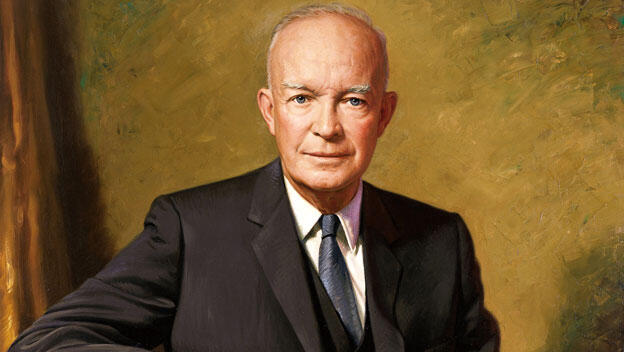
Dwight D. Eisenhower on the Middle East and related media

Dwight D. Eisenhower on the Middle East

On February 20, 1957, U.S. President Dwight D. Eisenhower appeared before his nation to discuss the on-going crisis in the Middle East and to win popular support for the Eisenhower Doctrine, a congressional bill that would authorize the deployment of U.S. military forces to any Middle East nation seeking aid against Communist aggression. Four months earlier, the latest crisis in the troubled region began when Israeli, British, and French forces invaded Egypt and occupied the Suez Canal Zone in retaliation for Egyptian leader Gamal Abdel Nasser's nationalization of the waterway. The United Nations, the U.S., and the U.S.S.R. all expressed outrage at the hostilities, and Britain, France, and Israel agreed to withdraw from the Suez as a U.N. emergency force was sent to the area. Although the superpowers presented a facade of unity during the Suez Canal Crisis, both were primarily motivated by their ambition to gain influence with Arab states in the Middle East.

Listen to Similar Speeches & Audio

Your Parental Control settings do not allow you to view thiscontent.

Related Speeches & Audio (10)

  • Dwight D. Eisenhower on the Middle East
    Dwight D. Eisenhower on the Middle East

    Audio Clip (2:04)

    On February 20, 1957, U.S. President Dwight D. Eisenhower appeared before his nation to discuss the on-going crisis in the Middle East and to win popular support for the Eisenhower Doctrine, a congressional bill that would authorize the deployment of U.S. military forces to any Middle East nation seeking aid against Communist aggression. Four months earlier, the latest crisis in the troubled region began when Israeli, British, and French forces invaded Egypt and occupied the Suez Canal Zone in retaliation for Egyptian leader Gamal Abdel Nasser's nationalization of the waterway. The United Nations, the U.S., and the U.S.S.R. all expressed outrage at the hostilities, and Britain, France, and Israel agreed to withdraw from the Suez as a U.N. emergency force was sent to the area. Although the superpowers presented a facade of unity during the Suez Canal Crisis, both were primarily motivated by their ambition to gain influence with Arab states in the Middle East.

    Audio Clip (2:04)
  • Eisenhower Returns From Cancelled Summit Meeting
    Eisenhower Returns From Cancelled Summit Meeting

    Audio Clip (4:19)

    On May 1, 1960, an American U-2 high-altitude reconnaissance aircraft was shot down over central Russia. As a result, the Paris Summit Conference, scheduled 13 days later, collapsed. Upon his return from the failed conference on May 20, President Eisenhower addresses the welcoming crowd at Andrews Air Force Base.

    Audio Clip (4:19)
  • George H. W. Bush Addresses U.S. Troops in Somalia
    George H. W. Bush Addresses U.S. Troops in Somalia

    Audio Clip (0:28)

    In an effort to provide humanitarian aid to Somalia, President George H.W. Bush ordered 30,000 U.S. troops into the East African country on December 4,1992. In a speech to the troops on the mission, President Bush assures them that an end is in sight.

    Audio Clip (0:28)
  • George H. W. Bush Announces Start of Persian Gulf War
    George H. W. Bush Announces Start of Persian Gulf War

    Audio Clip (6:33)

    On the evening of January 16,1991, President George H. W. Bush addresses the nation to discuss the launch of Operation Desert Storm.

    Audio Clip (6:33)
  • Jimmy Carter on Human Rights
    Jimmy Carter on Human Rights

    Audio Clip (3:58)

    In his address before the United Nations General Assembly on March 17, 1977, President Jimmy Carter lays out his plan for advancing the cause of human rights.

    Audio Clip (3:58)
  • Eisenhower Proclaims Alaska the 49th State
    Eisenhower Proclaims Alaska the 49th State

    Audio Clip (1:04)

    On January 3, 1959, President Eisenhower presides over the ceremony welcoming the territory of Alaska into the Union as the 49th and largest state.

    Audio Clip (1:04)
  • Eisenhower Welcomes Khrushchev to the U.S.
    Eisenhower Welcomes Khrushchev to the U.S.

    Audio Clip (1:38)

    On September 15, 1959, Soviet Premier Nikita Khrushchev, promising an open heart and good intentions, began an unprecedented tour of the United States. President Eisenhower expresses his hopes upon Khrushchev's arrival for improved relations between the two superpowers.

    Audio Clip (1:38)
  • Henry Cabot Lodge Jr. on Abraham Lincoln
    Henry Cabot Lodge Jr. on Abraham Lincoln

    Audio Clip (1:33)

    As the principal speaker at the National Republican Club's 1957 Lincoln Day Dinner, Ambassador Henry Cabot Lodge Jr. discusses the continuing appeal of the 16th president.

    Audio Clip (1:33)
  • Eisenhower Proclaims Hawaii the 50th state
    Eisenhower Proclaims Hawaii the 50th state

    Audio Clip (0:26)

    Eight months after Alaska became a U.S. state, President Eisenhower signs the official proclamation on August 21, 1959, admitting Hawaii into the Union as the 50th state and delivers a welcoming speech.

    Audio Clip (0:26)
  • George H. W. Bush Refuses More Debates
    George H. W. Bush Refuses More Debates

    Audio Clip (2:04)

    As the 1988 presidential campaign got underway, a debate over debates emerged, with Gov. Michael Dukakis' camp pushing for three and four and Vice President George H. W. Bush standing his ground at two. In an address to the American people, Bush tries to bring the matter to a close.

    Audio Clip (2:04)

Related Videos (10)

  • Jimmy Carter on Defense
    Jimmy Carter on Defense

    Video Clip (0:59)

    President Jimmy Carter, when questioned on our defense said we should resolve troubles around the world through negotiation, in this History Channel video. He said Ronald Reagan was for war.

    Video Clip (0:59)
  • Carter on the Persian Gulf 1980
    Carter on the Persian Gulf 1980

    Video Clip (1:00)

    President Jimmy Carter in this address says the Soviet Union and the Persian Gulf are threats to our security, in this History Channel video. He said we should address these issues peacefully.

    Video Clip (1:00)
  • Jimmy Carter on Military
    Jimmy Carter on Military

    Video Clip (2:10)

    President Jimmy Carter states his goal of keeping peace in this History Channel video. He said that eight years before him our military strength was down and he wants to increase our strength.

    Video Clip (2:10)
  • Jimmy Carter on Terrorism
    Jimmy Carter on Terrorism

    Video Clip (2:24)

    During the Iranian hostage crisis, President Jimmy Carter states his commitment against terrorism during a Barbara Walters interview, in this History Channel video. He named other acts of terrorism against Jews in France and Israel.

    Video Clip (2:24)
  • Reagan Advocates Small Government
    Reagan Advocates Small Government

    Video Clip (0:46)

    "I resent it when a representative of the people refers to you and me, the free men and women of this country, as the masses."

    Video Clip (0:46)
  • Reagan on Military Strength
    Reagan on Military Strength

    Video Clip (1:59)

    "We cannot shirk our responsibility as the leader of the free world."

    Video Clip (1:59)
  • Reagan: Don't Negotiate with Terrorists
    Reagan: Don't Negotiate with Terrorists

    Video Clip (0:37)

    The strategic defense initiative is outlined by President Ronald Reagan as he discusses his foreign policy position to halt terrorism.

    Video Clip (0:37)
  • Ford: Defends Nixon Pardon
    Ford: Defends Nixon Pardon

    Video Clip (1:49)

    Watch this historical clip of President Gerald Ford as he speaks in front of the House Judiciary Committee about the impeachment of President Nixon. Listen and see what he had to say in this clip.

    Video Clip (1:49)
  • Gerald Ford: Cold War vs. War on Terror
    Gerald Ford: Cold War vs. War on Terror

    Video Clip (2:08)

    Watch this interview clip of former U.S. President, Gerald Ford, about his views on war and President Bush. He claims President Bush has many more difficult decisions to make than he did while he was in office.

    Video Clip (2:08)
  • Eisenhower Defeats Stevenson
    Eisenhower Defeats Stevenson

    Video Clip (1:51)

    Eisenhower defeats Adlai Stevenson to become the 33rd President.

    Video Clip (1:51)

Related Photo Galleries (7)

  • Millard Fillmore
    Millard Fillmore

    8 Photos

    See pictures from the life and presidency of Millard Fillmore.

    (8 Photos)
  • William Henry Harrison
    William Henry Harrison

    7 Photos

    See pictures from the life and presidency of William Henry Harrison

    (7 Photos)
  • James Madison
    James Madison

    10 Photos

    See pictures from the life and presidency of James Madison.

    (10 Photos)
  • James Monroe
    James Monroe

    8 Photos

    See pictures from the life and presidency of James Monroe.

    (8 Photos)
  • John Quincy Adams
    John Quincy Adams

    8 Photos

    See pictures from the life and presidency of John Quincy Adams.

    (8 Photos)
  • John Tyler
    John Tyler

    6 Photos

    See pictures from the life and presidency of John Tyler

    (6 Photos)
  • Gandhi
    Gandhi

    6 Photos

    Mohandas Karamchand Gandhi is remembered for his nonviolent methods of effecting social and political change.

    (6 Photos)

Shop HISTORY