First Speech Broadcast by Satellite
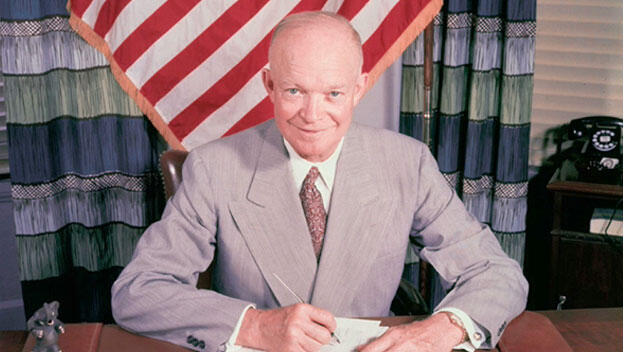
On August 12, 1960, NASA launched the world's first satellite into orbit. A message previously recorded by President Eisenhower was bounced off the Echo 1 and picked up by radio operators across the nation.
Related Speeches & Audio (10)
-
First Speech Broadcast by Satellite
First Speech Broadcast by SatelliteAudio Clip (1:43)
Audio Clip (1:43)
On August 12, 1960, NASA launched the world's first satellite into orbit. A message previously recorded by President Eisenhower was bounced off the Echo 1 and picked up by radio operators across the nation.
-
Eisenhower on the Salk Polio Vaccine
Eisenhower on the Salk Polio VaccineAudio Clip (2:44)
Audio Clip (2:44)
Two years after American medical researcher Jonas Salk reported that he had successfully tested a vaccine against poliomyelitis, polio vaccinations were still not widely available in the United States. To assuage the public's concerns, President Eisenhower holds a press conference on May 4, 1955, and explains the need for further testing.
-
Eisenhower on Atomic Energy
Eisenhower on Atomic EnergyAudio Clip (1:59)
Audio Clip (1:59)
On December 8, 1953, President Dwight D. Eisenhower addresses the General Assembly of the United Nations on the peaceful use of atomic energy.
-
Ford Phones Apollo Astronauts
Ford Phones Apollo AstronautsAudio Clip (8:14)
Audio Clip (8:14)
On July 17, 1975, President Gerald Ford speaks by telephone to the Apollo astronauts following their rendezvous and docking with the Russian Soyuz spacecraft. This was the first joint orbital mission between the two superpowers, and it helped pave the way for further cooperation in the exploration of space.
-
Nixon Calls Apollo 11 Astronauts
Nixon Calls Apollo 11 AstronautsAudio Clip (1:56)
Audio Clip (1:56)
In what he described as the most historic phone call ever made from the White House, President Richard Nixon speaks to astronauts Neil Armstrong and Edwin "Buzz" Aldrin shortly after they became the first humans to set foot on the moon on July 20, 1969.
-
Eisenhower on the Second Berlin Crisis
Eisenhower on the Second Berlin CrisisAudio Clip (1:11)
Audio Clip (1:11)
In November 1958, Soviet Premier Nikita Khrushchev demanded that Western forces pull out of West Berlin in six months. On March 16, 1959, in a radio and television report to the American people, President Eisenhower speaks of the escalating Cold War tensions over Berlin, stressing that the United States will not give in to pressure from the USSR.
-
Eisenhower on the Suez Canal Crisis
Eisenhower on the Suez Canal CrisisAudio Clip (4:03)
Audio Clip (4:03)
In October 1956, Britain and France entered into a coalition with Israel, and the three nations launched a military attack against Egyptian forces in the Suez Canal. On October 31, in a speech to the nation, President Eisenhower expresses the United States' opposition to the military action.
-
Eisenhower Proclaims Alaska the 49th State
Eisenhower Proclaims Alaska the 49th StateAudio Clip (1:04)
Audio Clip (1:04)
On January 3, 1959, President Eisenhower presides over the ceremony welcoming the territory of Alaska into the Union as the 49th and largest state.
-
Eisenhower Proclaims Hawaii the 50th state
Eisenhower Proclaims Hawaii the 50th stateAudio Clip (0:26)
Audio Clip (0:26)
Eight months after Alaska became a U.S. state, President Eisenhower signs the official proclamation on August 21, 1959, admitting Hawaii into the Union as the 50th state and delivers a welcoming speech.
-
Eisenhower Returns From Cancelled Summit Meeting
Eisenhower Returns From Cancelled Summit MeetingAudio Clip (4:19)
Audio Clip (4:19)
On May 1, 1960, an American U-2 high-altitude reconnaissance aircraft was shot down over central Russia. As a result, the Paris Summit Conference, scheduled 13 days later, collapsed. Upon his return from the failed conference on May 20, President Eisenhower addresses the welcoming crowd at Andrews Air Force Base.
Related Videos (10)
-
Eisenhower Defeats Stevenson
Eisenhower Defeats StevensonVideo Clip (1:51)
Video Clip (1:51)
Eisenhower defeats Adlai Stevenson to become the 33rd President.
-
Campaign Spot: Best Qualified (1960)
Campaign Spot: Best Qualified (1960)Video Clip (1:01)
Video Clip (1:01)
After some misinterpreted comments by President Eisenhower about Nixon that JFK used in a campaign ad against his opponent (Nixons Experience), Eisenhower fully endorses Nixon. But it was too little, too late. JFK won the election, by a slim margin.
-
Campaign Spot: Ike For President (1952)
Campaign Spot: Ike For President (1952)Video Clip (1:03)
Video Clip (1:03)
Up until Eisenhower, presidential candidates used tv for 30-minute speeches only. The idea for the celebrated WWII generals spots came from Madison Avenue ad exec Rossier Reeves, who had created M&Ms Melts in your mouth, not in your hands campaign. Reeves convinced Eisenhower that short spots placed before or after popular tv shows, such as I Love Lucy, would reach more viewers.
-
Campaign Spot: Taxi Driver and the Dog (1956)
Campaign Spot: Taxi Driver and the Dog (1956)Video Clip (4:21)
Video Clip (4:21)
In 1956, America was facing the threat of Communism, conflict in the Middle East over the Suez Canal, and domestic issues of wages, education, and family values. This spot dramatizes a regular guy out on his nightly walk with his dog aiming to assure that Eisenhower is a neighbor who just happens to have the most important job in the world, and would make the right choices, keeping Americans safe and prosperous.
-
Republicans Nominate Eisenhower
Republicans Nominate EisenhowerVideo Clip (2:18)
Video Clip (2:18)
Watch as General Dwight D. Eisenhower becomes the Republican nominee for President, in this History Channel video. He adds Richard Nixon as his running mate in this presidential race. Nixon was the youngest VP candidate in history.
-
Campaign Spot: Convention (1968)
Campaign Spot: Convention (1968)Video Clip (0:55)
Video Clip (0:55)
For his second run for the presidency, Nixon hired filmmaker Eugene Jones to produce ads that captured the turbulence and unrest in the nation at the time. Convention was one in a series -- mimicking the uneasy mood and tension in the US, suggesting that Nixon was the only man to bring the country together again.
-
Campaign Spot: Failure (1968)
Campaign Spot: Failure (1968)Video Clip (1:00)
Video Clip (1:00)
Similar to Convention, Nixon points out Americas major frustrations and links them to breakdowns in the Democratic leadership.
-
Campaign Spot: McGovern Defense (1972)
Campaign Spot: McGovern Defense (1972)Video Clip (1:01)
Video Clip (1:01)
In this ad, McGoverns defense cuts are criticized, questioning the candidates priorities for national security.
-
Frank Drake and the Founding of SETI
Frank Drake and the Founding of SETIVideo Clip (3:27)
Video Clip (3:27)
Using a radio antenna focused on two stars, Frank Drake began a search for extra-terrestrial intelligence.
-
Campaign Spot: China (1972)
Campaign Spot: China (1972)Video Clip (1:02)
Video Clip (1:02)
One of Nixons lasting legacies was his trip to China to normalize relations between the two countries which had been cut off for 20 years. No American president had ever visited China. Nixons tip signaled a major change -- for both America and Chinas policies. And for Republicans, a huge reason to re-elect their candidate.
Most Popular Videos on History.com
-
America Divided
(3:54)
-
Caroline Dries: NYU Dorm
(3:26)
Newest Videos on History.com
-
Vietnam in HD Preview
(2:00)
-
Two For the Road
(1:48)
-
HISTORY says Thanks
(2:47)
Shop HISTORY
-
Larry the Cable Guy Bobblehead
Own the official Larry Bobblehead and GIT-R-DONE!
-
-
Swamp People Troy Mask
Want the ultimate Big Head? The Swamp People Troy Mask is for Cajuns and Cajuns at heart.
$44.99
Buy Now
Email Updates
Keep up with the latest History shows, online features, special offers and more.
Sign up


