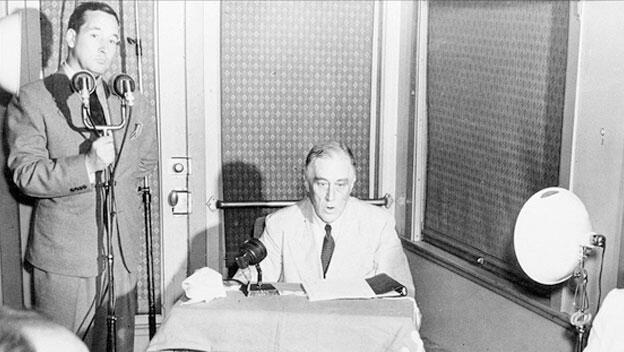
Franklin D. Roosevelt Accepts Fourth Term Nomination
Broadcast from a Pacific coast naval base to the Democratic National Convention in Chicago, Illinois, on July 20, 1944, Franklin D. Roosevelt accepts his party’s nomination for an unprecedented fourth presidential bid and speaks about postwar preparations now that victory is close at hand.
Related Speeches & Audio (10)
-
Franklin D. Roosevelt Accepts Fourth Term Nomination
Franklin D. Roosevelt Accepts Fourth Term NominationAudio Clip (2:08)
Audio Clip (2:08)
Broadcast from a Pacific coast naval base to the Democratic National Convention in Chicago, Illinois, on July 20, 1944, Franklin D. Roosevelt accepts his party’s nomination for an unprecedented fourth presidential bid and speaks about postwar preparations now that victory is close at hand.
-
Franklin D. Roosevelt Reports on Teheran and Cairo Conferences
Franklin D. Roosevelt Reports on Teheran and Cairo ConferencesAudio Clip (2:36)
Audio Clip (2:36)
Following the 1943 Big Four meetings in Teheran and Cairo, President Franklin D. Roosevelt delivers a Christmas Eve broadcast promising the nation that they can look forward to peace, though at a high cost.
-
Truman Announces Japan's Surrender
Truman Announces Japan's SurrenderAudio Clip (1:57)
Audio Clip (1:57)
On September 1, 1945, in a radio address to the American people, President Harry Truman announces the unconditional surrender of Japan, formalized aboard the U.S.S. Missouri.
-
Franklin D. Roosevelt's First Inaugural Address
Franklin D. Roosevelt's First Inaugural AddressAudio Clip (3:39)
Audio Clip (3:39)
On March 3, 1933, the newly elected president of the United States, Franklin D. Roosevelt, promises a country battered by the Great Depression a renewed prosperity, setting forth plans to put the government to work.
-
Roosevelt Elected to Third Term
Roosevelt Elected to Third TermAudio Clip (1:30)
Audio Clip (1:30)
From WGN Chicago on November 7, 1940, news reporter Fulton Lewis Jr. details the historic third-term election of Franklin D. Roosevelt as president of the United States.
-
Franklin D. Roosevelt's 1941 Labor Day Speech
Franklin D. Roosevelt's 1941 Labor Day SpeechAudio Clip (1:37)
Audio Clip (1:37)
In his Labor Day radio broadcast in 1941, President Franklin D. Roosevelt reminds his fellow citizens of the need to devote America’s industrial effort to building weaponry in order to "crush Hitler and his Nazi forces."
-
Franklin D. Roosevelt's Fourth of July Address
Franklin D. Roosevelt's Fourth of July AddressAudio Clip (2:07)
Audio Clip (2:07)
In a broadcast from his home in Hyde Park, New York, on July 4, 1941, President Franklin D. Roosevelt warns Americans who wish not to get involved in the war that "the United States will never survive as a happy and fertile oasis of liberty surrounded by a cruel desert of dictatorship."
-
Franklin D. Roosevelt's Fourth Inaugural Address
Franklin D. Roosevelt's Fourth Inaugural AddressAudio Clip (6:22)
Audio Clip (6:22)
With the country at war at the start of his unprecedented fourth term as president of the United States, Franklin D. Roosevelt delivers a short and somber inaugural address at a simple ceremony without a parade or ball on January 20, 1945.
-
Truman's Inaugural Address
Truman's Inaugural AddressAudio Clip (1:57)
Audio Clip (1:57)
On January 20, 1949, beginning his second term, President Harry Truman denounces communism and presents a program for peace in his inaugural address.
-
Truman Announces Germany's Surrender
Truman Announces Germany's SurrenderAudio Clip (2:04)
Audio Clip (2:04)
In a May 8, 1945, radio broadcast, President Harry Truman announces the unconditional surrender of Germany, but reminds Americans that the war wages on in the Far East.
Related Videos (10)
-
Franklin D. Roosevelt at the Moscow Conference
Franklin D. Roosevelt at the Moscow ConferenceVideo Clip (1:15)
Video Clip (1:15)
Watch the speech given by Franklin D. Roosevelt at the Moscow Conference during World War II.
-
Reagan
ReaganVideo Clip (01:28:23)
Video Clip (01:28:23)
A portrait of America's 40th president depicting the most defining moments of his 93 years.
-
John F. Kennedy and the TVA
John F. Kennedy and the TVAVideo Clip (1:24)
Video Clip (1:24)
President Kennedy is forced to improvise a stump speech in Tennessee, after discovering that his speech didn't make the trip.
-
Kennedy on His Qualifications
Kennedy on His QualificationsVideo Clip (1:17)
Video Clip (1:17)
See President John F. Kennedy respond to Richard Nixon's accusations that he is immature and ill-qualified to be President of the United States in this debate video. Kennedy explains how they both came to Congress in 1946.
-
Franklin D. Roosevelt Warns of Difficult War
Franklin D. Roosevelt Warns of Difficult WarVideo Clip (0:57)
Video Clip (0:57)
Watch as Franklin D. Roosevelt declares war on Japan in the wake of Pearl Harbor and warns the American public to steel themselves for the difficulties that lie ahead.
-
Franklin D. Roosevelt and Pearl Harbor
Franklin D. Roosevelt and Pearl HarborVideo Clip (2:20)
Video Clip (2:20)
Take a look at the events leading to the bombing of Pearl Harbor, which prompted President Roosevelt to declare war on the Japanese and enter World War II.
-
Republicans Nominate Eisenhower
Republicans Nominate EisenhowerVideo Clip (2:18)
Video Clip (2:18)
Watch as General Dwight D. Eisenhower becomes the Republican nominee for President, in this History Channel video. He adds Richard Nixon as his running mate in this presidential race. Nixon was the youngest VP candidate in history.
-
Kennedy's Summation
Kennedy's SummationVideo Clip (2:48)
Video Clip (2:48)
This John F. Kennedy vs. Richard Nixon 1960 presidential debate History Channel video shows Senator Kennedy speaking about the importance of the Social Security Act of 1935 and now was the time to do something for elderly medical care.
-
Kennedy: Teachers' Salaries
Kennedy: Teachers' SalariesVideo Clip (1:32)
Video Clip (1:32)
John F. Kennedy answers back to Nixon's accusation of supporting federal control of teacher salaries. Kennedy explains that was not the question before the Senate in February, the issue was whether to give federal aid to the state to support education.
-
Kennedy on 'Extreme' Bills
Kennedy on 'Extreme' BillsVideo Clip (1:24)
Video Clip (1:24)
Senator John F. Kennedy debates that none of the bills proposed by Nixon were extreme like Nixon was suggesting. Kennedy uses Nixon's proposals of $1.25 an hour plan, federal aid to education, and medical care for the aged to prove his point.
Related Photo Galleries (4)
-
Franklin D. Roosevelt
Franklin D. Roosevelt(20 Photos)
20 Photos
See pictures from the life and presidency of Franklin D. Roosevelt.
-
Civil War to Great Depression Presidents
Civil War to Great Depression Presidents(15 Photos)
15 Photos
View an image slideshow on Presidents from Reconstruction to the Great Depression.
-
Presidents: World War II to Today's Presidents
Presidents: World War II to Today's Presidents(13 Photos)
13 Photos
View an image slideshow on Presidents from World War II to Today.
-
Founding Fathers and Pre-Civil War Presidents
Founding Fathers and Pre-Civil War Presidents(15 Photos)
15 Photos
View an image slideshow on Founding Fathers and Pre-Civil War Presidents.
Most Popular Videos on History.com
-
America Divided
(3:54)
-
Caroline Dries: NYU Dorm
(3:26)
Newest Videos on History.com
-
Vietnam in HD Preview
(2:00)
-
Two For the Road
(1:48)
-
HISTORY says Thanks
(2:47)
Shop HISTORY
-
Civil War: Rebellion to Reconstruction DVD Set
Experience the turbulent events that ignited the bloodiest, most divisive war this country has known.
$53.99
Buy Now -
The American Civil War DVD Set
Experience for yourself the historical and personal impact of the Civil War.
$81.99
Buy Now -
WWII in HD DVD Set
The only people to see the war like this were the ones who lived it. Until now… Own this best-selling series today!
$14.99
Buy Now
Email Updates
Keep up with the latest History shows, online features, special offers and more.
Sign up


