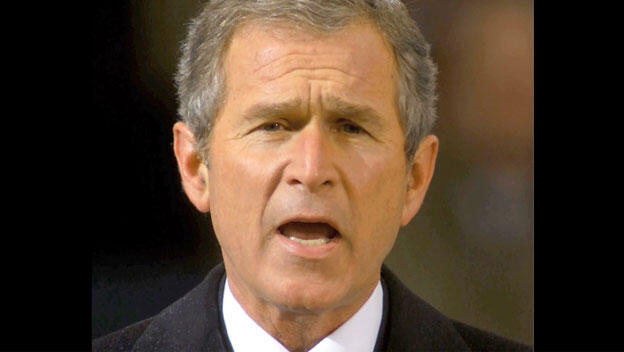
George W. Bush's First Inaugural Address
After an unprecedented 36-day legal battle over the 2000 presidential election results, the U.S. Supreme Court declared George W. Bush the winner. In his inaugural address on January 20, 2001, President Bush pledges to bring unity to the nation.
Related Speeches & Audio (10)
-
George W. Bush's First Inaugural Address
George W. Bush's First Inaugural AddressAudio Clip (3:52)
Audio Clip (3:52)
After an unprecedented 36-day legal battle over the 2000 presidential election results, the U.S. Supreme Court declared George W. Bush the winner. In his inaugural address on January 20, 2001, President Bush pledges to bring unity to the nation.

-
Obama's Inaugural Address
Obama's Inaugural AddressAudio Clip (2:16)
Audio Clip (2:16)
On January 20, 2009, Barack Obama was sworn in as the 44th president of the United States and the nation's first African-American president. In his inaugural address, he reminds Americans that he is taking office "in the midst of crisis" but offers hope in meeting the challenge.
-
Truman's Inaugural Address
Truman's Inaugural AddressAudio Clip (1:57)
Audio Clip (1:57)
On January 20, 1949, beginning his second term, President Harry Truman denounces communism and presents a program for peace in his inaugural address.
-
Roosevelt Elected to Third Term
Roosevelt Elected to Third TermAudio Clip (1:30)
Audio Clip (1:30)
From WGN Chicago on November 7, 1940, news reporter Fulton Lewis Jr. details the historic third-term election of Franklin D. Roosevelt as president of the United States.
-
Eisenhower's Inaugural Address
Eisenhower's Inaugural AddressAudio Clip (5:51)
Audio Clip (5:51)
When Dwight D. Eisenhower becomes the 34th president of the United States on January 20, 1953, his inaugural address lays out a nine-point plan for achieving world peace.
-
Franklin D. Roosevelt's First Inaugural Address
Franklin D. Roosevelt's First Inaugural AddressAudio Clip (3:39)
Audio Clip (3:39)
On March 3, 1933, the newly elected president of the United States, Franklin D. Roosevelt, promises a country battered by the Great Depression a renewed prosperity, setting forth plans to put the government to work.
-
Franklin D. Roosevelt Accepts Fourth Term Nomination
Franklin D. Roosevelt Accepts Fourth Term NominationAudio Clip (2:08)
Audio Clip (2:08)
Broadcast from a Pacific coast naval base to the Democratic National Convention in Chicago, Illinois, on July 20, 1944, Franklin D. Roosevelt accepts his party’s nomination for an unprecedented fourth presidential bid and speaks about postwar preparations now that victory is close at hand.
-
Obama Signs Health Insurance Reform Bill
Obama Signs Health Insurance Reform BillAudio Clip (1:24)
Audio Clip (1:24)
On March 23, 2010, President Barack Obama refers to the century-long struggle that has led to the new bill he will sign into law to overhaul the health insurance industry.
-
Reagan’s First Inaugural Address
Reagan’s First Inaugural AddressAudio Clip (1:29)
Audio Clip (1:29)
With the country discouraged by high inflation, unemployment, gas shortages and the Iran hostage crisis, former California governor Ronald Reagan easily defeated incumbent President Jimmy Carter in the 1980 election. In his inaugural address on January 20, 1981, President Reagan promises to limit the reach of the federal government.
-
Nixon’s First Inaugural Address
Nixon’s First Inaugural AddressAudio Clip (1:13)
Audio Clip (1:13)
After losing his first presidential bid to John F. Kennedy in 1960, former Vice President Richard Nixon brought the Republican Party back into power with a win in the 1968 presidential election. On January 20, 1969, he takes the oath of office and promises to heal a divided nation.
Related Videos (10)
-
Reagan
ReaganVideo Clip (01:28:23)
Video Clip (01:28:23)
A portrait of America's 40th president depicting the most defining moments of his 93 years.
-
Obama Makes History
Obama Makes HistoryVideo Clip (3:42)
Video Clip (3:42)
President Barack Obama was elected the first African-American president of the United States on November 5, 2008, transcending centuries of inequality in America.
-
Kennedy's Summation
Kennedy's SummationVideo Clip (2:48)
Video Clip (2:48)
This John F. Kennedy vs. Richard Nixon 1960 presidential debate History Channel video shows Senator Kennedy speaking about the importance of the Social Security Act of 1935 and now was the time to do something for elderly medical care.
-
Kennedy on His Qualifications
Kennedy on His QualificationsVideo Clip (1:17)
Video Clip (1:17)
See President John F. Kennedy respond to Richard Nixon's accusations that he is immature and ill-qualified to be President of the United States in this debate video. Kennedy explains how they both came to Congress in 1946.
-
Kennedy: Fiscal Policy
Kennedy: Fiscal PolicyVideo Clip (2:49)
Video Clip (2:49)
Watch Senator Kennedy discuss the federal budget in his 1960 debate with Vice President Richard Nixon in this video. Kennedy explains how the hard money policies of Nixon and the Eisenhower Administration helped slow down the economy.
-
Kennedy: Teachers' Salaries
Kennedy: Teachers' SalariesVideo Clip (1:32)
Video Clip (1:32)
John F. Kennedy answers back to Nixon's accusation of supporting federal control of teacher salaries. Kennedy explains that was not the question before the Senate in February, the issue was whether to give federal aid to the state to support education.
-
Kennedy on 'Extreme' Bills
Kennedy on 'Extreme' BillsVideo Clip (1:24)
Video Clip (1:24)
Senator John F. Kennedy debates that none of the bills proposed by Nixon were extreme like Nixon was suggesting. Kennedy uses Nixon's proposals of $1.25 an hour plan, federal aid to education, and medical care for the aged to prove his point.
-
Kennedy: Communism within the U.S.
Kennedy: Communism within the U.S.Video Clip (0:50)
Video Clip (0:50)
Senator John F. Kennedy talks about the internal threat that communism poses to national security. Kennedy describes that these internal factions are serious and should be taken care of by supporting laws that the U.S. has already passed.
-
Nixon's Summation
Nixon's SummationVideo Clip (3:19)
Video Clip (3:19)
Listen to the important issues in 1960 in this History Channel video of one of the first televised debates, which took place between Richard Nixon and John F. Kennedy. The video shows Nixon stating his views from the Soviet Union to health insurance.
-
Nixon's Opening Statement
Nixon's Opening StatementVideo Clip (2:34)
Video Clip (2:34)
In his opening statement during the first of four "Great Debates" between the two candidates in 1960, Richard Nixon agrees with John F. Kennedy's view of international affairs but disputes the notion that the country's growth has been stagnant.
Related Photo Galleries (3)
-
Civil War to Great Depression Presidents
Civil War to Great Depression Presidents(15 Photos)
15 Photos
View an image slideshow on Presidents from Reconstruction to the Great Depression.
-
Presidents: World War II to Today's Presidents
Presidents: World War II to Today's Presidents(13 Photos)
13 Photos
View an image slideshow on Presidents from World War II to Today.
-
Founding Fathers and Pre-Civil War Presidents
Founding Fathers and Pre-Civil War Presidents(15 Photos)
15 Photos
View an image slideshow on Founding Fathers and Pre-Civil War Presidents.
Most Popular Videos on History.com
-
Attack on Pearl Harbor
(1:49)
Newest Videos on History.com
-
Vietnam in HD Preview
(2:00)
-
Two For the Road
(1:48)
-
HISTORY says Thanks
(2:47)
Shop HISTORY
Email Updates
Keep up with the latest History shows, online features, special offers and more.
Sign up