Gerald Ford on Death of Mao Tse-Tung and related media

Gerald Ford on Death of Mao Tse-Tung

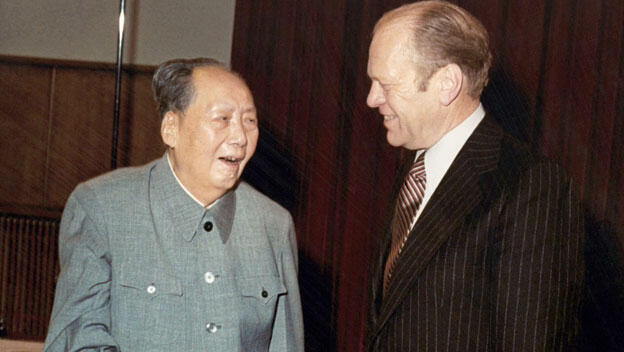
In a press conference on September 9, 1976, President Gerald Ford responds to the death of China's Chairman Mao Tse-tung, who died at the age of 82. Ford credits Mao with opening the door of diplomacy to America.
Listen to Similar Speeches & Audio

Your Parental Control settings do not allow you to view thiscontent.

Related Speeches & Audio (10)

  • Gerald Ford on Death of Mao Tse-Tung
    Gerald Ford on Death of Mao Tse-Tung

    Audio Clip (0:32)

    In a press conference on September 9, 1976, President Gerald Ford responds to the death of China's Chairman Mao Tse-tung, who died at the age of 82. Ford credits Mao with opening the door of diplomacy to America.

    Audio Clip (0:32)
  • Franklin D. Roosevelt's Fourth Inaugural Address
    Franklin D. Roosevelt's Fourth Inaugural Address

    Audio Clip (6:22)

    With the country at war at the start of his unprecedented fourth term as president of the United States, Franklin D. Roosevelt delivers a short and somber inaugural address at a simple ceremony without a parade or ball on January 20, 1945.

    Audio Clip (6:22)
  • Nixon Discusses Forthcoming Trip to China
    Nixon Discusses Forthcoming Trip to China

    Audio Clip (0:42)

    On January 26, 1972, President Richard Nixon holds a meeting in the Oval Office with Dutch Prime Minister Barend Biesheuvel, Chief of Staff Alexander Haig and U.S. Ambassador to the Netherlands J. William Middendorf. In the secretly recorded conversation, Nixon explains his rationale for his forthcoming trip to China.

    Audio Clip (0:42)
  • Truman Announces Japan's Surrender
    Truman Announces Japan's Surrender

    Audio Clip (1:57)

    On September 1, 1945, in a radio address to the American people, President Harry Truman announces the unconditional surrender of Japan, formalized aboard the U.S.S. Missouri.

    Audio Clip (1:57)
  • The Eisenhower Doctrine
    The Eisenhower Doctrine

    Audio Clip (1:01)

    In order to suppress growing Soviet influence in the Middle East following the Suez Crisis of 1956, President Dwight D. Eisenhower appears before a joint session of Congress on January 5, 1957, to present a policy that will become known as the Eisenhower Doctrine. It holds that the United States would be authorized to provide military assistance "to secure and protect the territorial integrity" of any nations threatened by international communism.

    Audio Clip (1:01)
  • Eisenhower Weighs Chance for Peace in the Cold War
    Eisenhower Weighs Chance for Peace in the Cold War

    Audio Clip (3:40)

    On April 16, 1953, after the death of Russian Premier Joseph Stalin, President Dwight D. Eisenhower delivers what is known as his “Cross of Iron” speech before the American Society for Newspaper Editors, contrasting the philosophies of the Soviet Union and the United States.

    Audio Clip (3:40)
  • Reagan Demands Fall of Berlin Wall
    Reagan Demands Fall of Berlin Wall

    Audio Clip (1:08)

    On June 12, 1987, in a speech delivered from the Brandenburg Gate in West Germany, President Ronald Reagan makes one of his most famous statements when he calls on Mikhail Gorbachev to tear down the Berlin Wall.

    Audio Clip (1:08)
  • Franklin D. Roosevelt Delivers D-Day Prayer
    Franklin D. Roosevelt Delivers D-Day Prayer

    Audio Clip (3:37)

    In a national radio broadcast on June 6, 1944, as 160,000 Allied troops land in Normandy in an attempt to liberate France, President Franklin D. Roosevelt asks America to join him in a prayer.

    Audio Clip (3:37)
  • Bush on Tiananmen Square
    Bush on Tiananmen Square

    Audio Clip (1:48)

    Several weeks of pro-democracy demonstrations in the streets of Beijing came to a violent end on June 4, 1989, when the Chinese Army fired on the crowds, killing hundreds. The next day, President George H. W. Bush publicly condemns the event.

    Audio Clip (1:48)
  • Franklin D. Roosevelt Reports on Teheran and Cairo Conferences
    Franklin D. Roosevelt Reports on Teheran and Cairo Conferences

    Audio Clip (2:36)

    Following the 1943 Big Four meetings in Teheran and Cairo, President Franklin D. Roosevelt delivers a Christmas Eve broadcast promising the nation that they can look forward to peace, though at a high cost.

    Audio Clip (2:36)

Related Videos (1)

  • Reagan
    Reagan

    Video Clip (01:28:23)

    A portrait of America's 40th president depicting the most defining moments of his 93 years.

    Video Clip (01:28:23)

Shop HISTORY