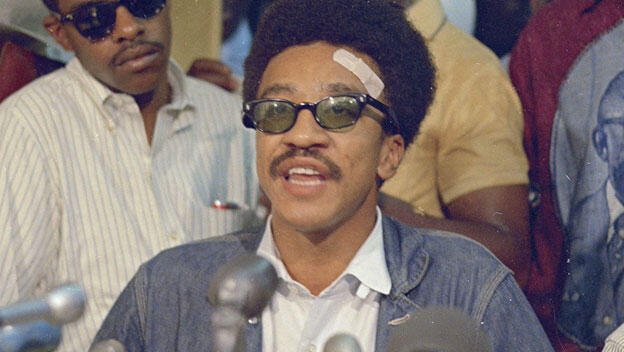
H. Rap Brown on the African-American Community
H. Rap Brown, the 1960s leader of the Student Nonviolent Coordinating Committee (SNCC), speaks about the state of the African-American community as a whole.
Related Speeches & Audio (10)
-
H. Rap Brown on the African-American Community
H. Rap Brown on the African-American CommunityAudio Clip (0:31)
Audio Clip (0:31)
H. Rap Brown, the 1960s leader of the Student Nonviolent Coordinating Committee (SNCC), speaks about the state of the African-American community as a whole.

-
Stokely Carmichael on Assassination of Martin Luther King Jr.
Stokely Carmichael on Assassination of Martin Luther King Jr.Audio Clip (2:42)
Audio Clip (2:42)
On April 5, 1968, in a press conference held the day after the slaying of Martin Luther King Jr., civil rights activist Stokely Carmichael predicts the outbreak of more violence across the nation in retaliation for "white America's biggest mistake."
-
Adam Clayton Powell Rallies Congregation
Adam Clayton Powell Rallies CongregationAudio Clip (3:54)
Audio Clip (3:54)
In a 1967 sermon, Adam Clayton Powell Jr., pastor and congressman from Harlem, New York City, reaches out to the downtrodden and depressed with his "keep the faith, baby" slogan.
-
John F. Kennedy Appeals to Mississippi Governor
John F. Kennedy Appeals to Mississippi GovernorAudio Clip (3:42)
Audio Clip (3:42)
After many unfruitful telephone conversations with Mississippi Gov. Ross Barnett, President John F. Kennedy calls the governor one more time to discuss the building tension over James Meredith’s impending registration at the University of Mississippi. Though the governor has made clear his opposition to the Supreme Court order to allow Meredith to attend the school, President Kennedy tries to assess whether the governor will maintain law and order when Meredith arrives.
-
Bush on Los Angeles Riots
Bush on Los Angeles RiotsAudio Clip (1:40)
Audio Clip (1:40)
On April 29, 1992, shortly after four white LAPD officers were acquitted in the beating of Rodney King, rioting broke out in Los Angeles. On May 1, President George H. W. Bush delivers a nationally broadcast response to the unrest, which lasted more than a week.
-
NAACP's Walter White Decries Racial Inequality
NAACP's Walter White Decries Racial InequalityAudio Clip (2:28)
Audio Clip (2:28)
On June 29, 1947, at the closing session of the 38th annual conference for the National Association for the Advancement of Colored People (NAACP), Walter F. White, the organization’s executive secretary, warns that despite progress made in civil rights, true equality can’t be achieved with a "separate but equal" mandate.
-
John F. Kennedy on Desegregation at Ole Miss
John F. Kennedy on Desegregation at Ole MissAudio Clip (3:18)
Audio Clip (3:18)
When Mississippi Gov. Ross Barnett refused to comply with the U.S. Supreme Court ruling demanding desegregation at the University of Mississippi and the admittance of James Meredith, President John F. Kennedy was forced to intervene. In his address to the nation on September 30, 1962, Kennedy explains his decision to federalize the state national guard in order to maintain law and order while Meredith registers at the college.
-
Eleanor Roosevelt Commemorates World Children’s Day
Eleanor Roosevelt Commemorates World Children’s DayAudio Clip (0:58)
Audio Clip (0:58)
"First Lady of the World" Eleanor Roosevelt reads a statement regarding child welfare in honor of World Children’s Day, which was first celebrated one year earlier on October 4, 1953.
-
Brown v. Board of Education Ruling
Brown v. Board of Education RulingAudio Clip (1:02)
Audio Clip (1:02)
On May 17, 1954, U.S. Supreme Court Chief Justice Earl Warren delivered the unanimous ruling against the "separate but equal" mandate and demanded desegregation of schools. Outside the courtroom, the attorneys who argued the Brown v. Board of Education case, James Nabrit Jr., Thurgood Marshall and George Hayes, give a press conference.
-
Booker T. Washington on Race Relations
Booker T. Washington on Race RelationsAudio Clip (3:28)
Audio Clip (3:28)
On September 18, 1895, at the Atlanta Exposition, Booker T. Washington rises to national fame when he delivers what came to be known as his “Atlanta Compromise” speech, in which he advocates for the races to work together while remaining separate socially.
Related Videos (1)
-
America's Book of Secrets: Ku Klux Klan
America's Book of Secrets: Ku Klux KlanVideo Clip (44:11)
Video Clip (44:11)
An inside look at the philosophy of racial intolerance, segregation and white supremacy that has been protected by the right to free speech in America for nearly 150 years.
Most Popular Videos on History.com
-
Attack on Pearl Harbor
(1:49)
Newest Videos on History.com
-
Vietnam in HD Preview
(2:00)
-
Two For the Road
(1:48)
-
HISTORY says Thanks
(2:47)
Shop HISTORY
-
Martin Luther King Jr. - I Have a Dream DVD
Learn the history of King's famous speech and the March on Washington.
$19.98
Buy Now -
The 60s
Relive the epic events of the times in this sweeping collection from HISTORY.
-
Civil War: Rebellion to Reconstruction DVD Set
Experience the turbulent events that ignited the bloodiest, most divisive war this country has known.
$53.99
Buy Now
Email Updates
Keep up with the latest History shows, online features, special offers and more.
Sign up