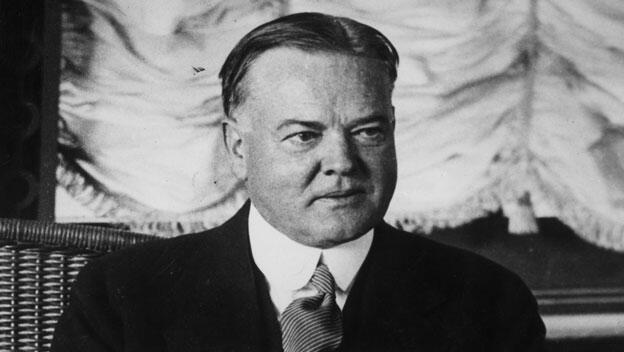
Herbert Hoover Accepts 1932 Nomination
In 1928, Herbert Hoover was elected president of the United States in a landslide Republican victory over Governor Alfred E. Smith of New York.
Related Speeches & Audio (10)
-
Herbert Hoover Accepts 1932 Nomination
Herbert Hoover Accepts 1932 NominationAudio Clip (6:59)
Audio Clip (6:59)
In 1928, Herbert Hoover was elected president of the United States in a landslide Republican victory over Governor Alfred E. Smith of New York.
-
Nixon Reelected to Presidency
Nixon Reelected to PresidencyAudio Clip (1:03)
Audio Clip (1:03)
On November 7, 1972, incumbent President Richard Nixon won a second term in a landslide victory over Democrat George McGovern. In a brief statement from the Oval Office, President Nixon promises to bring "peace with honor" in Vietnam and to usher in a "new era of peace" with the Soviet Union.
-
Roosevelt Elected to Third Term
Roosevelt Elected to Third TermAudio Clip (1:30)
Audio Clip (1:30)
From WGN Chicago on November 7, 1940, news reporter Fulton Lewis Jr. details the historic third-term election of Franklin D. Roosevelt as president of the United States.
-
Franklin D. Roosevelt Accepts Fourth Term Nomination
Franklin D. Roosevelt Accepts Fourth Term NominationAudio Clip (2:08)
Audio Clip (2:08)
Broadcast from a Pacific coast naval base to the Democratic National Convention in Chicago, Illinois, on July 20, 1944, Franklin D. Roosevelt accepts his party’s nomination for an unprecedented fourth presidential bid and speaks about postwar preparations now that victory is close at hand.
-
Truman's Inaugural Address
Truman's Inaugural AddressAudio Clip (1:57)
Audio Clip (1:57)
On January 20, 1949, beginning his second term, President Harry Truman denounces communism and presents a program for peace in his inaugural address.
-
JFK Announces Candidacy for Presidency
JFK Announces Candidacy for PresidencyAudio Clip (1:00)
Audio Clip (1:00)
In 1960, John F. Kennedy announced his bid for the presidency when a reporter asked him if he was a candidate for the Democratic nomination for vice president.
-
Johnson Runs for President in 1960
Johnson Runs for President in 1960Audio Clip (2:23)
Audio Clip (2:23)
After weeks of campaigning, Sen. Lyndon Johnson of Texas officially announces his candidacy for the Democratic presidential nomination at a press conference on July 5, 1960. But by July 14, after a poor first-ballot showing against Sen. John F. Kennedy, Johnson accepted a second-place role, becoming his former rival's running mate.
-
Johnson Will Not Seek Reelection
Johnson Will Not Seek ReelectionAudio Clip (0:38)
Audio Clip (0:38)
Facing a country sharply divided over the Vietnam War, President Lyndon B. Johnson announces in a national television and radio broadcast on March 31, 1968, that he will not seek reelection to the presidency.
-
Nixon Concedes Defeat in 1962 Governor's Race
Nixon Concedes Defeat in 1962 Governor's RaceAudio Clip (16:18)
Audio Clip (16:18)
Nixon was defeated by Edmund Brown California's gubernatorial seat. He conceded defeat in one of the most bitter speeches of his political career.
-
Nixon Declines Candidacy in 1964
Nixon Declines Candidacy in 1964Audio Clip (0:49)
Audio Clip (0:49)
On July 13, 1964, the Republican Party convened at the National Convention in San Francisco to nominate their candidates for the presidency and vice presidency. Though he had flirted with the idea of running for president during the pre-primary period, Richard Nixon makes it clear in his speech that he has decided not to seek a nomination.
Related Videos (10)
-
The Checkers Speech
The Checkers SpeechVideo Clip (3:34)
Video Clip (3:34)
On September 23, 1952 Richard Nixon, mired in a scandal involving bribary and campaign funds, went on television and saved his political career.
-
Nixon: Communism within the U.S.
Nixon: Communism within the U.S.Video Clip (1:38)
Video Clip (1:38)
The Cold War was a serious issue that engulfed the United States. Coupled with this war was the fear of communism in the United States. This fear became a central issue between Kennedy and Nixon. Hear their debate in this History Channel video.
-
John F. Kennedy and the TVA
John F. Kennedy and the TVAVideo Clip (1:24)
Video Clip (1:24)
President Kennedy is forced to improvise a stump speech in Tennessee, after discovering that his speech didn't make the trip.
-
Ask Steve: Southern Strategy
Ask Steve: Southern StrategyVideo Clip (1:23)
Video Clip (1:23)
In this video clip from Ask Steve, the Southern Strategy is explained. It was the republican party's successful plan of getting the white southern population to shift their views from democratic to republican.
-
Eisenhower Defeats Stevenson
Eisenhower Defeats StevensonVideo Clip (1:51)
Video Clip (1:51)
Eisenhower defeats Adlai Stevenson to become the 33rd President.
-
Republicans Nominate Eisenhower
Republicans Nominate EisenhowerVideo Clip (2:18)
Video Clip (2:18)
Watch as General Dwight D. Eisenhower becomes the Republican nominee for President, in this History Channel video. He adds Richard Nixon as his running mate in this presidential race. Nixon was the youngest VP candidate in history.
-
Kennedy's Summation
Kennedy's SummationVideo Clip (2:48)
Video Clip (2:48)
This John F. Kennedy vs. Richard Nixon 1960 presidential debate History Channel video shows Senator Kennedy speaking about the importance of the Social Security Act of 1935 and now was the time to do something for elderly medical care.
-
Kennedy on His Qualifications
Kennedy on His QualificationsVideo Clip (1:17)
Video Clip (1:17)
See President John F. Kennedy respond to Richard Nixon's accusations that he is immature and ill-qualified to be President of the United States in this debate video. Kennedy explains how they both came to Congress in 1946.
-
Kennedy: Teachers' Salaries
Kennedy: Teachers' SalariesVideo Clip (1:32)
Video Clip (1:32)
John F. Kennedy answers back to Nixon's accusation of supporting federal control of teacher salaries. Kennedy explains that was not the question before the Senate in February, the issue was whether to give federal aid to the state to support education.
-
Kennedy on 'Extreme' Bills
Kennedy on 'Extreme' BillsVideo Clip (1:24)
Video Clip (1:24)
Senator John F. Kennedy debates that none of the bills proposed by Nixon were extreme like Nixon was suggesting. Kennedy uses Nixon's proposals of $1.25 an hour plan, federal aid to education, and medical care for the aged to prove his point.
Related Photo Galleries (6)
-
James Madison
James Madison(10 Photos)
10 Photos
See pictures from the life and presidency of James Madison.
-
James Monroe
James Monroe(8 Photos)
8 Photos
See pictures from the life and presidency of James Monroe.
-
John Quincy Adams
John Quincy Adams(8 Photos)
8 Photos
See pictures from the life and presidency of John Quincy Adams.
-
John Tyler
John Tyler(6 Photos)
6 Photos
See pictures from the life and presidency of John Tyler
-
Millard Fillmore
Millard Fillmore(8 Photos)
8 Photos
See pictures from the life and presidency of Millard Fillmore.
-
William Henry Harrison
William Henry Harrison(7 Photos)
7 Photos
See pictures from the life and presidency of William Henry Harrison
Most Popular Videos on History.com
-
America Divided
(3:54)
-
Caroline Dries: NYU Dorm
(3:26)
Newest Videos on History.com
-
Vietnam in HD Preview
(2:00)
-
Two For the Road
(1:48)
-
HISTORY says Thanks
(2:47)
Shop HISTORY
-
-
Civil War: Rebellion to Reconstruction DVD Set
Experience the turbulent events that ignited the bloodiest, most divisive war this country has known.
$53.99
Buy Now -
The American Civil War DVD Set
Experience for yourself the historical and personal impact of the Civil War.
$61.15
Buy Now
Email Updates
Keep up with the latest History shows, online features, special offers and more.
Sign up