Nixon Responds to Watergate Subpoena
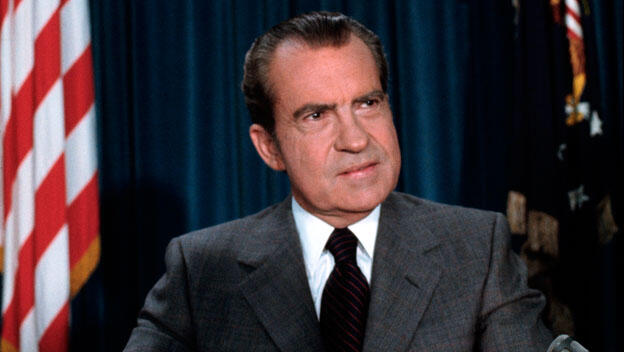
In an address to the nation on April 29, 1974, President Richard Nixon explains why he will not be turning over additional subpoenaed tapes in the Watergate trial but will instead provide transcripts of the recordings.
Related Speeches & Audio (10)
-
Nixon Responds to Watergate Subpoena
Nixon Responds to Watergate SubpoenaAudio Clip (2:27)
Audio Clip (2:27)
In an address to the nation on April 29, 1974, President Richard Nixon explains why he will not be turning over additional subpoenaed tapes in the Watergate trial but will instead provide transcripts of the recordings.
-
Nixon Resigns
Nixon ResignsAudio Clip (4:16)
Audio Clip (4:16)
After the revelations of the Watergate scandal, President Richard Nixon announces to the nation on August 8, 1974, that he will resign the presidency at noon the following day.
-
Nixon's Second Inaugural Address
Nixon's Second Inaugural AddressAudio Clip (1:42)
Audio Clip (1:42)
After a landslide reelection victory, incumbent President Richard Nixon stresses America's role in the pursuit of world peace during his second inaugural address, delivered on January 20, 1973.
-
Nixon Reelected to Presidency
Nixon Reelected to PresidencyAudio Clip (1:03)
Audio Clip (1:03)
On November 7, 1972, incumbent President Richard Nixon won a second term in a landslide victory over Democrat George McGovern. In a brief statement from the Oval Office, President Nixon promises to bring "peace with honor" in Vietnam and to usher in a "new era of peace" with the Soviet Union.
-
Nixon’s First Inaugural Address
Nixon’s First Inaugural AddressAudio Clip (1:13)
Audio Clip (1:13)
After losing his first presidential bid to John F. Kennedy in 1960, former Vice President Richard Nixon brought the Republican Party back into power with a win in the 1968 presidential election. On January 20, 1969, he takes the oath of office and promises to heal a divided nation.
-
Reagan Accepts Presidential Nomination
Reagan Accepts Presidential NominationAudio Clip (1:33)
Audio Clip (1:33)
After unsuccessfully seeking the presidential nomination in 1968 and 1976, Ronald Reagan was nominated at the Republican National Convention on September 7, 1980. In his acceptance speech, the former California governor tells American taxpayers that they do not exist to fund the federal government.
-
Nixon and Dean Discuss Watergate
Nixon and Dean Discuss WatergateAudio Clip (1:26)
Audio Clip (1:26)
On March 21, 1973, in a secretly recorded conversation, President Richard Nixon and his aide John Dean discuss the unfolding Watergate scandal. Dean tells Nixon that the cover-up is "a cancer on the presidency."
-
Nixon and Dean Discuss Watergate Resignations
Nixon and Dean Discuss Watergate ResignationsAudio Clip (2:44)
Audio Clip (2:44)
In a secretly recorded conversation on April 16, 1973, President Richard Nixon discusses with his aide John Dean the need to have the resignations of Dean, H.R. Haldeman and John Ehrlichman "at the ready" in the wake of the Watergate scandal.
-
Nixon Announces Watergate Resignations
Nixon Announces Watergate ResignationsAudio Clip (1:59)
Audio Clip (1:59)
On April 30, 1973, with the Watergate trial well underway, President Richard Nixon announces on nationwide television and radio the resignation of his closest advisers, H.R. Haldeman and John Ehrlichman, as well as White House Counsel John Dean and Attorney General Richard Kleindienst.
-
Reagan’s 1984 Presidential Nomination
Reagan’s 1984 Presidential NominationAudio Clip (0:57)
Audio Clip (0:57)
On August 23, 1984, President Ronald Reagan accepts his party's nomination for a second term. In his speech at the Republican National Convention, President Reagan promises a "springtime of hope" for America.
Related Videos (10)
-
Nixon Announces His Resignation
Nixon Announces His ResignationVideo Clip (2:38)
Video Clip (2:38)
View and listen to President Nixon's resignation speech in its entirety from the White House.
-
Eisenhower Defeats Stevenson
Eisenhower Defeats StevensonVideo Clip (1:51)
Video Clip (1:51)
Eisenhower defeats Adlai Stevenson to become the 33rd President.
-
Franklin D. Roosevelt at the Moscow Conference
Franklin D. Roosevelt at the Moscow ConferenceVideo Clip (1:15)
Video Clip (1:15)
Watch the speech given by Franklin D. Roosevelt at the Moscow Conference during World War II.
-
Ask Steve: Southern Strategy
Ask Steve: Southern StrategyVideo Clip (1:23)
Video Clip (1:23)
In this video clip from Ask Steve, the Southern Strategy is explained. It was the republican party's successful plan of getting the white southern population to shift their views from democratic to republican.
-
Republicans Nominate Eisenhower
Republicans Nominate EisenhowerVideo Clip (2:18)
Video Clip (2:18)
Watch as General Dwight D. Eisenhower becomes the Republican nominee for President, in this History Channel video. He adds Richard Nixon as his running mate in this presidential race. Nixon was the youngest VP candidate in history.
-
National Recovery Administration Created
National Recovery Administration CreatedVideo Clip (2:06)
Video Clip (2:06)
Established in 1933, the National Recovery Administration (NRA) was a key component of President Franklin Roosevelt's New Deal program designed to combat the effects of the Great Depression.
-
John F. Kennedy and the TVA
John F. Kennedy and the TVAVideo Clip (1:24)
Video Clip (1:24)
President Kennedy is forced to improvise a stump speech in Tennessee, after discovering that his speech didn't make the trip.
-
Kennedy on His Qualifications
Kennedy on His QualificationsVideo Clip (1:17)
Video Clip (1:17)
See President John F. Kennedy respond to Richard Nixon's accusations that he is immature and ill-qualified to be President of the United States in this debate video. Kennedy explains how they both came to Congress in 1946.
-
Kennedy: Teachers' Salaries
Kennedy: Teachers' SalariesVideo Clip (1:32)
Video Clip (1:32)
John F. Kennedy answers back to Nixon's accusation of supporting federal control of teacher salaries. Kennedy explains that was not the question before the Senate in February, the issue was whether to give federal aid to the state to support education.
-
Kennedy on 'Extreme' Bills
Kennedy on 'Extreme' BillsVideo Clip (1:24)
Video Clip (1:24)
Senator John F. Kennedy debates that none of the bills proposed by Nixon were extreme like Nixon was suggesting. Kennedy uses Nixon's proposals of $1.25 an hour plan, federal aid to education, and medical care for the aged to prove his point.
Most Popular Videos on History.com
-
America Divided
(3:54)
-
Caroline Dries: NYU Dorm
(3:26)
Newest Videos on History.com
-
Vietnam in HD Preview
(2:00)
-
Two For the Road
(1:48)
-
HISTORY says Thanks
(2:47)
Shop HISTORY
-
Civil War: Rebellion to Reconstruction DVD Set
Experience the turbulent events that ignited the bloodiest, most divisive war this country has known.
$53.99
Buy Now -
The American Civil War DVD Set
Experience for yourself the historical and personal impact of the Civil War.
$61.15
Buy Now
Email Updates
Keep up with the latest History shows, online features, special offers and more.
Sign up


