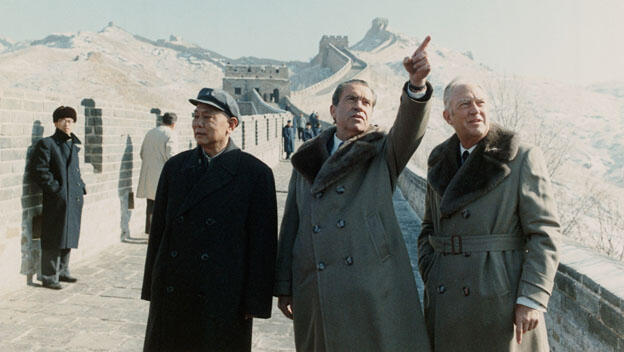
Nixon Returns From China
After returning from his historic trip to China, President Richard Nixon meets with a group of Congressional leaders in the Cabinet Room on February 29, 1972, and in a recorded conversation discusses the importance of opening the lines of communication with the communist nation.
Related Speeches & Audio (10)
-
Nixon Returns From China
Nixon Returns From ChinaAudio Clip (3:20)
Audio Clip (3:20)
After returning from his historic trip to China, President Richard Nixon meets with a group of Congressional leaders in the Cabinet Room on February 29, 1972, and in a recorded conversation discusses the importance of opening the lines of communication with the communist nation.
-
Nixon Discusses Forthcoming Trip to China
Nixon Discusses Forthcoming Trip to ChinaAudio Clip (0:42)
Audio Clip (0:42)
On January 26, 1972, President Richard Nixon holds a meeting in the Oval Office with Dutch Prime Minister Barend Biesheuvel, Chief of Staff Alexander Haig and U.S. Ambassador to the Netherlands J. William Middendorf. In the secretly recorded conversation, Nixon explains his rationale for his forthcoming trip to China.
-
Franklin D. Roosevelt Reports on Teheran and Cairo Conferences
Franklin D. Roosevelt Reports on Teheran and Cairo ConferencesAudio Clip (2:36)
Audio Clip (2:36)
Following the 1943 Big Four meetings in Teheran and Cairo, President Franklin D. Roosevelt delivers a Christmas Eve broadcast promising the nation that they can look forward to peace, though at a high cost.
-
Gerald Ford on Death of Mao Tse-Tung
Gerald Ford on Death of Mao Tse-TungAudio Clip (0:32)
Audio Clip (0:32)
In a press conference on September 9, 1976, President Gerald Ford responds to the death of China's Chairman Mao Tse-tung, who died at the age of 82. Ford credits Mao with opening the door of diplomacy to America.
-
Bush on Tiananmen Square
Bush on Tiananmen SquareAudio Clip (1:48)
Audio Clip (1:48)
Several weeks of pro-democracy demonstrations in the streets of Beijing came to a violent end on June 4, 1989, when the Chinese Army fired on the crowds, killing hundreds. The next day, President George H. W. Bush publicly condemns the event.
-
John F. Kennedy on Coup in South Vietnam
John F. Kennedy on Coup in South VietnamAudio Clip (6:06)
Audio Clip (6:06)
On October 29, 1963, President John F. Kennedy meets with the National Security Council to discuss whether to support the overthrow of South Vietnam's President Ngo Dinh Diem. During the secretly recorded conversation, Secretary of State Dean Rusk and the president craft a detailed plan involving Henry Cabot Lodge, ambassador to South Vietnam, Gen. Paul D. Harkins and the general of the South Vietnamese military, hoping to avoid setting off a civil war in the country.
-
The Truman Doctrine
The Truman DoctrineAudio Clip (1:50)
Audio Clip (1:50)
On March 12, 1947, President Harry Truman urges a joint session of Congress to support his doctrine, which calls for U.S. financial and military aid to Greece and Turkey in an effort to protect the countries from Soviet domination.
-
Truman Announces Japan's Surrender
Truman Announces Japan's SurrenderAudio Clip (1:57)
Audio Clip (1:57)
On September 1, 1945, in a radio address to the American people, President Harry Truman announces the unconditional surrender of Japan, formalized aboard the U.S.S. Missouri.
-
Clinton on U.S. Involvement in Somalia
Clinton on U.S. Involvement in SomaliaAudio Clip (2:10)
Audio Clip (2:10)
After a humanitarian mission in Somalia turned violent and U.S. soldiers were killed and dragged through the streets by a Somali gang, President Bill Clinton addresses the nation on October 7, 1993, regarding U.S. military action.
-
The "Clinton Apology"
The "Clinton Apology"Audio Clip (1:49)
Audio Clip (1:49)
On a March 25, 1998, visit to Rwanda, President Bill Clinton delivers what later became known as the Clinton apology, in which he acknowledges America's failure to respond to the Rwandan genocide.
Related Videos (6)
-
United Nations Founded
United Nations FoundedVideo Clip (1:06)
Video Clip (1:06)
The nations of the world signed the United Nations into existence on June 26, 1945. The charter was signed in San Francisco and signaled the return of hope for peace in the world after World War II. | Courtesy of The National Archives
-
Nixon Announces His Resignation
Nixon Announces His ResignationVideo Clip (2:38)
Video Clip (2:38)
View and listen to President Nixon's resignation speech in its entirety from the White House.
-
Franklin D. Roosevelt at the Moscow Conference
Franklin D. Roosevelt at the Moscow ConferenceVideo Clip (1:15)
Video Clip (1:15)
Watch the speech given by Franklin D. Roosevelt at the Moscow Conference during World War II.
-
Franklin D. Roosevelt Warns of Difficult War
Franklin D. Roosevelt Warns of Difficult WarVideo Clip (0:57)
Video Clip (0:57)
Watch as Franklin D. Roosevelt declares war on Japan in the wake of Pearl Harbor and warns the American public to steel themselves for the difficulties that lie ahead.
-
Franklin D. Roosevelt's First Fireside Chat
Franklin D. Roosevelt's First Fireside ChatVideo Clip
-
National Recovery Administration Created
National Recovery Administration CreatedVideo Clip (2:06)
Video Clip (2:06)
Established in 1933, the National Recovery Administration (NRA) was a key component of President Franklin Roosevelt's New Deal program designed to combat the effects of the Great Depression.
Most Popular Videos on History.com
-
D-Day Invasion
(3:07)
-
Hitler's Military Blunders
(3:27)
Newest Videos on History.com
-
Vietnam in HD Preview
(2:00)
-
Two For the Road
(1:48)
-
HISTORY says Thanks
(2:47)
Shop HISTORY
-
The Korean War: Fire and Ice DVD
Historians, battle veterans and archival footage reveal the pain, glory, and pathos of the war.
$23.99
Buy Now
Email Updates
Keep up with the latest History shows, online features, special offers and more.
Sign up


