Nixon's Memo to Haldeman
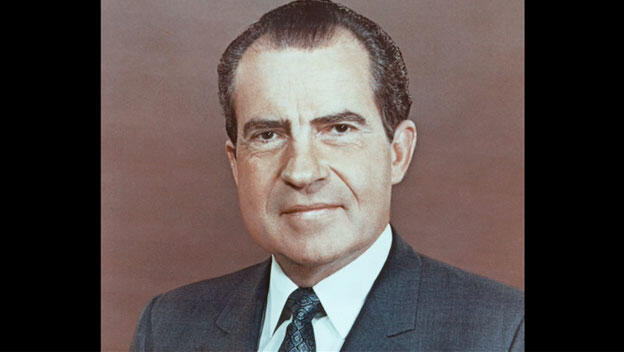
On March 10, 1970, President Richard Nixon records a memorandum to his aide H.R. Haldeman asking him to set up a special group to keep tabs on Nixon's opponents.

Related Speeches & Audio (10)
-
Nixon's Memo to Haldeman
Nixon's Memo to HaldemanAudio Clip (0:41)
Audio Clip (0:41)
On March 10, 1970, President Richard Nixon records a memorandum to his aide H.R. Haldeman asking him to set up a special group to keep tabs on Nixon's opponents.
-
Nixon Orders Invasion of Cambodia
Nixon Orders Invasion of CambodiaAudio Clip (1:02)
Audio Clip (1:02)
On April 30, 1970, President Richard Nixon asks the American people to support his decision to send troops into Cambodia in response to North Vietnam’s invasion of the country.
-
Nixon’s First Inaugural Address
Nixon’s First Inaugural AddressAudio Clip (1:13)
Audio Clip (1:13)
After losing his first presidential bid to John F. Kennedy in 1960, former Vice President Richard Nixon brought the Republican Party back into power with a win in the 1968 presidential election. On January 20, 1969, he takes the oath of office and promises to heal a divided nation.
-
Johnson Introduces "Great Society"
Johnson Introduces "Great Society"Audio Clip (2:54)
Audio Clip (2:54)
In a speech presented at the University of Michigan on May 22, 1964, President Lyndon B. Johnson outlines his vision of a "Great Society," which includes the ideas that will later become programs such as Medicare, Medicaid and Head Start.
-
Lyndon Johnson's Inaugural Address
Lyndon Johnson's Inaugural AddressAudio Clip (2:02)
Audio Clip (2:02)
On January 20, 1965, Lyndon B. Johnson began his first elected term as president of the United States. In his inaugural address, Johnson calls for the nation to unite toward a common goal.
-
McNamara Briefs President Johnson on Tonkin Gulf
McNamara Briefs President Johnson on Tonkin GulfAudio Clip (1:00)
Audio Clip (1:00)
On August 4, 1964, as events in the Tonkin Gulf unfold, Secretary of Defense Robert McNamara apprised President Lyndon B. Johnson of the situation in a series of phone calls. In the third secretly recorded phone call of the day, McNamara reports that two U.S. destroyers deployed in the Gulf east of Vietnam are under attack. While McNamara did not know it at the time, the information he relayed was later determined to be false.
-
Lyndon Johnson on Missing Civil Rights Workers
Lyndon Johnson on Missing Civil Rights WorkersAudio Clip (3:00)
Audio Clip (3:00)
On June 23, 1964, two days after three civil rights workers disappeared in Mississippi, President Lyndon B. Johnson telephones Senator James Eastland for help with the matter, but Eastland denies trouble and declares the event a publicity stunt.
-
Lyndon Johnson on Death of Civil Rights Workers
Lyndon Johnson on Death of Civil Rights WorkersAudio Clip (0:59)
Audio Clip (0:59)
After receiving news that the bodies of three missing civil rights workers were found in Mississippi on August 4, 1964, President Lyndon B. Johnson calls Civil Rights Counselor Lee White and asks him to inform the families of the victims.
-
Lyndon Johnson Learns Fate of Missing Civil Rights Workers
Lyndon Johnson Learns Fate of Missing Civil Rights WorkersAudio Clip (1:33)
Audio Clip (1:33)
On August 4, 1964, in a recorded phone call, FBI Deputy Director Cartha “Deke” DeLoach informs President Lyndon B. Johnson that the bodies of the three civil rights workers who had been missing in Mississippi since June 21, 1964, have been found.
-
Lyndon Johnson Twists Senator Ribicoff's Arm
Lyndon Johnson Twists Senator Ribicoff's ArmAudio Clip (3:30)
Audio Clip (3:30)
In early 1964, President Lyndon B. Johnson wanted to pass an excise tax bill, but, with two members of his party opposing, the bill was likely to die in the Senate. In a secretly recorded telephone call to Senator Abraham Ribicoff on January 23, Johnson is heard applying his power of persuasion.
Related Videos (10)
-
Franklin D. Roosevelt Warns of Difficult War
Franklin D. Roosevelt Warns of Difficult WarVideo Clip (0:57)
Video Clip (0:57)
Watch as Franklin D. Roosevelt declares war on Japan in the wake of Pearl Harbor and warns the American public to steel themselves for the difficulties that lie ahead.
-
Nixon Announces His Resignation
Nixon Announces His ResignationVideo Clip (2:38)
Video Clip (2:38)
View and listen to President Nixon's resignation speech in its entirety from the White House.
-
Franklin D. Roosevelt at the Moscow Conference
Franklin D. Roosevelt at the Moscow ConferenceVideo Clip (1:15)
Video Clip (1:15)
Watch the speech given by Franklin D. Roosevelt at the Moscow Conference during World War II.
-
Franklin D. Roosevelt's First Fireside Chat
Franklin D. Roosevelt's First Fireside ChatVideo Clip
-
National Recovery Administration Created
National Recovery Administration CreatedVideo Clip (2:06)
Video Clip (2:06)
Established in 1933, the National Recovery Administration (NRA) was a key component of President Franklin Roosevelt's New Deal program designed to combat the effects of the Great Depression.
-
Martin Luther King, Jr: I Have A Dream
Martin Luther King, Jr: I Have A DreamVideo Clip (16:15)
Video Clip (16:15)
We are unable to offer the full ''I Have a Dream'' speech, the rights to which are controlled by the Estate of Dr. Martin Luther King, Jr.
To view a full transcript of this and other speeches of Dr. Martin Luther King, Jr., visit The Kings Papers Project Web site.
-
Kennedy's Summation
Kennedy's SummationVideo Clip (2:48)
Video Clip (2:48)
This John F. Kennedy vs. Richard Nixon 1960 presidential debate History Channel video shows Senator Kennedy speaking about the importance of the Social Security Act of 1935 and now was the time to do something for elderly medical care.
-
Kennedy on His Qualifications
Kennedy on His QualificationsVideo Clip (1:17)
Video Clip (1:17)
See President John F. Kennedy respond to Richard Nixon's accusations that he is immature and ill-qualified to be President of the United States in this debate video. Kennedy explains how they both came to Congress in 1946.
-
Kennedy: Teachers' Salaries
Kennedy: Teachers' SalariesVideo Clip (1:32)
Video Clip (1:32)
John F. Kennedy answers back to Nixon's accusation of supporting federal control of teacher salaries. Kennedy explains that was not the question before the Senate in February, the issue was whether to give federal aid to the state to support education.
-
Kennedy: Communism within the U.S.
Kennedy: Communism within the U.S.Video Clip (0:50)
Video Clip (0:50)
Senator John F. Kennedy talks about the internal threat that communism poses to national security. Kennedy describes that these internal factions are serious and should be taken care of by supporting laws that the U.S. has already passed.
Related Photo Galleries (1)
-
Famous Leaks in U.S. History
Famous Leaks in U.S. History(6 Photos)
6 Photos
Throughout U.S. history, leaks have shaped public opinion and public policy, raising vital questions about the role of the press and the people’s right to know. These four rank among the best known leak scandals.
Most Popular Videos on History.com
-
Attack on Pearl Harbor
(1:49)
Newest Videos on History.com
-
Vietnam in HD Preview
(2:00)
-
Two For the Road
(1:48)
-
HISTORY says Thanks
(2:47)
Shop HISTORY
-
Larry the Cable Guy Bobblehead
Own the official Larry Bobblehead and GIT-R-DONE!
-
-
Swamp People Troy Mask
Want the ultimate Big Head? The Swamp People Troy Mask is for Cajuns and Cajuns at heart.
$44.99
Buy Now
Email Updates
Keep up with the latest History shows, online features, special offers and more.
Sign up


