Obama on the Egyptian Uprising
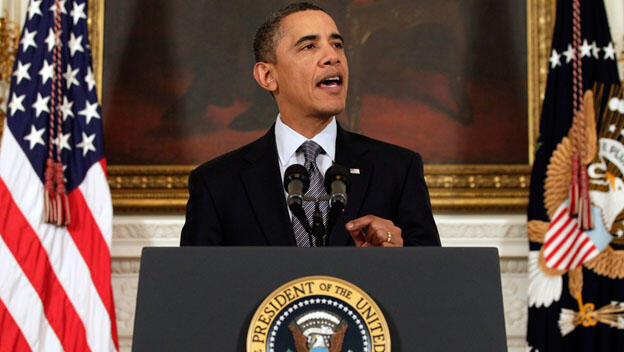
On January 25, 2011, Egyptians took to the streets in an uprising against President Hosni Mubarak. On the third day of the uprising, President Barack Obama addresses the American people after speaking to Mubarak about his country’s future.
Related Speeches & Audio (10)
-
Obama on the Egyptian Uprising
Obama on the Egyptian UprisingAudio Clip (2:14)
Audio Clip (2:14)
On January 25, 2011, Egyptians took to the streets in an uprising against President Hosni Mubarak. On the third day of the uprising, President Barack Obama addresses the American people after speaking to Mubarak about his country’s future.
-
Obama Approves Military Action in Libya
Obama Approves Military Action in LibyaAudio Clip (1:21)
Audio Clip (1:21)
On March 19, 2011, President Barack Obama announced authorization for U.S. armed forces to begin an aerial campaign in Libya to protect citizens protesting the government of Moammar el Qaddafi.
-
Jimmy Carter's Remarks on Camp David Summit
Jimmy Carter's Remarks on Camp David SummitAudio Clip (3:33)
Audio Clip (3:33)
In 1978, President Jimmy Carter held a 13-day summit with Egyptian President Anwar el-Sadat and Israeli Prime Minister Menachem Begin, helping to broker the first-ever peace treaty between Israel and one of its Arab neighbors. On September 17, at the end of the summit, President Carter describes the two agreements the two world leaders will sign.
-
Bush on Tiananmen Square
Bush on Tiananmen SquareAudio Clip (1:48)
Audio Clip (1:48)
Several weeks of pro-democracy demonstrations in the streets of Beijing came to a violent end on June 4, 1989, when the Chinese Army fired on the crowds, killing hundreds. The next day, President George H. W. Bush publicly condemns the event.
-
Reagan Addresses British Parliament
Reagan Addresses British ParliamentAudio Clip (0:17)
Audio Clip (0:17)
On June 8, 1982, in the first speech by an American president to a meeting of both houses of the British Parliament, President Ronald Reagan presents his hope for a future that would "leave Marxism-Leninism on the ash heap of history."
-
The Eisenhower Doctrine
The Eisenhower DoctrineAudio Clip (1:01)
Audio Clip (1:01)
In order to suppress growing Soviet influence in the Middle East following the Suez Crisis of 1956, President Dwight D. Eisenhower appears before a joint session of Congress on January 5, 1957, to present a policy that will become known as the Eisenhower Doctrine. It holds that the United States would be authorized to provide military assistance "to secure and protect the territorial integrity" of any nations threatened by international communism.
-
Obama on Rebellion in Libya
Obama on Rebellion in LibyaAudio Clip (1:28)
Audio Clip (1:28)
On February 23, 2011, in an address to the nation, President Barack Obama pledges that the United States will support the democratic rights of Libyan citizens in rebellion against Muammar el-Qaddafi's regime.
-
Ford Offers Clemency to Draft Evaders
Ford Offers Clemency to Draft EvadersAudio Clip (1:20)
Audio Clip (1:20)
On September 16, 1974, President Gerald Ford signed a proclamation that would offer Vietnam War draft evaders the chance to earn clemency by performing alternative service for their country. In a speech to the American people, Ford defends his decision as one that's best for the nation.
-
Franklin D. Roosevelt's Fourth Inaugural Address
Franklin D. Roosevelt's Fourth Inaugural AddressAudio Clip (6:22)
Audio Clip (6:22)
With the country at war at the start of his unprecedented fourth term as president of the United States, Franklin D. Roosevelt delivers a short and somber inaugural address at a simple ceremony without a parade or ball on January 20, 1945.
-
Franklin D. Roosevelt's "Stab in the Back" Speech
Franklin D. Roosevelt's "Stab in the Back" SpeechAudio Clip (3:07)
Audio Clip (3:07)
On June 10, 1940, as President Franklin D. Roosevelt prepares to deliver the commencement address at the University of Virginia where his son is graduating with a law degree, Italy declares war on France and Great Britain. Rather than deliver his prepared speech, Roosevelt instead expresses his opposition to Mussolini's move and calls on America to end its isolationism.
Related Videos (10)
-
Reagan
ReaganVideo Clip (01:28:23)
Video Clip (01:28:23)
A portrait of America's 40th president depicting the most defining moments of his 93 years.
-
Nixon Addresses "Silent Majority"
Nixon Addresses "Silent Majority"Video Clip (1:53)
Video Clip (1:53)
On the heels of a major nationwide protest against the Vietnam War in October 1969, President Richard Nixon delivers a speech on November 3, laying out his plans for ending the war through diplomatic negotiations and asking for the support of the "great silent majority" of Americans.
-
Franklin D. Roosevelt at the Moscow Conference
Franklin D. Roosevelt at the Moscow ConferenceVideo Clip (1:15)
Video Clip (1:15)
Watch the speech given by Franklin D. Roosevelt at the Moscow Conference during World War II.
-
Truman Urges Religious Tolerance
Truman Urges Religious ToleranceVideo Clip (1:16)
Video Clip (1:16)
History Features explores an important post-war speech by President Harry Truman, asking for religious unity and tolerance.
-
James Madison: Did You Know?
James Madison: Did You Know?Video Clip (1:36)
Video Clip (1:36)
At just 5'4", James Madison was hardly a commanding presence, but that didn't stop him from shaping American history.
-
Brad Meltzer's Decoded: The President's Inner Circle
Brad Meltzer's Decoded: The President's Inner CircleVideo Clip (44:13)
Video Clip (44:13)
The Culper Spy Ring was made up of shopkeepers, tavern owners and even housewives. Brad and the team investigate how this group of ordinary citizens may have helped the US win the Revolutionary War.
-
Jefferson Writes the Declaration of Independence
Jefferson Writes the Declaration of IndependenceVideo Clip (2:37)
Video Clip (2:37)
At 33, Thomas Jefferson wrote the original draft of America's historic Declaration of Independence, which was approved by the Continental Congress after several days of debate and revisions on July 4, 1776.
-
Watergate Forces Nixon to Resign
Watergate Forces Nixon to ResignVideo Clip (3:20)
Video Clip (3:20)
In this History Rocks the 70's video, brought to you by the History Channel, learn about special investigator Archibald Cox's quest to investigate the Watergate cover-up. Nixon tries to get Cox fired several times.
-
John Adams: The Early Years
John Adams: The Early YearsVideo Clip (4:00)
Video Clip (4:00)
One of the most influential founding fathers of the United States, John Adams persuaded Congress to adopt the Declaration of Independence in 1776.
-
Ask HISTORY: Did all the founding fathers wear wigs?
Ask HISTORY: Did all the founding fathers wear wigs?Video Clip (2:17)
Video Clip (2:17)
Did America's creators really hide their hair under white toupees? Get the answer now.
Related Photo Galleries (1)
-
French Revolution
French Revolution(9 Photos)
9 Photos
The French Revolution
Most Popular Videos on History.com
-
America Divided
(3:54)
-
Caroline Dries: NYU Dorm
(3:26)
Newest Videos on History.com
-
Vietnam in HD Preview
(2:00)
-
Two For the Road
(1:48)
-
HISTORY says Thanks
(2:47)
Shop HISTORY
-
The American Civil War DVD Set
Experience for yourself the historical and personal impact of the Civil War.
$81.99
Buy Now -
Civil War: Rebellion to Reconstruction DVD Set
Experience the turbulent events that ignited the bloodiest, most divisive war this country has known.
$53.99
Buy Now -
The Berlin Wall DVD
It surrounded the free city of West Berlin, but it symbolized a prison for those on the outside.
$19.99
Buy Now
Email Updates
Keep up with the latest History shows, online features, special offers and more.
Sign up


