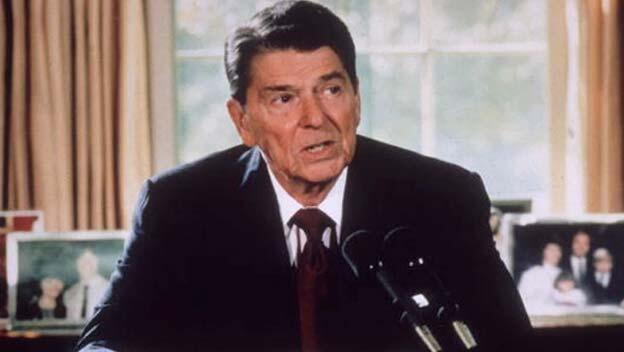
Reagan on Libya Air Strikes
On April 14, 1986, President Ronald Reagan addresses the nation to announce that he has authorized a series of air strikes against Lybia. The military action was ordered as retaliation for a Berlin terrorist bombing, which Reagan describes as the latest act in Lybia's "reign of terror."
Related Speeches & Audio (10)
-
Reagan on Libya Air Strikes
Reagan on Libya Air StrikesAudio Clip (6:49)
Audio Clip (6:49)
On April 14, 1986, President Ronald Reagan addresses the nation to announce that he has authorized a series of air strikes against Lybia. The military action was ordered as retaliation for a Berlin terrorist bombing, which Reagan describes as the latest act in Lybia's "reign of terror."
-
U.S. Marines Attacked in Lebanon
U.S. Marines Attacked in LebanonAudio Clip (3:05)
Audio Clip (3:05)
On October 23, 1983, a Lebanese terrorist drove a truck packed with more than 2,000 pounds of explosives into the U.S. Marine barracks in Beirut, killing 241 U.S. military personnel. The next day, President Ronald Reagan holds a press conference to discuss the situation.
-
Reagan on Middle East Policy
Reagan on Middle East PolicyAudio Clip (5:15)
Audio Clip (5:15)
When the war broke out in Lebanon in June, 1982, President Ronald Reagan's plans to facilitate autonomy talks between Palestine and Israel were put on hold. Now, in September, with the conflict ended and the evacuation of the PLO from Beirut complete, President Reagan speaks from the studios of KNBC-TV on America's policy for peace in the Middle East.
-
Eisenhower on the Suez Canal Crisis
Eisenhower on the Suez Canal CrisisAudio Clip (4:03)
Audio Clip (4:03)
In October 1956, Britain and France entered into a coalition with Israel, and the three nations launched a military attack against Egyptian forces in the Suez Canal. On October 31, in a speech to the nation, President Eisenhower expresses the United States' opposition to the military action.
-
Saddam Hussein Captured
Saddam Hussein CapturedAudio Clip (2:01)
Audio Clip (2:01)
Almost a year after sending U.S. troops to fight in Iraq, President George W. Bush announces the capture of the country's dictator, Saddam Hussein, in an address to the nation on December 14, 2003.
-
Obama Approves Military Action in Libya
Obama Approves Military Action in LibyaAudio Clip (1:21)
Audio Clip (1:21)
On March 19, 2011, President Barack Obama announced authorization for U.S. armed forces to begin an aerial campaign in Libya to protect citizens protesting the government of Moammar el Qaddafi.
-
Ronald Reagan on Iran-Contra Hearings
Ronald Reagan on Iran-Contra HearingsAudio Clip (2:56)
Audio Clip (2:56)
In 1987, Congress held 40 days of public hearings on the Iran-Contra affair during which they listened to 28 witnesses give more than 250 hours of testimony. On August 12, 1987, in a live broadcast from the Oval Office, President Ronald Reagan comments on the recent congressional hearings now that they are over.
-
American Hostages Released from Iran
American Hostages Released from IranAudio Clip (0:37)
Audio Clip (0:37)
On the day of Ronald Reagan's inauguration, the U.S. freed almost $8 billion in frozen Iranian assets. Algerian intermediaries helped negotiations between the U.S. and Iran to free the fifty-two captives held at the U.S. embassy in Teheran, Iran.
-
Bush on Iraq's Invasion of Kuwait
Bush on Iraq's Invasion of KuwaitAudio Clip (1:38)
Audio Clip (1:38)
In a live report from the Oval Office, President George H.W. Bush announces the deployment of U.S. armed forces to Saudi Arabia. Troops were sent to the Arab nation to deter further Iraqi aggression after Iraq's invasion of Kuwait on August 2, 1990.
-
Jimmy Carter's Remarks on Camp David Summit
Jimmy Carter's Remarks on Camp David SummitAudio Clip (3:33)
Audio Clip (3:33)
In 1978, President Jimmy Carter held a 13-day summit with Egyptian President Anwar el-Sadat and Israeli Prime Minister Menachem Begin, helping to broker the first-ever peace treaty between Israel and one of its Arab neighbors. On September 17, at the end of the summit, President Carter describes the two agreements the two world leaders will sign.
Related Videos (10)
-
Reagan on Vietnam 1964
Reagan on Vietnam 1964Video Clip (1:45)
Video Clip (1:45)
"There can be no real peace while one American is dying some place in the world for the rest of us."
-
Franklin D. Roosevelt and Pearl Harbor
Franklin D. Roosevelt and Pearl HarborVideo Clip (2:20)
Video Clip (2:20)
Take a look at the events leading to the bombing of Pearl Harbor, which prompted President Roosevelt to declare war on the Japanese and enter World War II.
-
Kennedy Responds to Berlin Wall
Kennedy Responds to Berlin WallVideo Clip (3:05)
Video Clip (3:05)
President Kennedy's diplomatic resolve was tested as tension mounted at the Berlin wall.
-
LBJ: Gulf of Tonkin Incident
LBJ: Gulf of Tonkin IncidentVideo Clip (3:49)
Video Clip (3:49)
The Gulf of Tonkin incident was the result of mounting tensions between the U.S. and North Vietnam.
-
Nixon's Secret Plan to End the Vietnam War
Nixon's Secret Plan to End the Vietnam WarVideo Clip (3:36)
Video Clip (3:36)
In 1968, Richard Nixon ran on a platform for presidency that included a "secret plan" to end the war in Vietnam.
-
Theodore Roosevelt Fights in Spanish-American War
Theodore Roosevelt Fights in Spanish-American WarVideo Clip (3:09)
Video Clip (3:09)
Explore the role of Teddy Roosevelt and the Rough Riders during the Spanish-American War.
-
William McKinley's Presidency
William McKinley's PresidencyVideo Clip (3:25)
Video Clip (3:25)
Explore the presidency of William McKinley, from his modernization of political news distribution to his war policy and assassination.
-
Last Stand of the Confederacy
Last Stand of the ConfederacyVideo Clip (3:21)
Video Clip (3:21)
In march of 1865, Confederate forces made a valiant last stand against General Sherman's advancing troops, but were undone by the most unlikely of errors
-
Presidents Who Served
Presidents Who ServedVideo Clip (3:39)
Video Clip (3:39)
Military service helped build character for Presidents George Bush and Henry Ford.
-
FDR Meets Churchill in Quebec
FDR Meets Churchill in QuebecVideo Clip (1:21)
Video Clip (1:21)
At a famous meeting between President Franklin D. Roosevelt and the British Prime Minister Winston Churchill in Quebec, Canada, the men discuss United Nations issues and plans that will bring peace to the East.
Related Photo Galleries (1)
-
Vietnam War: Leaders
Vietnam War: Leaders(15 Photos)
15 Photos
View images of the Presidents, politicians, and military leaders who influenced American involvement in the Vietnam War.
Most Popular Videos on History.com
-
America Divided
(3:54)
-
Caroline Dries: NYU Dorm
(3:26)
Newest Videos on History.com
-
Vietnam in HD Preview
(2:00)
-
Two For the Road
(1:48)
-
HISTORY says Thanks
(2:47)
Shop HISTORY
-
History Channel Presents: The War of 1812 DVD Set
Follow a seemingly disastrous decision to declare war to the glory of the stars and stripes.
$14.98
Buy Now -
The White House: Behind Closed Doors DVD
Learn the secrets of America's most recognizable residence.
$17.47
Buy Now -
WWII in HD DVD Set
The only people to see the war like this were the ones who lived it. Until now… Own this best-selling series today!
$18.73
Buy Now
Email Updates
Keep up with the latest History shows, online features, special offers and more.
Sign up


