Senator Nixon Takes Tough Stand on Communism and related media

Senator Nixon Takes Tough Stand on Communism

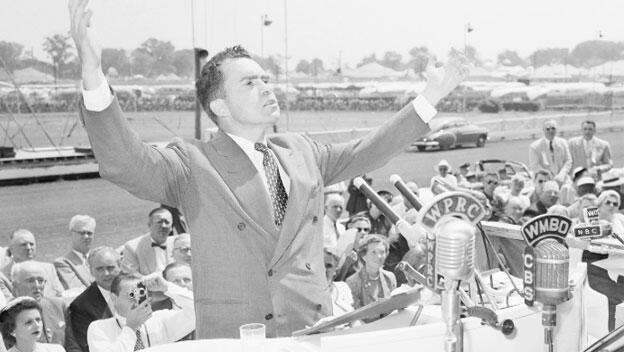
As a candidate for vice president, Sen. Richard Nixon delivers a speech at a political rally in Sanford, Maine, on September 3, 1952, and promises that he will take care of the communist problem plaguing the federal government.
Listen to Similar Speeches & Audio

Your Parental Control settings do not allow you to view thiscontent.

Related Speeches & Audio (10)

  • Senator Nixon Takes Tough Stand on Communism
    Senator Nixon Takes Tough Stand on Communism

    Audio Clip (0:56)

    As a candidate for vice president, Sen. Richard Nixon delivers a speech at a political rally in Sanford, Maine, on September 3, 1952, and promises that he will take care of the communist problem plaguing the federal government.

    Audio Clip (0:56)
  • Reagan Demands Fall of Berlin Wall
    Reagan Demands Fall of Berlin Wall

    Audio Clip (1:08)

    On June 12, 1987, in a speech delivered from the Brandenburg Gate in West Germany, President Ronald Reagan makes one of his most famous statements when he calls on Mikhail Gorbachev to tear down the Berlin Wall.

    Audio Clip (1:08)
  • African-Americans Vote in South Carolina
    African-Americans Vote in South Carolina

    Audio Clip (1:28)

    A report from Charleston, South Carolina, describes heavy voter turnout at the state's primary election on August 10, 1948. For the first time since the Reconstruction era, African-Americans were permitted to vote in a Democratic primary, after a federal judge ruled their exclusion unconstitutional.

    Audio Clip (1:28)
  • Eisenhower Weighs Chance for Peace in the Cold War
    Eisenhower Weighs Chance for Peace in the Cold War

    Audio Clip (3:40)

    On April 16, 1953, after the death of Russian Premier Joseph Stalin, President Dwight D. Eisenhower delivers what is known as his “Cross of Iron” speech before the American Society for Newspaper Editors, contrasting the philosophies of the Soviet Union and the United States.

    Audio Clip (3:40)
  • Margaret Chase Smith Cautions Anti-Eisenhower Republicans
    Margaret Chase Smith Cautions Anti-Eisenhower Republicans

    Audio Clip (0:47)

    In a speech delivered March 3, 1951, in Town Hall, New York, Sen. Margaret Chase Smith warns those in her party who are critical of Gen. Dwight D. Eisenhower, the likely presidential nominee, to tone down their rhetoric as a division grows in the GOP over the stationing of troops in post-World War II Germany.

    Audio Clip (0:47)
  • The Eisenhower Doctrine
    The Eisenhower Doctrine

    Audio Clip (1:01)

    In order to suppress growing Soviet influence in the Middle East following the Suez Crisis of 1956, President Dwight D. Eisenhower appears before a joint session of Congress on January 5, 1957, to present a policy that will become known as the Eisenhower Doctrine. It holds that the United States would be authorized to provide military assistance "to secure and protect the territorial integrity" of any nations threatened by international communism.

    Audio Clip (1:01)
  • Bush and Gorbachev Declare End of Cold War
    Bush and Gorbachev Declare End of Cold War

    Audio Clip (1:45)

    President George H. W. Bush and Soviet leader Mikhail Gorbachev declared an end to the Cold War at the Malta Summit on December 3, 1989. At a joint press conference aboard the Soviet passenger liner Maxim Gorky in Marsaxlokk Harbor, President Bush speaks about his hopes for a cooperative U.S.-Soviet relationship.

    Audio Clip (1:45)
  • Bush on the Fall of the Berlin Wall
    Bush on the Fall of the Berlin Wall

    Audio Clip (0:32)

    The day after the fall of the Berlin Wall on November 20, 1989, President George H. W. Bush met with West German Foreign Minister Hans-Dietrich Genscher to discuss plans for the reunification of Germany. As a token of his gratitude to the United States, Genscher brought President Bush a piece of the Berlin Wall. In a press conference, Bush thanks the foreign minister for the gift.

    Audio Clip (0:32)
  • Reagan’s Evil Empire
    Reagan’s Evil Empire

    Audio Clip (0:28)

    In a speech delivered to the National Association of Evangelicals in Orlando, Florida, on March 8, 1983, President Ronald Reagan criticizes the Soviet Union’s lack of religious faith.

    Audio Clip (0:28)
  • Reagan Accepts Presidential Nomination
    Reagan Accepts Presidential Nomination

    Audio Clip (1:33)

    After unsuccessfully seeking the presidential nomination in 1968 and 1976, Ronald Reagan was nominated at the Republican National Convention on September 7, 1980. In his acceptance speech, the former California governor tells American taxpayers that they do not exist to fund the federal government.

    Audio Clip (1:33)

Related Videos (10)

  • Nixon's Summation
    Nixon's Summation

    Video Clip (3:19)

    Listen to the important issues in 1960 in this History Channel video of one of the first televised debates, which took place between Richard Nixon and John F. Kennedy. The video shows Nixon stating his views from the Soviet Union to health insurance.

    Video Clip (3:19)
  • Kennedy's Summation
    Kennedy's Summation

    Video Clip (2:48)

    This John F. Kennedy vs. Richard Nixon 1960 presidential debate History Channel video shows Senator Kennedy speaking about the importance of the Social Security Act of 1935 and now was the time to do something for elderly medical care.

    Video Clip (2:48)
  • Kennedy: Fiscal Policy
    Kennedy: Fiscal Policy

    Video Clip (2:49)

    Watch Senator Kennedy discuss the federal budget in his 1960 debate with Vice President Richard Nixon in this video. Kennedy explains how the hard money policies of Nixon and the Eisenhower Administration helped slow down the economy.

    Video Clip (2:49)
  • Kennedy: Teachers' Salaries
    Kennedy: Teachers' Salaries

    Video Clip (1:32)

    John F. Kennedy answers back to Nixon's accusation of supporting federal control of teacher salaries. Kennedy explains that was not the question before the Senate in February, the issue was whether to give federal aid to the state to support education.

    Video Clip (1:32)
  • Kennedy on 'Extreme' Bills
    Kennedy on 'Extreme' Bills

    Video Clip (1:24)

    Senator John F. Kennedy debates that none of the bills proposed by Nixon were extreme like Nixon was suggesting. Kennedy uses Nixon's proposals of $1.25 an hour plan, federal aid to education, and medical care for the aged to prove his point.

    Video Clip (1:24)
  • Nixon's Opening Statement
    Nixon's Opening Statement

    Video Clip (2:34)

    In his opening statement during the first of four "Great Debates" between the two candidates in 1960, Richard Nixon agrees with John F. Kennedy's view of international affairs but disputes the notion that the country's growth has been stagnant.

    Video Clip (2:34)
  • Nixon: Communism within the U.S.
    Nixon: Communism within the U.S.

    Video Clip (1:38)

    The Cold War was a serious issue that engulfed the United States. Coupled with this war was the fear of communism in the United States. This fear became a central issue between Kennedy and Nixon. Hear their debate in this History Channel video.

    Video Clip (1:38)
  • Reagan
    Reagan

    Video Clip (01:28:23)

    A portrait of America's 40th president depicting the most defining moments of his 93 years.

    Video Clip (01:28:23)
  • Kennedy on His Qualifications
    Kennedy on His Qualifications

    Video Clip (1:17)

    See President John F. Kennedy respond to Richard Nixon's accusations that he is immature and ill-qualified to be President of the United States in this debate video. Kennedy explains how they both came to Congress in 1946.

    Video Clip (1:17)
  • Kennedy: Communism within the U.S.
    Kennedy: Communism within the U.S.

    Video Clip (0:50)

    Senator John F. Kennedy talks about the internal threat that communism poses to national security. Kennedy describes that these internal factions are serious and should be taken care of by supporting laws that the U.S. has already passed.

    Video Clip (0:50)

Shop HISTORY