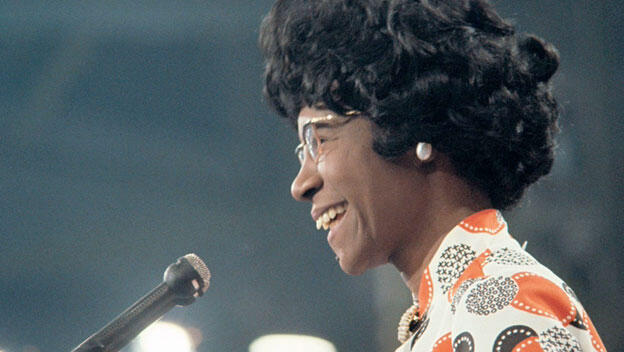
Shirley Chisholm Runs for Presidential Nomination
During her 1972 campaign for the Democratic presidential nomination, Shirley Chisholm, the first African-American congresswoman, promises to tell the truth about sex and race.
Related Speeches & Audio (10)
-
Shirley Chisholm Runs for Presidential Nomination
Shirley Chisholm Runs for Presidential NominationAudio Clip (1:30)
Audio Clip (1:30)
During her 1972 campaign for the Democratic presidential nomination, Shirley Chisholm, the first African-American congresswoman, promises to tell the truth about sex and race.
-
Shirley Chisholm Campaigns for Nomination
Shirley Chisholm Campaigns for NominationAudio Clip (3:24)
Audio Clip (3:24)
While seeking the candidacy for president of the United States in 1972, Shirley Chisholm campaigns hard, speaking to crowds across the country about her beliefs in equality for women and minorities. In 1968, Chisholm became the first African-American congresswoman.
-
Colin Powell Declines Presidential Bid
Colin Powell Declines Presidential BidAudio Clip (2:26)
Audio Clip (2:26)
On November 8, 1995, Colin Powell put an end to speculation when he announced that he would not run for president in the next election.
-
Barack Obama Elected President
Barack Obama Elected PresidentAudio Clip (1:38)
Audio Clip (1:38)
On November 4, 2008, Barack Obama is elected the 44th president and becomes the first African-American chief executive of the United States. In his victory speech, President Obama remarks that "change has come to America."
-
Reagan Accepts Presidential Nomination
Reagan Accepts Presidential NominationAudio Clip (1:33)
Audio Clip (1:33)
After unsuccessfully seeking the presidential nomination in 1968 and 1976, Ronald Reagan was nominated at the Republican National Convention on September 7, 1980. In his acceptance speech, the former California governor tells American taxpayers that they do not exist to fund the federal government.
-
Nixon's Second Inaugural Address
Nixon's Second Inaugural AddressAudio Clip (1:42)
Audio Clip (1:42)
After a landslide reelection victory, incumbent President Richard Nixon stresses America's role in the pursuit of world peace during his second inaugural address, delivered on January 20, 1973.
-
Nixon Reelected to Presidency
Nixon Reelected to PresidencyAudio Clip (1:03)
Audio Clip (1:03)
On November 7, 1972, incumbent President Richard Nixon won a second term in a landslide victory over Democrat George McGovern. In a brief statement from the Oval Office, President Nixon promises to bring "peace with honor" in Vietnam and to usher in a "new era of peace" with the Soviet Union.
-
Reagan’s Second Inaugural Address
Reagan’s Second Inaugural AddressAudio Clip (0:47)
Audio Clip (0:47)
Defeating Democratic nominee Walter Mondale with an unprecedented electoral vote margin, President Ronald Reagan secured a second term as president of the United States. In his inaugural address on January 21, 1985, Reagan introduces the idea of a "new American emancipation."
-
Franklin D. Roosevelt Accepts Fourth Term Nomination
Franklin D. Roosevelt Accepts Fourth Term NominationAudio Clip (2:08)
Audio Clip (2:08)
Broadcast from a Pacific coast naval base to the Democratic National Convention in Chicago, Illinois, on July 20, 1944, Franklin D. Roosevelt accepts his party’s nomination for an unprecedented fourth presidential bid and speaks about postwar preparations now that victory is close at hand.
-
Truman's Inaugural Address
Truman's Inaugural AddressAudio Clip (1:57)
Audio Clip (1:57)
On January 20, 1949, beginning his second term, President Harry Truman denounces communism and presents a program for peace in his inaugural address.
Related Videos (10)
-
Obama Makes History
Obama Makes HistoryVideo Clip (3:42)
Video Clip (3:42)
President Barack Obama was elected the first African-American president of the United States on November 5, 2008, transcending centuries of inequality in America.
-
Barbara Jordan's Keynote Address
Barbara Jordan's Keynote AddressVideo Clip (2:12)
Video Clip (2:12)
An excerpt from Barbara Jordan's keynote speech at the Democratic National Convection. Jordan was the first African-American woman ever elected to Congress from a southern state.
-
Kennedy on His Qualifications
Kennedy on His QualificationsVideo Clip (1:17)
Video Clip (1:17)
See President John F. Kennedy respond to Richard Nixon's accusations that he is immature and ill-qualified to be President of the United States in this debate video. Kennedy explains how they both came to Congress in 1946.
-
Kennedy on 'Extreme' Bills
Kennedy on 'Extreme' BillsVideo Clip (1:24)
Video Clip (1:24)
Senator John F. Kennedy debates that none of the bills proposed by Nixon were extreme like Nixon was suggesting. Kennedy uses Nixon's proposals of $1.25 an hour plan, federal aid to education, and medical care for the aged to prove his point.
-
George Wallace Opposes Integration
George Wallace Opposes IntegrationVideo Clip (1:30)
Video Clip (1:30)
Newsreel footage of former Alabama Governor George Wallace standing against desegregation while being confronted by federal authorities at the University of Alabama in 1963.
-
Ask Steve: Southern Strategy
Ask Steve: Southern StrategyVideo Clip (1:23)
Video Clip (1:23)
In this video clip from Ask Steve, the Southern Strategy is explained. It was the republican party's successful plan of getting the white southern population to shift their views from democratic to republican.
-
Kennedy's Summation
Kennedy's SummationVideo Clip (2:48)
Video Clip (2:48)
This John F. Kennedy vs. Richard Nixon 1960 presidential debate History Channel video shows Senator Kennedy speaking about the importance of the Social Security Act of 1935 and now was the time to do something for elderly medical care.
-
Kennedy: Teachers' Salaries
Kennedy: Teachers' SalariesVideo Clip (1:32)
Video Clip (1:32)
John F. Kennedy answers back to Nixon's accusation of supporting federal control of teacher salaries. Kennedy explains that was not the question before the Senate in February, the issue was whether to give federal aid to the state to support education.
-
Kennedy: Communism within the U.S.
Kennedy: Communism within the U.S.Video Clip (0:50)
Video Clip (0:50)
Senator John F. Kennedy talks about the internal threat that communism poses to national security. Kennedy describes that these internal factions are serious and should be taken care of by supporting laws that the U.S. has already passed.
-
Nixon's Summation
Nixon's SummationVideo Clip (3:19)
Video Clip (3:19)
Listen to the important issues in 1960 in this History Channel video of one of the first televised debates, which took place between Richard Nixon and John F. Kennedy. The video shows Nixon stating his views from the Soviet Union to health insurance.
Related Photo Galleries (6)
-
James Monroe
James Monroe(8 Photos)
8 Photos
See pictures from the life and presidency of James Monroe.
-
John Tyler
John Tyler(6 Photos)
6 Photos
See pictures from the life and presidency of John Tyler
-
James Madison
James Madison(10 Photos)
10 Photos
See pictures from the life and presidency of James Madison.
-
John Quincy Adams
John Quincy Adams(8 Photos)
8 Photos
See pictures from the life and presidency of John Quincy Adams.
-
Millard Fillmore
Millard Fillmore(8 Photos)
8 Photos
See pictures from the life and presidency of Millard Fillmore.
-
William Henry Harrison
William Henry Harrison(7 Photos)
7 Photos
See pictures from the life and presidency of William Henry Harrison
Most Popular Videos on History.com
-
D-Day Invasion
(3:07)
-
Hitler's Military Blunders
(3:27)
Newest Videos on History.com
-
Vietnam in HD Preview
(2:00)
-
Two For the Road
(1:48)
-
HISTORY says Thanks
(2:47)
Shop HISTORY
-
Civil War: Rebellion to Reconstruction DVD Set
Experience the turbulent events that ignited the bloodiest, most divisive war this country has known.
$53.99
Buy Now -
The American Civil War DVD Set
Experience for yourself the historical and personal impact of the Civil War.
$81.99
Buy Now -
Email Updates
Keep up with the latest History shows, online features, special offers and more.
Sign up


