Stokely Carmichael on Assassination of Martin Luther King Jr.
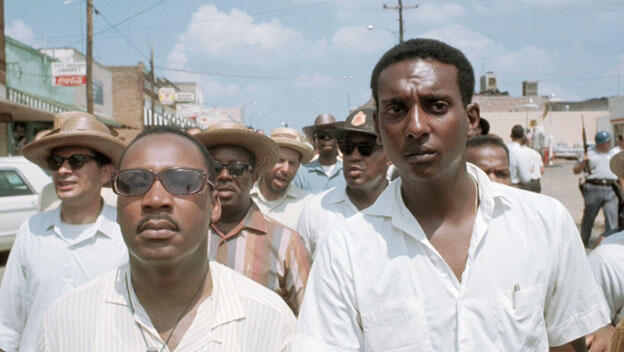
On April 5, 1968, in a press conference held the day after the slaying of Martin Luther King Jr., civil rights activist Stokely Carmichael predicts the outbreak of more violence across the nation in retaliation for "white America's biggest mistake."
Related Speeches & Audio (10)
-
Stokely Carmichael on Assassination of Martin Luther King Jr.
Stokely Carmichael on Assassination of Martin Luther King Jr.Audio Clip (2:42)
Audio Clip (2:42)
On April 5, 1968, in a press conference held the day after the slaying of Martin Luther King Jr., civil rights activist Stokely Carmichael predicts the outbreak of more violence across the nation in retaliation for "white America's biggest mistake."
-
Adam Clayton Powell Rallies Congregation
Adam Clayton Powell Rallies CongregationAudio Clip (3:54)
Audio Clip (3:54)
In a 1967 sermon, Adam Clayton Powell Jr., pastor and congressman from Harlem, New York City, reaches out to the downtrodden and depressed with his "keep the faith, baby" slogan.
-
Tutu Speaks Out Against Apartheid
Tutu Speaks Out Against ApartheidAudio Clip (1:54)
Audio Clip (1:54)
In an October 28, 1985, address to the United Nations Special Political Committee, Bishop Desmond Tutu calls for the immediate dismantling of apartheid.
-
John F. Kennedy on Desegregation at Ole Miss
John F. Kennedy on Desegregation at Ole MissAudio Clip (3:18)
Audio Clip (3:18)
When Mississippi Gov. Ross Barnett refused to comply with the U.S. Supreme Court ruling demanding desegregation at the University of Mississippi and the admittance of James Meredith, President John F. Kennedy was forced to intervene. In his address to the nation on September 30, 1962, Kennedy explains his decision to federalize the state national guard in order to maintain law and order while Meredith registers at the college.
-
Booker T. Washington on Race Relations
Booker T. Washington on Race RelationsAudio Clip (3:28)
Audio Clip (3:28)
On September 18, 1895, at the Atlanta Exposition, Booker T. Washington rises to national fame when he delivers what came to be known as his “Atlanta Compromise” speech, in which he advocates for the races to work together while remaining separate socially.
-
NAACP's Walter White Decries Racial Inequality
NAACP's Walter White Decries Racial InequalityAudio Clip (2:28)
Audio Clip (2:28)
On June 29, 1947, at the closing session of the 38th annual conference for the National Association for the Advancement of Colored People (NAACP), Walter F. White, the organization’s executive secretary, warns that despite progress made in civil rights, true equality can’t be achieved with a "separate but equal" mandate.
-
Brown v. Board of Education Ruling
Brown v. Board of Education RulingAudio Clip (1:02)
Audio Clip (1:02)
On May 17, 1954, U.S. Supreme Court Chief Justice Earl Warren delivered the unanimous ruling against the "separate but equal" mandate and demanded desegregation of schools. Outside the courtroom, the attorneys who argued the Brown v. Board of Education case, James Nabrit Jr., Thurgood Marshall and George Hayes, give a press conference.
-
Nelson Mandela Gathers Support to Abolish Apartheid
Nelson Mandela Gathers Support to Abolish ApartheidAudio Clip (2:03)
Audio Clip (2:03)
After being held for 27 years as a political prisoner, the newly freed Nelson Mandela stands before the United Nations on June 22, 1990. As deputy president of the African National Congress, Mandela delivers a speech to the Special Committee Against Apartheid and calls for continued economic sanctions against South Africa to help force an end to segregation.
-
John F. Kennedy Appeals to Mississippi Governor
John F. Kennedy Appeals to Mississippi GovernorAudio Clip (3:42)
Audio Clip (3:42)
After many unfruitful telephone conversations with Mississippi Gov. Ross Barnett, President John F. Kennedy calls the governor one more time to discuss the building tension over James Meredith’s impending registration at the University of Mississippi. Though the governor has made clear his opposition to the Supreme Court order to allow Meredith to attend the school, President Kennedy tries to assess whether the governor will maintain law and order when Meredith arrives.
-
John F. Kennedy Intervenes in James Meredith Case
John F. Kennedy Intervenes in James Meredith CaseAudio Clip (4:38)
Audio Clip (4:38)
In defiance of the Supreme Court ruling that the University of Mississippi desegregate and allow James Meredith to attend, Gov. Ross Barnett physically blocked the African-American student from entering the building to register on September 20, 1962. Nine days later, President John F. Kennedy telephones Barnett to persuade him to cooperate with the Court's ruling. Barnett does little to reassure Kennedy, and attempts to pawn off the decision on his lawyer friend Tom Watkins.
Related Videos (10)
-
Ask Steve: MLK, JR.
Ask Steve: MLK, JR.Video Clip (1:39)
Video Clip (1:39)
On Ask Steve, the efforts of Martin Luther King Jr. and his assassination was discussed. His connection with the White House was cut off my President Lyndon Johnson because of his lack of support for the Vietnam War. He then went to Memphis.
-
Origins of Black History Month
Origins of Black History MonthVideo Clip (2:20)
Video Clip (2:20)
A brief look at the history of African Americans and Black History Month.
-
Jesse Jackson: Impact of MLK's Death
Jesse Jackson: Impact of MLK's DeathVideo Clip (1:39)
Video Clip (1:39)
"...All that I really knew to do at the time was to call upon my own analytic instincts. When a major player is hurt, you can't forfeit the game. You have to toughen up and buckle up, take a deep breath, and keep playing even in that player's name. You have to continue..."
-
Martin Luther King, Jr: I Have A Dream
Martin Luther King, Jr: I Have A DreamVideo Clip (16:15)
Video Clip (16:15)
We are unable to offer the full ''I Have a Dream'' speech, the rights to which are controlled by the Estate of Dr. Martin Luther King, Jr.
To view a full transcript of this and other speeches of Dr. Martin Luther King, Jr., visit The Kings Papers Project Web site.
-
Jesse Jackson: Aftermath of King Assassination
Jesse Jackson: Aftermath of King AssassinationVideo Clip (1:38)
Video Clip (1:38)
In this History Channel video clip, we see an interview with Jesse Jackson. See how emotional it still is for Jackson, to sit down and talk about Martin Luther King and how he was killed right next to him some years ago.
-
Martin Luther King III on his Father
Martin Luther King III on his FatherVideo Clip (1:26)
Video Clip (1:26)
Martin Luther King III remembers his father's love of all people and transformative effects on the world.
-
Tom Brokaw on King's Legacy
Tom Brokaw on King's LegacyVideo Clip (1:49)
Video Clip (1:49)
Tom Brokaw talks about Martin Luther King, Jr.'s lasting effects on American Society.
-
Forest Whitaker: Growing Up with Dr. King
Forest Whitaker: Growing Up with Dr. KingVideo Clip (1:12)
Video Clip (1:12)
Actor Forest Whitaker reflects on the legacy of Dr. Martin Luther King, Jr.
-
Stokely Carmichael
Stokely CarmichaelVideo Clip (1:14)
Video Clip (1:14)
Stokely Carmichael, leader of the Student Nonviolent Coordinating Committee, spoke to a crowd in Greenwood, Mississippi in 1964.
-
W.E.B. Dubois and the Niagara Movement
W.E.B. Dubois and the Niagara MovementVideo Clip (3:44)
Video Clip (3:44)
W.E.B. Dubois was integral to the advancement of racial equality.
Related Photo Galleries (1)
-
Integration of Central High School
Integration of Central High School(9 Photos)
9 Photos
In 1957 nine black students enrolled at the formerly all-white Central High School in Little Rock, Arkansas.
Most Popular Videos on History.com
-
Attack on Pearl Harbor
(1:49)
Newest Videos on History.com
-
Vietnam in HD Preview
(2:00)
-
Two For the Road
(1:48)
-
HISTORY says Thanks
(2:47)
Shop HISTORY
-
Martin Luther King Jr. - I Have a Dream DVD
Learn the history of King's famous speech and the March on Washington.
$19.98
Buy Now -
The 60s
Relive the epic events of the times in this sweeping collection from HISTORY.
-
The American Civil War DVD Set
Experience for yourself the historical and personal impact of the Civil War.
$81.99
Buy Now
Email Updates
Keep up with the latest History shows, online features, special offers and more.
Sign up


