Suez Crisis Threatens World Peace and related media

Suez Crisis Threatens World Peace

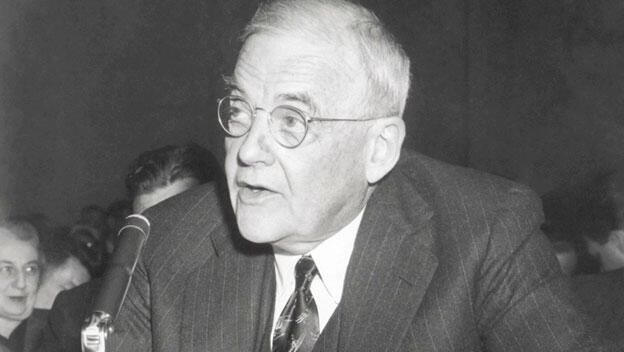
On February 24, 1956, Secretary of State John Foster Dulles addresses a Senate Committee assembled to discuss increasing tensions in the Middle East centered on Egypt's Suez Canal region.
Listen to Similar Speeches & Audio

Your Parental Control settings do not allow you to view thiscontent.

Related Speeches & Audio (10)

  • Suez Crisis Threatens World Peace
    Suez Crisis Threatens World Peace

    Audio Clip (1:08)

    On February 24, 1956, Secretary of State John Foster Dulles addresses a Senate Committee assembled to discuss increasing tensions in the Middle East centered on Egypt's Suez Canal region.

    Audio Clip (1:08)
  • French Politician Discusses Home Rule for Algeria
    French Politician Discusses Home Rule for Algeria

    Audio Clip (1:13)

    French Consul Jean Bailard supports a law that would give Algeria limited home rule, offering the colony more power within the French government while keeping it part of France.

    Audio Clip (1:13)
  • Yasir Arafat on First Israel-Palestinian Peace
    Yasir Arafat on First Israel-Palestinian Peace

    Audio Clip (8:46)

    On September 13, 1993, the first peace accord between Israel and Palestine was signed in a ceremony on the south lawn of the White House in Washington, D.C. Palestinian Chairman Arafat delivers a speech at the occasion.

    Audio Clip (8:46)
  • Israel Fights Arab Nations in Yom Kippur War
    Israel Fights Arab Nations in Yom Kippur War

    Audio Clip (1:44)

    Israeli foreign minister Abba Eban speaks to the media about the origins of the Yom Kippur War.

    Audio Clip (1:44)
  • President Charles de Gaulle on the Algerian Crisis
    President Charles de Gaulle on the Algerian Crisis

    Audio Clip (3:28)

    The Mutual Broadcasting System presents a simultaneous translation of a speech being delivered to the French people by President Charles de Gaulle on the uprising in the French colony of Algeria. In 1954, Algeria's National Liberation Front began a guerrilla war against France in order to gain independence and establish self-rule.

    Audio Clip (3:28)
  • De Valera Observes Anniversary of Easter Rising
    De Valera Observes Anniversary of Easter Rising

    Audio Clip (0:34)

    Born in New York City in 1882, Eamon de Valera emigrated to Ireland as a child and participated in the Easter Rising against British rule, which began in Dublin on Easter Sunday, April 24, 1916. De Valera was sentenced to death for his participation in the rebellion but escaped execution because of his American birth. In a speech delivered on the anniversary, De Valera recounts the events of the protest.

    Audio Clip (0:34)
  • Woodrow Wilson Addresses Native Americans
    Woodrow Wilson Addresses Native Americans

    Audio Clip (1:45)

    In his 1913 speech to the Native American community, President Woodrow Wilson acknowledges the country's history of dark dealings with American Indians, but also stresses the progress made in forming a unified society.

    Audio Clip (1:45)
  • Britain Recognizes People's Republic of China
    Britain Recognizes People's Republic of China

    Audio Clip (0:22)

    On January 6, 1950, the British government under Prime Minister Clement Attlee followed the USSR and several other nations in recognizing the new communist government of China. A news report provides details.

    Audio Clip (0:22)
  • Earl Browder Runs for President on a Communist Party Ticket
    Earl Browder Runs for President on a Communist Party Ticket

    Audio Clip (1:06)

    Earl Browder, who was the Communist party's candidate in 1936 and 1940, reaches out to progressives in a speech on the campaign trail. While appealing a passport forgery conviction in 1940, he was forbidden to travel and thus ran his campaign exclusively out of New York.

    Audio Clip (1:06)
  • Reagan’s 1984 Presidential Nomination
    Reagan’s 1984 Presidential Nomination

    Audio Clip (0:57)

    On August 23, 1984, President Ronald Reagan accepts his party's nomination for a second term. In his speech at the Republican National Convention, President Reagan promises a "springtime of hope" for America.

    Audio Clip (0:57)

Related Videos (10)

  • Nixon Announces His Resignation
    Nixon Announces His Resignation

    Video Clip (2:38)

    View and listen to President Nixon's resignation speech in its entirety from the White House.

    Video Clip (2:38)
  • Eisenhower Defeats Stevenson
    Eisenhower Defeats Stevenson

    Video Clip (1:51)

    Eisenhower defeats Adlai Stevenson to become the 33rd President.

    Video Clip (1:51)
  • Republicans Nominate Eisenhower
    Republicans Nominate Eisenhower

    Video Clip (2:18)

    Watch as General Dwight D. Eisenhower becomes the Republican nominee for President, in this History Channel video. He adds Richard Nixon as his running mate in this presidential race. Nixon was the youngest VP candidate in history.

    Video Clip (2:18)
  • John F. Kennedy and the TVA
    John F. Kennedy and the TVA

    Video Clip (1:24)

    President Kennedy is forced to improvise a stump speech in Tennessee, after discovering that his speech didn't make the trip.

    Video Clip (1:24)
  • Kennedy's Summation
    Kennedy's Summation

    Video Clip (2:48)

    This John F. Kennedy vs. Richard Nixon 1960 presidential debate History Channel video shows Senator Kennedy speaking about the importance of the Social Security Act of 1935 and now was the time to do something for elderly medical care.

    Video Clip (2:48)
  • Kennedy on His Qualifications
    Kennedy on His Qualifications

    Video Clip (1:17)

    See President John F. Kennedy respond to Richard Nixon's accusations that he is immature and ill-qualified to be President of the United States in this debate video. Kennedy explains how they both came to Congress in 1946.

    Video Clip (1:17)
  • Kennedy: Teachers' Salaries
    Kennedy: Teachers' Salaries

    Video Clip (1:32)

    John F. Kennedy answers back to Nixon's accusation of supporting federal control of teacher salaries. Kennedy explains that was not the question before the Senate in February, the issue was whether to give federal aid to the state to support education.

    Video Clip (1:32)
  • Kennedy on 'Extreme' Bills
    Kennedy on 'Extreme' Bills

    Video Clip (1:24)

    Senator John F. Kennedy debates that none of the bills proposed by Nixon were extreme like Nixon was suggesting. Kennedy uses Nixon's proposals of $1.25 an hour plan, federal aid to education, and medical care for the aged to prove his point.

    Video Clip (1:24)
  • Kennedy: Communism within the U.S.
    Kennedy: Communism within the U.S.

    Video Clip (0:50)

    Senator John F. Kennedy talks about the internal threat that communism poses to national security. Kennedy describes that these internal factions are serious and should be taken care of by supporting laws that the U.S. has already passed.

    Video Clip (0:50)
  • Nixon's Summation
    Nixon's Summation

    Video Clip (3:19)

    Listen to the important issues in 1960 in this History Channel video of one of the first televised debates, which took place between Richard Nixon and John F. Kennedy. The video shows Nixon stating his views from the Soviet Union to health insurance.

    Video Clip (3:19)

Shop HISTORY