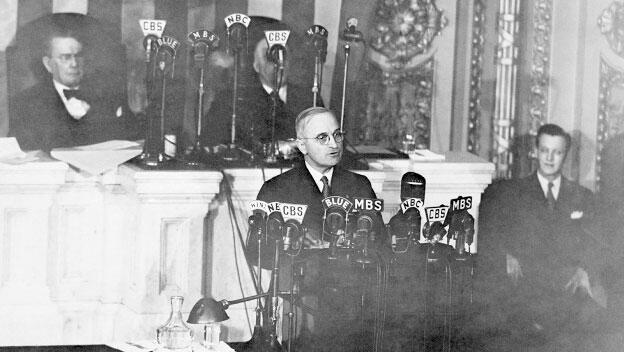
Truman's First Appearance as President
On April 16, 1945, Harry Truman makes his first official appearance before Congress as president of the United States, after being sworn in following the death of President Franklin D. Roosevelt four days earlier. In his speech, Truman pledges to bring World War II to a victorious end.
Related Speeches & Audio (10)
-
Truman's First Appearance as President
Truman's First Appearance as PresidentAudio Clip (3:20)
Audio Clip (3:20)
On April 16, 1945, Harry Truman makes his first official appearance before Congress as president of the United States, after being sworn in following the death of President Franklin D. Roosevelt four days earlier. In his speech, Truman pledges to bring World War II to a victorious end.
-
Truman Announces Japan's Surrender
Truman Announces Japan's SurrenderAudio Clip (1:57)
Audio Clip (1:57)
On September 1, 1945, in a radio address to the American people, President Harry Truman announces the unconditional surrender of Japan, formalized aboard the U.S.S. Missouri.
-
Franklin D. Roosevelt on American Progress in World War II
Franklin D. Roosevelt on American Progress in World War IIAudio Clip (1:00)
Audio Clip (1:00)
With the United States now entered into World War II, President Franklin D. Roosevelt uses the occasion of Washington’s birthday to broadcast to the nation on February 23, 1942, an outline of America’s progress in the war.
-
Franklin D. Roosevelt's War Progress Report
Franklin D. Roosevelt's War Progress ReportAudio Clip (0:57)
Audio Clip (0:57)
In his progress report on World War II on July 28, 1943, President Franklin D. Roosevelt informs the nation that "the first crack in the Axis has come" as Italian Premier Mussolini falls from power.
-
Franklin D. Roosevelt's 1941 Labor Day Speech
Franklin D. Roosevelt's 1941 Labor Day SpeechAudio Clip (1:37)
Audio Clip (1:37)
In his Labor Day radio broadcast in 1941, President Franklin D. Roosevelt reminds his fellow citizens of the need to devote America’s industrial effort to building weaponry in order to "crush Hitler and his Nazi forces."
-
Franklin D. Roosevelt's Fourth of July Address
Franklin D. Roosevelt's Fourth of July AddressAudio Clip (2:07)
Audio Clip (2:07)
In a broadcast from his home in Hyde Park, New York, on July 4, 1941, President Franklin D. Roosevelt warns Americans who wish not to get involved in the war that "the United States will never survive as a happy and fertile oasis of liberty surrounded by a cruel desert of dictatorship."
-
Franklin D. Roosevelt Encourages Greek Resistance
Franklin D. Roosevelt Encourages Greek ResistanceAudio Clip (1:37)
Audio Clip (1:37)
On June 10, 1943, the United States transferred a 173-foot anti-submarine patrol ship named King George II to Greece to aid in their resistance efforts. At the ceremony, President Franklin D. Roosevelt expresses hope that Greece will soon be liberated from the control of Axis powers.
-
Truman Announces Germany's Surrender
Truman Announces Germany's SurrenderAudio Clip (2:04)
Audio Clip (2:04)
In a May 8, 1945, radio broadcast, President Harry Truman announces the unconditional surrender of Germany, but reminds Americans that the war wages on in the Far East.
-
Franklin D. Roosevelt's Fourth Inaugural Address
Franklin D. Roosevelt's Fourth Inaugural AddressAudio Clip (6:22)
Audio Clip (6:22)
With the country at war at the start of his unprecedented fourth term as president of the United States, Franklin D. Roosevelt delivers a short and somber inaugural address at a simple ceremony without a parade or ball on January 20, 1945.
-
Franklin D. Roosevelt Accepts Fourth Term Nomination
Franklin D. Roosevelt Accepts Fourth Term NominationAudio Clip (2:08)
Audio Clip (2:08)
Broadcast from a Pacific coast naval base to the Democratic National Convention in Chicago, Illinois, on July 20, 1944, Franklin D. Roosevelt accepts his party’s nomination for an unprecedented fourth presidential bid and speaks about postwar preparations now that victory is close at hand.
Related Videos (10)
-
Franklin D. Roosevelt Warns of Difficult War
Franklin D. Roosevelt Warns of Difficult WarVideo Clip (0:57)
Video Clip (0:57)
Watch as Franklin D. Roosevelt declares war on Japan in the wake of Pearl Harbor and warns the American public to steel themselves for the difficulties that lie ahead.
-
Franklin D. Roosevelt and Pearl Harbor
Franklin D. Roosevelt and Pearl HarborVideo Clip (2:20)
Video Clip (2:20)
Take a look at the events leading to the bombing of Pearl Harbor, which prompted President Roosevelt to declare war on the Japanese and enter World War II.
-
Franklin D. Roosevelt at the Moscow Conference
Franklin D. Roosevelt at the Moscow ConferenceVideo Clip (1:15)
Video Clip (1:15)
Watch the speech given by Franklin D. Roosevelt at the Moscow Conference during World War II.
-
After the Emancipation
After the EmancipationVideo Clip (3:30)
Video Clip (3:30)
Four million slaves were formally freed when the Emancipation Proclamation took effect on January 1, 1863, but with the Civil War still raging, their future was far from certain.
-
Atomic Bomb Ends WWII
Atomic Bomb Ends WWIIVideo Clip (2:49)
Video Clip (2:49)
The U.S. looked to a new weapon to put an end to WWII.
-
Franklin D. Roosevelt Reports to the New American Congress
Franklin D. Roosevelt Reports to the New American CongressVideo Clip (1:52)
Video Clip (1:52)
The new American Congress, chosen by the people during Franklin D. Roosevelt's administration, gathered at the Capitol to hear his inspiring message of courage and hope.
-
Eisenhower Leads America
Eisenhower Leads AmericaVideo Clip (3:21)
Video Clip (3:21)
This five-star general and 34th U.S. president launched the Space Race and created the federal interstate highway system.
-
Reagan on Vietnam 1964
Reagan on Vietnam 1964Video Clip (1:45)
Video Clip (1:45)
"There can be no real peace while one American is dying some place in the world for the rest of us."
-
Nixon Addresses "Silent Majority"
Nixon Addresses "Silent Majority"Video Clip (1:53)
Video Clip (1:53)
On the heels of a major nationwide protest against the Vietnam War in October 1969, President Richard Nixon delivers a speech on November 3, laying out his plans for ending the war through diplomatic negotiations and asking for the support of the "great silent majority" of Americans.
-
Friend or Enemy?
Friend or Enemy?Video Clip (2:09)
Video Clip (2:09)
During WWII, American soldiers were sometimes met by friendly German civilians and Russian allies.
Related Photo Galleries (1)
-
Vietnam War: Leaders
Vietnam War: Leaders(15 Photos)
15 Photos
View images of the Presidents, politicians, and military leaders who influenced American involvement in the Vietnam War.
Most Popular Videos on History.com
-
America Divided
(3:54)
-
Caroline Dries: NYU Dorm
(3:26)
Newest Videos on History.com
-
Vietnam in HD Preview
(2:00)
-
Two For the Road
(1:48)
-
HISTORY says Thanks
(2:47)
Shop HISTORY
-
WWII in HD DVD Set
The only people to see the war like this were the ones who lived it. Until now… Own this best-selling series today!
$14.99
Buy Now -
WWII in HD DVD SET
The only people to see the war like this were the ones who lived it. Until now…
-
U-Boat
Own this intricate model of a German military submarine.
Email Updates
Keep up with the latest History shows, online features, special offers and more.
Sign up


