
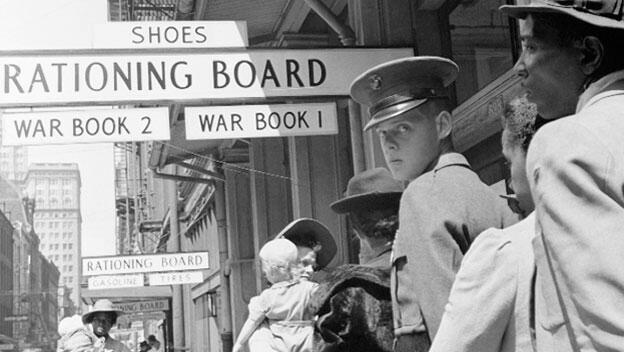
World War II Rationing on the Homefront
To ensure that there is enough food available to reach U.S. soldiers fighting abroad, the United States enacted a canned goods rationing program in 1942. Paul M. O'Leary of the Office of Price Administration carries on a "conversation" with a housewife and grocer in a December 12 radio broadcast.
Related Speeches & Audio (10)
-
World War II Rationing on the Homefront
World War II Rationing on the HomefrontAudio Clip (2:11)
Audio Clip (2:11)
To ensure that there is enough food available to reach U.S. soldiers fighting abroad, the United States enacted a canned goods rationing program in 1942. Paul M. O'Leary of the Office of Price Administration carries on a "conversation" with a housewife and grocer in a December 12 radio broadcast.
-
Franklin D. Roosevelt on Financing the War
Franklin D. Roosevelt on Financing the WarAudio Clip (2:41)
Audio Clip (2:41)
In his fireside chat radio broadcast on April 28, 1942, President Franklin D. Roosevelt presents his seven-point economic stabilization plan to deal with the country’s unprecedented wartime spending.
-
Franklin D. Roosevelt's Labor Day Address 1942
Franklin D. Roosevelt's Labor Day Address 1942Audio Clip (1:23)
Audio Clip (1:23)
In an address to the nation on Labor Day 1942, President Franklin D. Roosevelt summarizes an earlier meeting with Congress in which he urged cooperation to pass his seven-point economic plan to fight inflation, which was presented to both houses on April 28.
-
Polish Prime Minister Supports U.S. Bonds
Polish Prime Minister Supports U.S. BondsAudio Clip (2:08)
Audio Clip (2:08)
In a public service broadcast on May 16, 1941, Ignace Jan Paderewski, the exiled former prime minister of Poland, urges Americans to buy U.S. savings bonds to fulfill a moral obligation in helping with the war effort
-
Hoover on Unemployment Relief
Hoover on Unemployment ReliefAudio Clip (1:23)
Audio Clip (1:23)
On October 18, 1931, as the nation faces a deepening depression, President Herbert Hoover announces in his radio address the inauguration of a six-week campaign to raise local relief funds to aid the unemployed.
-
Franklin D. Roosevelt Handles Banking Crisis
Franklin D. Roosevelt Handles Banking CrisisAudio Clip (0:55)
Audio Clip (0:55)
On March 6, 1933, newly elected President Franklin D. Roosevelt orders the temporary closing of all banks in an effort to stem a financial crisis. On March 12, Roosevelt delivers his first fireside chat radio broadcast to assure the American people that their savings are safe.
-
Franklin D. Roosevelt's First Inaugural Address
Franklin D. Roosevelt's First Inaugural AddressAudio Clip (3:39)
Audio Clip (3:39)
On March 3, 1933, the newly elected president of the United States, Franklin D. Roosevelt, promises a country battered by the Great Depression a renewed prosperity, setting forth plans to put the government to work.
-
World War II Rationing in Europe
World War II Rationing in EuropeAudio Clip (2:00)
Audio Clip (2:00)
In a radio interview on March 6, 1944, a Swedish industrialist on a fact-gathering mission to the United States describes the effects of war rationing in neutral Sweden.
-
U.S. Financial Market Nears Collapse in September 2008
U.S. Financial Market Nears Collapse in September 2008Audio Clip (0:30)
Audio Clip (0:30)
In the wake of the worst financial crisis since the Depression, ABC News reports on September 14, 2008, on the impending collapse of the giant investment bank Lehman Brothers. Alan Greenspan, former chairman of the Federal Reserve, provides further analysis.
-
U.S. Credit Rating Is Downgraded in August 2011
U.S. Credit Rating Is Downgraded in August 2011Audio Clip (0:34)
Audio Clip (0:34)
An August 6, 2011, report describes the unprecedented decision by the debt securities adviser Standard & Poor's to downgrade the United States' credit rating from AAA to AA+.
Related Videos (10)
-
Franklin D. Roosevelt's Last Presidential Term
Franklin D. Roosevelt's Last Presidential TermVideo Clip (1:54)
Video Clip (1:54)
Franklin D. Roosevelt's capable handling of two major crises--the depression and WWII-- earned him a legacy as one of the greatest U.S. multi-term presidents.
-
Native Americans Aid War Effort
Native Americans Aid War EffortVideo Clip (1:00)
Video Clip (1:00)
Native Americans assist U.S. troops in the war effort (circa 1943).
-
The Rise of Cornelius Vanderbilt
The Rise of Cornelius VanderbiltVideo Clip (3:47)
Video Clip (3:47)
Discover how a steamboat captain built a railroad empire.
-
The Men Who Built America: The Every Man
The Men Who Built America: The Every ManVideo Clip (2:23)
Video Clip (2:23)
Henry Ford went against his investors and believed that there should be an automobile that was affordable to the working class.
-
The Men Who Built America: Monopoly
The Men Who Built America: MonopolyVideo Clip (2:50)
Video Clip (2:50)
John D. Rockefeller gained his fortune monopolizing the oil industry through often times unethical means.
-
The Men Who Built America: From Rich to Richer
The Men Who Built America: From Rich to RicherVideo Clip (3:08)
Video Clip (3:08)
J.P. Morgan used his wealth and power to control the largest corporations of the time including U.S. Steel and General Electric.
-
The Men Who Built America: Andrew Carnegie
The Men Who Built America: Andrew CarnegieVideo Clip (4:06)
Video Clip (4:06)
The rags to riches story of a Scottish immigrant who became one of America's greatest entrepreneurs and philanthropists.
-
The Rise of Thomas Edison
The Rise of Thomas EdisonVideo Clip (3:43)
Video Clip (3:43)
Meet the man who brought to life the light bulb, record player and moving pictures.
-
The Rise of J. P. Morgan
The Rise of J. P. MorganVideo Clip (4:37)
Video Clip (4:37)
Get the story of how one man went from buying railroads to bailing out the U.S. government.
-
Vanderbilt Constructs Grand Central
Vanderbilt Constructs Grand CentralVideo Clip (2:36)
Video Clip (2:36)
Commissioned by Cornelius Vanderbilt, Grand Central Depot opened in 1871 and was the largest building in New York City at the time.
Related Photo Galleries (3)
-
The Dust Bowl
The Dust Bowl(13 Photos)
13 Photos
In the 1930s, agricultural damage coupled with drought and windstorms, resulted in severe storms and destruction in the region that became known as the Dust Bowl.
-
Soup Kitchens and Bread Lines
Soup Kitchens and Bread Lines(10 Photos)
10 Photos
As the United States slipped into the economic turmoil of the Great Depression, millions of Americans turned to soup kitchens and bread lines for their daily survival.
-
New Deal Programs
New Deal Programs(14 Photos)
14 Photos
In the 1930s, President Franklin D. Roosevelt launched an ambitious series of social programs and legislation known as the "New Deal," designed to lift the United States out of the economic downturn of the Great Depression.
Most Popular Videos on History.com
-
America Divided
(3:54)
-
Caroline Dries: NYU Dorm
(3:26)
Newest Videos on History.com
-
Vietnam in HD Preview
(2:00)
-
Two For the Road
(1:48)
-
HISTORY says Thanks
(2:47)
Shop HISTORY
-
America The Story of Us Book & DVD Set
Own the DVD & the stunning companion book from the most anticipated HISTORY broadcast of all time.
$49.99
Buy Now -
Email Updates
Keep up with the latest History shows, online features, special offers and more.
Sign up


