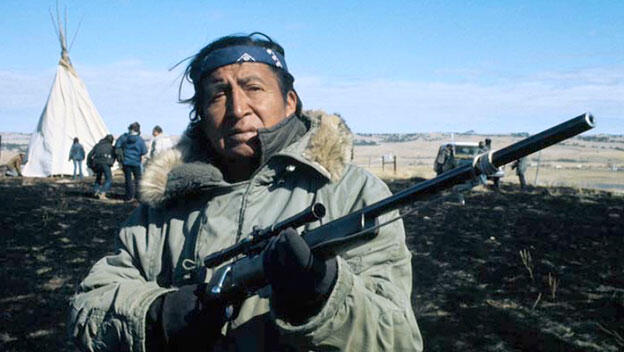
Wounded Knee Siege Ends
On May 6, 1973, 71 days after the American Indian Movement (AIM) held the South Dakota town of Wounded Knee hostage, a report recaps the events of the takeover and the subsequent agreement to end the occupation. The siege had been staged to call attention to government mistreatment of Native Americans.
Related Speeches & Audio (10)
-
Wounded Knee Siege Ends
Wounded Knee Siege EndsAudio Clip (2:04)
Audio Clip (2:04)
On May 6, 1973, 71 days after the American Indian Movement (AIM) held the South Dakota town of Wounded Knee hostage, a report recaps the events of the takeover and the subsequent agreement to end the occupation. The siege had been staged to call attention to government mistreatment of Native Americans.
-
Nixon on Vietnam War
Nixon on Vietnam WarAudio Clip (3:34)
Audio Clip (3:34)
On March 26, 1971, President Richard Nixon holds a meeting in the Oval Office with his National Security Council to discuss the war in Vietnam. The meeting is secretly recorded. Among the many topics he raises, Nixon recounts a prior conversation with House majority leader Hale Boggs on setting a date for the final withdrawal of U.S. forces.
-
Nixon Orders Invasion of Cambodia
Nixon Orders Invasion of CambodiaAudio Clip (1:02)
Audio Clip (1:02)
On April 30, 1970, President Richard Nixon asks the American people to support his decision to send troops into Cambodia in response to North Vietnam’s invasion of the country.
-
Franklin D. Roosevelt on American Progress in World War II
Franklin D. Roosevelt on American Progress in World War IIAudio Clip (1:00)
Audio Clip (1:00)
With the United States now entered into World War II, President Franklin D. Roosevelt uses the occasion of Washington’s birthday to broadcast to the nation on February 23, 1942, an outline of America’s progress in the war.
-
Franklin D. Roosevelt's 1941 Labor Day Speech
Franklin D. Roosevelt's 1941 Labor Day SpeechAudio Clip (1:37)
Audio Clip (1:37)
In his Labor Day radio broadcast in 1941, President Franklin D. Roosevelt reminds his fellow citizens of the need to devote America’s industrial effort to building weaponry in order to "crush Hitler and his Nazi forces."
-
Franklin D. Roosevelt's Fourth of July Address
Franklin D. Roosevelt's Fourth of July AddressAudio Clip (2:07)
Audio Clip (2:07)
In a broadcast from his home in Hyde Park, New York, on July 4, 1941, President Franklin D. Roosevelt warns Americans who wish not to get involved in the war that "the United States will never survive as a happy and fertile oasis of liberty surrounded by a cruel desert of dictatorship."
-
Franklin D. Roosevelt's Fourth Inaugural Address
Franklin D. Roosevelt's Fourth Inaugural AddressAudio Clip (6:22)
Audio Clip (6:22)
With the country at war at the start of his unprecedented fourth term as president of the United States, Franklin D. Roosevelt delivers a short and somber inaugural address at a simple ceremony without a parade or ball on January 20, 1945.
-
Franklin D. Roosevelt Reports on Teheran and Cairo Conferences
Franklin D. Roosevelt Reports on Teheran and Cairo ConferencesAudio Clip (2:36)
Audio Clip (2:36)
Following the 1943 Big Four meetings in Teheran and Cairo, President Franklin D. Roosevelt delivers a Christmas Eve broadcast promising the nation that they can look forward to peace, though at a high cost.
-
Truman Announces Japan's Surrender
Truman Announces Japan's SurrenderAudio Clip (1:57)
Audio Clip (1:57)
On September 1, 1945, in a radio address to the American people, President Harry Truman announces the unconditional surrender of Japan, formalized aboard the U.S.S. Missouri.
-
France Bombs Tunisian Village During Algerian War
France Bombs Tunisian Village During Algerian WarAudio Clip (1:21)
Audio Clip (1:21)
On February 7, 1958, French planes flying over the Tunisian village of Saqiyat Sidi Yusuf were machine-gunned by Algerian forces. The next day, France responded by bombing the village. Diplomat Herve Alphand delivers a statement on the retaliatory strike.
Related Videos (5)
-
Native Americans Aid War Effort
Native Americans Aid War EffortVideo Clip (1:00)
Video Clip (1:00)
Native Americans assist U.S. troops in the war effort (circa 1943).
-
John Brown's Raid
John Brown's RaidVideo Clip (1:38)
Video Clip (1:38)
Although poorly planned and executed, John Brown's raid helped lead the nation into Civil War and made him one of the most controversial men of his day.
-
The Last of the Sioux
The Last of the SiouxVideo Clip (3:48)
Video Clip (3:48)
Resistant to government regulated reservations, the Sioux retreated into the Black Hills until a final massacre at Wounded Knee.
-
Arlo Guthrie Reflects on Vietnam Era
Arlo Guthrie Reflects on Vietnam EraVideo Clip (3:19)
Video Clip (3:19)
Arlo Guthrie talks with Tom Brokaw about what he saw as a change of consciousness during the 1960s.
-
Sitting Bull
Sitting BullVideo Clip (2:54)
Video Clip (2:54)
The tragic, yet true tale of Sitting Bull, the leader of the Hunkpapa Lakota Sioux tribe who led his people's resistance against the United States, sung by musician and artist Jeffrey Lewis.
Most Popular Videos on History.com
-
D-Day Deception
(3:24)
Newest Videos on History.com
-
Vietnam in HD Preview
(2:00)
-
Two For the Road
(1:48)
-
HISTORY says Thanks
(2:47)
Shop HISTORY
-
-
America The Story of Us Book & DVD Set
Own the DVD & the stunning companion book from the most anticipated HISTORY broadcast of all time.
$49.99
Buy Now
Email Updates
Keep up with the latest History shows, online features, special offers and more.
Sign up


