
Watergate Forces Nixon to Resign and related media

  • Log out

Watergate Forces Nixon to Resign (3:20)

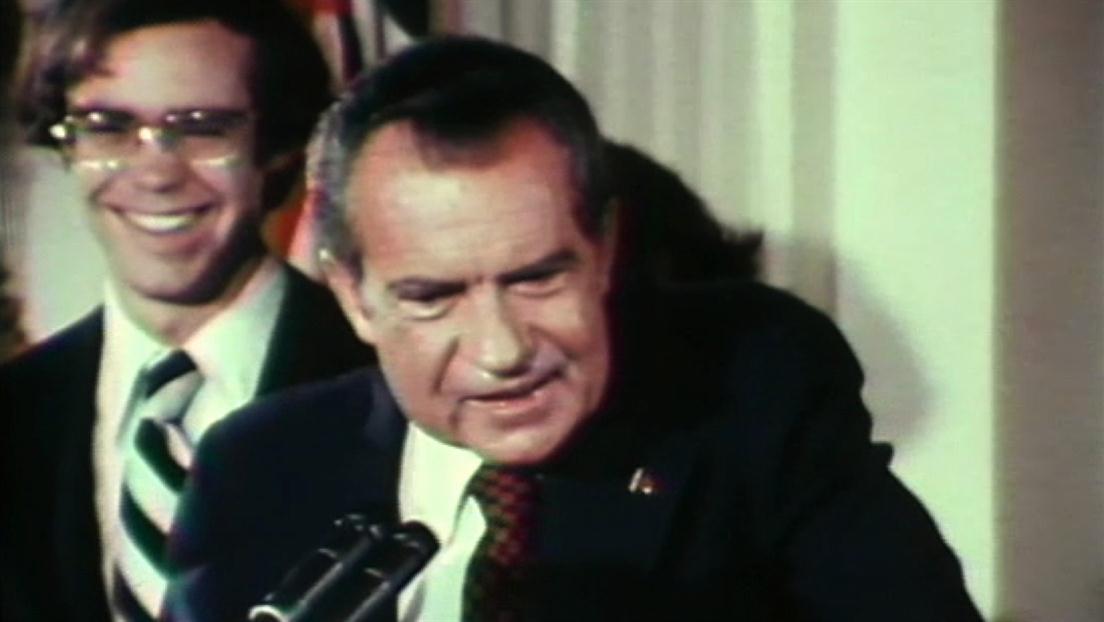
In this History Rocks the 70's video, brought to you by the History Channel, learn about special investigator Archibald Cox's quest to investigate the Watergate cover-up. Nixon tries to get Cox fired several times.

Watch Similar Videos

  • This video can be viewed when you log in with your TV provider.

    Select your TV provider to log in to have full access to videos

    • Select your TV provider
    • See More Providers
    Don't see your TV provider? Learn more

Your Parental Control settings do not allow you to view thiscontent.

Related Videos (6)

  • Watergate Forces Nixon to Resign
    Watergate Forces Nixon to Resign

    Video Clip (3:20)

    In this History Rocks the 70's video, brought to you by the History Channel, learn about special investigator Archibald Cox's quest to investigate the Watergate cover-up. Nixon tries to get Cox fired several times.

    Video Clip (3:20)
  • Reagan
    Reagan

    Video Clip (01:28:23)

    A portrait of America's 40th president depicting the most defining moments of his 93 years.

    Video Clip (01:28:23)
  • Reagan Describes Shooting
    Reagan Describes Shooting

    Video Clip (0:46)

    President Ronald Reagan's assassination attempt by John Hinckley, Jr. in front of the Washington Hilton Hotel is shown on this History Channel video. White House Press Secretary James Brady was also seriously wounded.

    Video Clip (0:46)
  • Thomas Jefferson Meets John Adams
    Thomas Jefferson Meets John Adams

    Video Clip (2:59)

    An unlikely pair whose tumultuous friendship lasted half a century, Thomas Jefferson and John Adams both died on July 4, 1826, 50 years after signing the Declaration of Independence.

    Video Clip (2:59)
  • Jefferson Writes the Declaration of Independence
    Jefferson Writes the Declaration of Independence

    Video Clip (2:37)

    At 33, Thomas Jefferson wrote the original draft of America's historic Declaration of Independence, which was approved by the Continental Congress after several days of debate and revisions on July 4, 1776.

    Video Clip (2:37)
  • James Madison: Did You Know?
    James Madison: Did You Know?

    Video Clip (1:36)

    At just 5'4", James Madison was hardly a commanding presence, but that didn't stop him from shaping American history.

    Video Clip (1:36)

Related Speeches & Audio (6)

  • Johnson Introduces "Great Society"
    Johnson Introduces "Great Society"

    Audio Clip (2:54)

    In a speech presented at the University of Michigan on May 22, 1964, President Lyndon B. Johnson outlines his vision of a "Great Society," which includes the ideas that will later become programs such as Medicare, Medicaid and Head Start.

    Audio Clip (2:54)
  • Franklin D. Roosevelt Handles Banking Crisis
    Franklin D. Roosevelt Handles Banking Crisis

    Audio Clip (0:55)

    On March 6, 1933, newly elected President Franklin D. Roosevelt orders the temporary closing of all banks in an effort to stem a financial crisis. On March 12, Roosevelt delivers his first fireside chat radio broadcast to assure the American people that their savings are safe.

    Audio Clip (0:55)
  • Franklin D. Roosevelt on New Deal Programs
    Franklin D. Roosevelt on New Deal Programs

    Audio Clip (2:25)

    In his April 28, 1935, fireside chat radio broadcast, President Franklin D. Roosevelt praises the newly adopted Works Relief Program and discusses the new Social Security Act recently introduced in Congress.

    Audio Clip (2:25)
  • Obama on the Egyptian Uprising
    Obama on the Egyptian Uprising

    Audio Clip (2:14)

    On January 25, 2011, Egyptians took to the streets in an uprising against President Hosni Mubarak. On the third day of the uprising, President Barack Obama addresses the American people after speaking to Mubarak about his country’s future.

    Audio Clip (2:14)
  • Reagan Addresses British Parliament
    Reagan Addresses British Parliament

    Audio Clip (0:17)

    On June 8, 1982, in the first speech by an American president to a meeting of both houses of the British Parliament, President Ronald Reagan presents his hope for a future that would "leave Marxism-Leninism on the ash heap of history."

    Audio Clip (0:17)
  • The Eisenhower Doctrine
    The Eisenhower Doctrine

    Audio Clip (1:01)

    In order to suppress growing Soviet influence in the Middle East following the Suez Crisis of 1956, President Dwight D. Eisenhower appears before a joint session of Congress on January 5, 1957, to present a policy that will become known as the Eisenhower Doctrine. It holds that the United States would be authorized to provide military assistance "to secure and protect the territorial integrity" of any nations threatened by international communism.

    Audio Clip (1:01)

Shop HISTORY