
Carter Signs the Panama Canal Treaty and related media

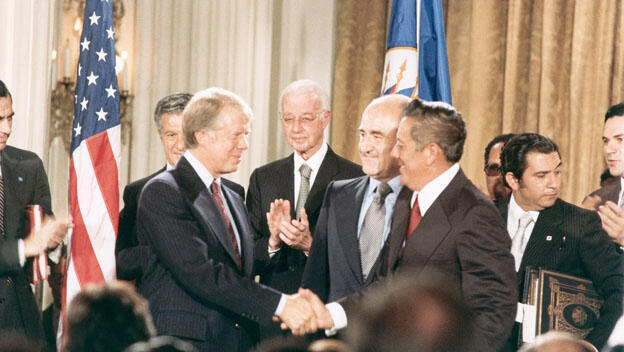
Carter Signs the Panama Canal Treaty

On September 7, 1977, President Jimmy Carter and Panamanian leader Omar Torrijos signed the Panama Canal Treaty, which ceded U.S. control of the canal beginning in 2000 and guaranteed the neutrality of the waterway thereafter. President Carter delivers a speech on the occasion of the treaty signing.

Listen to Similar Speeches & Audio

Your Parental Control settings do not allow you to view thiscontent.

Related Speeches & Audio (10)

  • Carter Signs the Panama Canal Treaty
    Carter Signs the Panama Canal Treaty

    Audio Clip (1:18)

    On September 7, 1977, President Jimmy Carter and Panamanian leader Omar Torrijos signed the Panama Canal Treaty, which ceded U.S. control of the canal beginning in 2000 and guaranteed the neutrality of the waterway thereafter. President Carter delivers a speech on the occasion of the treaty signing.

    Audio Clip (1:18)
  • Ford's Address at the Helsinki Conference
    Ford's Address at the Helsinki Conference

    Audio Clip (1:54)

    On August 1, 1975, at the Helsinki Accords, a major diplomatic agreement was signed by 35 nations, including the United States and the Soviet Union, in an attempt to secure peace between the eastern and western blocs. In a speech delivered at the Finland conference, President Gerald Ford promises to do his part for the good of all nations.

    Audio Clip (1:54)
  • Clinton Remarks on the Dayton Peace Accords
    Clinton Remarks on the Dayton Peace Accords

    Audio Clip (2:02)

    On November 27, 1995, President Bill Clinton announces the end of years of ethnic warfare in Serbia, Bosnia-Herzegovina and Croatia. The leaders of the three warring factions met in Dayton, Ohio, and signed an agreement known as the Dayton Peace Accords, which created two new sovereign states: Bosnia and Herzegovina.

    Audio Clip (2:02)
  • Bush and Gorbachev Sign the START I Treaty
    Bush and Gorbachev Sign the START I Treaty

    Audio Clip (2:25)

    On July 31, 1991, the Strategic Arms Reduction Treaty was signed in Moscow by U.S. President George H.W. Bush and Soviet President Mikhail Gorbachev, committing each superpower to reducing nuclear arms by a third. In a press conference held at the Kremlin, President Bush discusses the economic cooperation implicit in the peace negotiations.

    Audio Clip (2:25)
  • Bush and Gorbachev Declare End of Cold War
    Bush and Gorbachev Declare End of Cold War

    Audio Clip (1:45)

    President George H. W. Bush and Soviet leader Mikhail Gorbachev declared an end to the Cold War at the Malta Summit on December 3, 1989. At a joint press conference aboard the Soviet passenger liner Maxim Gorky in Marsaxlokk Harbor, President Bush speaks about his hopes for a cooperative U.S.-Soviet relationship.

    Audio Clip (1:45)
  • President Kennedy Addresses United Nations Staff
    President Kennedy Addresses United Nations Staff

    Audio Clip (3:42)

    On a September 20, 1963, visit to New York that includes an address to the United Nations General Assembly on the nuclear test-ban treaty, President John F. Kennedy takes time out to express his appreciation to Americans working at the United Nations.

    Audio Clip (3:42)
  • Jimmy Carter's Remarks on Camp David Summit
    Jimmy Carter's Remarks on Camp David Summit

    Audio Clip (3:33)

    In 1978, President Jimmy Carter held a 13-day summit with Egyptian President Anwar el-Sadat and Israeli Prime Minister Menachem Begin, helping to broker the first-ever peace treaty between Israel and one of its Arab neighbors. On September 17, at the end of the summit, President Carter describes the two agreements the two world leaders will sign.

    Audio Clip (3:33)
  • Clinton Brokers Israeli-PLO Peace Accords
    Clinton Brokers Israeli-PLO Peace Accords

    Audio Clip (1:50)

    In a ceremony held at the White House on September 13, 1993, Israeli leader Yitzhak Rabin and Yasser Arafat, leader of the Palestine Liberation Organization, signed an agreement to help resolve the Israeli-Palestinian conflict. President Bill Clinton pledges U.S. support in the work that lies ahead.

    Audio Clip (1:50)
  • The "Clinton Apology"
    The "Clinton Apology"

    Audio Clip (1:49)

    On a March 25, 1998, visit to Rwanda, President Bill Clinton delivers what later became known as the Clinton apology, in which he acknowledges America's failure to respond to the Rwandan genocide.

    Audio Clip (1:49)
  • Bush on the Fall of the Berlin Wall
    Bush on the Fall of the Berlin Wall

    Audio Clip (0:32)

    The day after the fall of the Berlin Wall on November 20, 1989, President George H. W. Bush met with West German Foreign Minister Hans-Dietrich Genscher to discuss plans for the reunification of Germany. As a token of his gratitude to the United States, Genscher brought President Bush a piece of the Berlin Wall. In a press conference, Bush thanks the foreign minister for the gift.

    Audio Clip (0:32)

Related Videos (10)

  • Nixon Announces His Resignation
    Nixon Announces His Resignation

    Video Clip (2:38)

    View and listen to President Nixon's resignation speech in its entirety from the White House.

    Video Clip (2:38)
  • Kennedy's Summation
    Kennedy's Summation

    Video Clip (2:48)

    This John F. Kennedy vs. Richard Nixon 1960 presidential debate History Channel video shows Senator Kennedy speaking about the importance of the Social Security Act of 1935 and now was the time to do something for elderly medical care.

    Video Clip (2:48)
  • Kennedy on His Qualifications
    Kennedy on His Qualifications

    Video Clip (1:17)

    See President John F. Kennedy respond to Richard Nixon's accusations that he is immature and ill-qualified to be President of the United States in this debate video. Kennedy explains how they both came to Congress in 1946.

    Video Clip (1:17)
  • Kennedy: Teachers' Salaries
    Kennedy: Teachers' Salaries

    Video Clip (1:32)

    John F. Kennedy answers back to Nixon's accusation of supporting federal control of teacher salaries. Kennedy explains that was not the question before the Senate in February, the issue was whether to give federal aid to the state to support education.

    Video Clip (1:32)
  • Kennedy on 'Extreme' Bills
    Kennedy on 'Extreme' Bills

    Video Clip (1:24)

    Senator John F. Kennedy debates that none of the bills proposed by Nixon were extreme like Nixon was suggesting. Kennedy uses Nixon's proposals of $1.25 an hour plan, federal aid to education, and medical care for the aged to prove his point.

    Video Clip (1:24)
  • Kennedy: Communism within the U.S.
    Kennedy: Communism within the U.S.

    Video Clip (0:50)

    Senator John F. Kennedy talks about the internal threat that communism poses to national security. Kennedy describes that these internal factions are serious and should be taken care of by supporting laws that the U.S. has already passed.

    Video Clip (0:50)
  • Nixon's Summation
    Nixon's Summation

    Video Clip (3:19)

    Listen to the important issues in 1960 in this History Channel video of one of the first televised debates, which took place between Richard Nixon and John F. Kennedy. The video shows Nixon stating his views from the Soviet Union to health insurance.

    Video Clip (3:19)
  • Nixon: Communism within the U.S.
    Nixon: Communism within the U.S.

    Video Clip (1:38)

    The Cold War was a serious issue that engulfed the United States. Coupled with this war was the fear of communism in the United States. This fear became a central issue between Kennedy and Nixon. Hear their debate in this History Channel video.

    Video Clip (1:38)
  • Franklin D. Roosevelt's First Fireside Chat
    Franklin D. Roosevelt's First Fireside Chat

    Video Clip
  • National Recovery Administration Created
    National Recovery Administration Created

    Video Clip (2:06)

    Established in 1933, the National Recovery Administration (NRA) was a key component of President Franklin Roosevelt's New Deal program designed to combat the effects of the Great Depression.

    Video Clip (2:06)

Related Photo Galleries (6)

  • James Madison
    James Madison

    10 Photos

    See pictures from the life and presidency of James Madison.

    (10 Photos)
  • James Monroe
    James Monroe

    8 Photos

    See pictures from the life and presidency of James Monroe.

    (8 Photos)
  • John Quincy Adams
    John Quincy Adams

    8 Photos

    See pictures from the life and presidency of John Quincy Adams.

    (8 Photos)
  • John Tyler
    John Tyler

    6 Photos

    See pictures from the life and presidency of John Tyler

    (6 Photos)
  • Millard Fillmore
    Millard Fillmore

    8 Photos

    See pictures from the life and presidency of Millard Fillmore.

    (8 Photos)
  • William Henry Harrison
    William Henry Harrison

    7 Photos

    See pictures from the life and presidency of William Henry Harrison

    (7 Photos)

Shop HISTORY