Campaign Spot: Convention (1968) and related media

  • Log out

Campaign Spot: Convention (1968) (0:55)

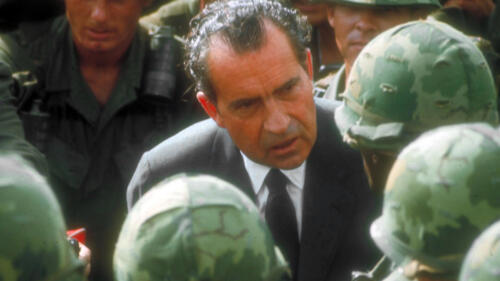
For his second run for the presidency, Nixon hired filmmaker Eugene Jones to produce ads that captured the turbulence and unrest in the nation at the time. Convention was one in a series -- mimicking the uneasy mood and tension in the US, suggesting that Nixon was the only man to bring the country together again.

Watch Similar Videos

  • This video can be viewed when you log in with your TV provider.

    Select your TV provider to log in to have full access to videos

    • Select your TV provider
    • See More Providers
    Don't see your TV provider? Learn more

Your Parental Control settings do not allow you to view thiscontent.

Related Videos (10)

  • Campaign Spot: Convention (1968)
    Campaign Spot: Convention (1968)

    Video Clip (0:55)

    For his second run for the presidency, Nixon hired filmmaker Eugene Jones to produce ads that captured the turbulence and unrest in the nation at the time. Convention was one in a series -- mimicking the uneasy mood and tension in the US, suggesting that Nixon was the only man to bring the country together again.

    Video Clip (0:55)
  • Campaign Spot: Failure (1968)
    Campaign Spot: Failure (1968)

    Video Clip (1:00)

    Similar to Convention, Nixon points out Americas major frustrations and links them to breakdowns in the Democratic leadership.

    Video Clip (1:00)
  • Campaign Spot: Ike For President (1952)
    Campaign Spot: Ike For President (1952)

    Video Clip (1:03)

    Up until Eisenhower, presidential candidates used tv for 30-minute speeches only. The idea for the celebrated WWII generals spots came from Madison Avenue ad exec Rossier Reeves, who had created M&Ms Melts in your mouth, not in your hands campaign. Reeves convinced Eisenhower that short spots placed before or after popular tv shows, such as I Love Lucy, would reach more viewers.

    Video Clip (1:03)
  • Campaign Spot: Best Qualified (1960)
    Campaign Spot: Best Qualified (1960)

    Video Clip (1:01)

    After some misinterpreted comments by President Eisenhower about Nixon that JFK used in a campaign ad against his opponent (Nixons Experience), Eisenhower fully endorses Nixon. But it was too little, too late. JFK won the election, by a slim margin.

    Video Clip (1:01)
  • Campaign Spot: China (1972)
    Campaign Spot: China (1972)

    Video Clip (1:02)

    One of Nixons lasting legacies was his trip to China to normalize relations between the two countries which had been cut off for 20 years. No American president had ever visited China. Nixons tip signaled a major change -- for both America and Chinas policies. And for Republicans, a huge reason to re-elect their candidate.

    Video Clip (1:02)
  • Campaign Spot: McGovern Defense (1972)
    Campaign Spot: McGovern Defense (1972)

    Video Clip (1:01)

    In this ad, McGoverns defense cuts are criticized, questioning the candidates priorities for national security.

    Video Clip (1:01)
  • Campaign Spot: Peace (1976)
    Campaign Spot: Peace (1976)

    Video Clip (0:30)

    Gerald Ford took office after Nixon resigned in 1973. Ford attempted to distance himself from the Nixon presidency, showcasing himself as a normal guy. His campaign focused on an upbeat, positive view of America.

    Video Clip (0:30)
  • Campaign Spot: Taxi Driver and the Dog (1956)
    Campaign Spot: Taxi Driver and the Dog (1956)

    Video Clip (4:21)

    In 1956, America was facing the threat of Communism, conflict in the Middle East over the Suez Canal, and domestic issues of wages, education, and family values. This spot dramatizes a regular guy out on his nightly walk with his dog aiming to assure that Eisenhower is a neighbor who just happens to have the most important job in the world, and would make the right choices, keeping Americans safe and prosperous.

    Video Clip (4:21)
  • Campaign Spot: The Truth About Taxes (1940)
    Campaign Spot: The Truth About Taxes (1940)

    Video Clip (10:45)

    Democrat Franklin D. Roosevelt ran for an unprecedented third term in 1940. In this spot against him opponent Wendell Wilkie aimed to raise concern that this is the act of a budding dictator.

    Video Clip (10:45)
  • Campaign Spot: We Will Bury You (1964)
    Campaign Spot: We Will Bury You (1964)

    Video Clip (1:01)

    If Democrats could use children to remind the public how dangerous the world can be, so can Republicans. In this ad for his defense, Goldwater implies that LBJ is soft on Communism, and only he could protect America.

    Video Clip (1:01)

Related Speeches & Audio (10)

  • Reagan Endorses Barry Goldwater
    Reagan Endorses Barry Goldwater

    Audio Clip (0:58)

    When Ronald Reagan, as spokesperson for General Electric, gives his “Time for Choosing” speech in support of Barry Goldwater’s 1964 presidential run, he establishes himself as an important player in the Republican Party and jumpstarts his political career.

    Audio Clip (0:58)
  • Nixon’s First Inaugural Address
    Nixon’s First Inaugural Address

    Audio Clip (1:13)

    After losing his first presidential bid to John F. Kennedy in 1960, former Vice President Richard Nixon brought the Republican Party back into power with a win in the 1968 presidential election. On January 20, 1969, he takes the oath of office and promises to heal a divided nation.

    Audio Clip (1:13)
  • Reagan’s First Inaugural Address
    Reagan’s First Inaugural Address

    Audio Clip (1:29)

    With the country discouraged by high inflation, unemployment, gas shortages and the Iran hostage crisis, former California governor Ronald Reagan easily defeated incumbent President Jimmy Carter in the 1980 election. In his inaugural address on January 20, 1981, President Reagan promises to limit the reach of the federal government.

    Audio Clip (1:29)
  • Reagan’s 1984 Presidential Nomination
    Reagan’s 1984 Presidential Nomination

    Audio Clip (0:57)

    On August 23, 1984, President Ronald Reagan accepts his party's nomination for a second term. In his speech at the Republican National Convention, President Reagan promises a "springtime of hope" for America.

    Audio Clip (0:57)
  • Reagan and Mondale in 1984 Presidential Debate
    Reagan and Mondale in 1984 Presidential Debate

    Audio Clip (1:15)

    On October 21, 1984, President Ronald Reagan and former Vice President Walter Mondale engage in their second nationally broadcast debate. When Henry Trewhitt of the Baltimore Sun asks the president about his advancing age, Reagan turns the question on its head by promising not to make an issue of his opponent’s youth and inexperience.

    Audio Clip (1:15)
  • Reagan Accepts Presidential Nomination
    Reagan Accepts Presidential Nomination

    Audio Clip (1:33)

    After unsuccessfully seeking the presidential nomination in 1968 and 1976, Ronald Reagan was nominated at the Republican National Convention on September 7, 1980. In his acceptance speech, the former California governor tells American taxpayers that they do not exist to fund the federal government.

    Audio Clip (1:33)
  • Reagan and Carter in 1980 Presidential Debate
    Reagan and Carter in 1980 Presidential Debate

    Audio Clip (1:06)

    Held on October 28, 1980, the debate between former California governor Ronald Reagan and incumbent President Jimmy Carter covers the issues of inflation, the energy crisis and terrorism. In his closing statement, Reagan makes an impact when he poses this question: "Are you better off now than you were four years ago?"

    Audio Clip (1:06)
  • Nixon's Second Inaugural Address
    Nixon's Second Inaugural Address

    Audio Clip (1:42)

    After a landslide reelection victory, incumbent President Richard Nixon stresses America's role in the pursuit of world peace during his second inaugural address, delivered on January 20, 1973.

    Audio Clip (1:42)
  • Nixon Reelected to Presidency
    Nixon Reelected to Presidency

    Audio Clip (1:03)

    On November 7, 1972, incumbent President Richard Nixon won a second term in a landslide victory over Democrat George McGovern. In a brief statement from the Oval Office, President Nixon promises to bring "peace with honor" in Vietnam and to usher in a "new era of peace" with the Soviet Union.

    Audio Clip (1:03)
  • Margaret Chase Smith Cautions Anti-Eisenhower Republicans
    Margaret Chase Smith Cautions Anti-Eisenhower Republicans

    Audio Clip (0:47)

    In a speech delivered March 3, 1951, in Town Hall, New York, Sen. Margaret Chase Smith warns those in her party who are critical of Gen. Dwight D. Eisenhower, the likely presidential nominee, to tone down their rhetoric as a division grows in the GOP over the stationing of troops in post-World War II Germany.

    Audio Clip (0:47)

Shop HISTORY