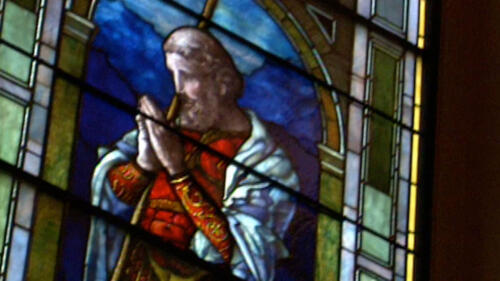
St. Patrick's Day is celebrated on March 17, the saint's religious feast day and the anniversary of his death in the fifth century. The Irish have observed this day as a religious holiday for over 1,000 years. On St. Patrick's Day, which falls during the Christian season of Lent, Irish families would traditionally attend church in the morning and celebrate in the afternoon. Lenten prohibitions against the consumption of meat were waived and people would dance, drink and feast--on the traditional meal of Irish bacon and cabbage.
More to Explore
Recommended Articles
-
St. Patrick's Day Facts
Find out where to celebrate in the U.S. and how much corned beef and cabbage Americans eat every year.
-
St. Patrick's Day Symbols and Traditions
From shamrocks to leprechauns see how the symbols of St. Patrick's Day came to be part of the holiday.
-
United States Immigration Before 1965
America received large waves of European immigrants during the colonial era, the mid-19th century and from 1880 to 1920.
-
History of the Holidays
Holidays bring people together, commemorate historic events and usher in the seasons. Discover the history behind the holidays.
Did You Know?
More than 100 St. Patrick's Day parades are held across the United States; New York City and Boston are home to the largest celebrations.
Contents
- St. Patrick and the First St. Patrick's Day Parade
- Growth of St. Patrick's Day Celebrations
- St. Patrick's Day, No Irish Need Apply and the "Green Machine"
St. Patrick and the First St. Patrick's Day Parade
Saint Patrick, who lived during the fifth century, is the patron saint and national apostle of Ireland. Born in Roman Britain, he was kidnapped and brought to Ireland as a slave at the age of 16. He later escaped, but returned to Ireland and was credited with bringing Christianity to its people. In the centuries following Patrick's death (believed to have been on March 17, 461), the mythology surrounding his life became ever more ingrained in the Irish culture: Perhaps the most well known legend is that he explained the Holy Trinity (Father, Son and Holy Spirit) using the three leaves of a native Irish clover, the shamrock.
Since around the ninth or 10th century, people in Ireland have been observing the Roman Catholic feast day of St. Patrick on March 17. Interestingly, however, the first parade held to honor St. Patrick's Day took place not in Ireland but in the United States. On March 17, 1762, Irish soldiers serving in the English military marched through New York City. Along with their music, the parade helped the soldiers reconnect with their Irish roots, as well as with fellow Irishmen serving in the English army.
Growth of St. Patrick's Day Celebrations
Over the next 35 years, Irish patriotism among American immigrants flourished, prompting the rise of so-called "Irish Aid" societies like the Friendly Sons of Saint Patrick and the Hibernian Society. Each group would hold annual parades featuring bagpipes (which actually first became popular in the Scottish and British armies) and drums.
In 1848, several New York Irish Aid societies decided to unite their parades to form one official New York City St. Patrick's Day Parade. Today, that parade is the world 's oldest civilian parade and the largest in the United States, with over 150,000 participants. Each year, nearly 3 million people line the 1.5-mile parade route to watch the procession, which takes more than five hours. Boston, Chicago, Philadelphia and Savannah also celebrate the day with parades involving between 10,000 and 20,000 participants each.
St. Patrick's Day, No Irish Need Apply and the "Green Machine"
Up until the mid-19th century, most Irish immigrants in America were members of the Protestant middle class. When the Great Potato Famine hit Ireland in 1845, close to 1 million poor and uneducated Irish Catholics began pouring into America to escape starvation. Despised for their alien religious beliefs and unfamiliar accents by the American Protestant majority, the immigrants had trouble finding even menial jobs. When Irish Americans in the country's cities took to the streets on St. Patrick's Day to celebrate their heritage, newspapers portrayed them in cartoons as drunk, violent monkeys.
The American Irish soon began to realize, however, that their large and growing numbers endowed them with a political power that had yet to be exploited. They started to organize, and their voting block, known as the "green machine," became an important swing vote for political hopefuls. Suddenly, annual St. Patrick's Day parades became a show of strength for Irish Americans, as well as a must-attend event for a slew of political candidates. In 1948, President Harry S. Truman attended New York City 's St. Patrick's Day parade, a proud moment for the many Irish Americans whose ancestors had to fight stereotypes and racial prejudice to find acceptance in the New World.
The Chicago River on St. Patrick's Day
As Irish immigrants spread out over the United States, other cities developed their own traditions. One of these is Chicago’s annual dyeing of the Chicago River green. The practice started in 1962, when city pollution-control workers used dyes to trace illegal sewage discharges and realized that the green dye might provide a unique way to celebrate the holiday. That year, they released 100 pounds of green vegetable dye into the river--enough to keep it green for a week! Today, in order to minimize environmental damage, only 40 pounds of dye are used, and the river turns green for only several hours.
Although Chicago historians claim their city's idea for a river of green was original, some natives of Savannah, Georgia (whose St. Patrick's Day parade, the oldest in the nation, dates back to 1813) believe the idea originated in their town. They point out that, in 1961, a hotel restaurant manager named Tom Woolley convinced city officials to dye Savannah's river green. The experiment didn't exactly work as planned, and the water only took on a slight greenish hue. Savannah never attempted to dye its river again, but Woolley maintains (though others refute the claim) that he personally suggested the idea to Chicago's Mayor Richard J. Daley.
St. Patrick's Day Around the World
Today, people of all backgrounds celebrate St. Patrick's Day, especially throughout the United States, Canada and Australia. Although North America is home to the largest productions, St. Patrick's Day is celebrated in many other locations far from Ireland, including Japan, Singapore and Russia.
In modern-day Ireland, St. Patrick's Day was traditionally been a religious occasion. In fact, up until the 1970s, Irish laws mandated that pubs be closed on March 17. Beginning in 1995, however, the Irish government began a national campaign to use interest in St. Patrick's Day to drive tourism and showcase Ireland and Irish culture to the rest of the world. Today, approximately 1 million people annually take part in Ireland 's St. Patrick's Festival in Dublin, a multi-day celebration featuring parades, concerts, outdoor theater productions and fireworks shows.
Fact Check We strive for accuracy and fairness. But if you see something that doesn't look right, contact us!
This Day in History
Jun 18
Lead Story
War of 1812 begins, 1812
The day after the Senate followed the House of Representatives in voting to declare war against Great Britain, President James Madison signs the…
Shop HISTORY
-
The History of St. Patrick’s Day DVD
FREE with any $50 History Shop purchase! Enter coupon code SHAMROCK at checkout.
$6.99
Buy Now -
Ultimate Bible Collection
Experience the greatest stories of the Bible in a whole new way.
$95.99
Buy Now -
Swamp People Troy Mask
Want the ultimate Big Head? The Swamp People Troy Mask is for Cajuns and Cajuns at heart.
$44.99
Buy Now
Email Updates
Keep up with the latest History shows, online features, special offers and more.
Sign upMore Outside History.com
-
St. Patrick's Day on Biography
-
Interactive Map of Ireland on Biography
-
Irish Icons on Biography
The talented and driven people of Ireland have contributed so much to the to world.