Jefferson and the Continental Congress (3:33)
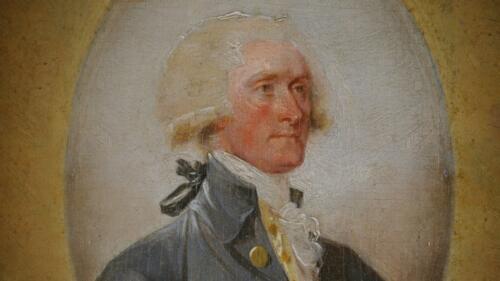
Over 17 days, Thomas Jefferson writes what will become the mission statement for a revolution and a new nation: the Declaration of Independence.
-
This video can be viewed when you log in with your TV provider.
Select your TV provider to log in to have full access to videos
-
- Select your TV provider
- See More Providers
Related Videos (10)
-
Jefferson and the Continental Congress
Jefferson and the Continental CongressVideo Clip (3:33)
Video Clip (3:33)
Over 17 days, Thomas Jefferson writes what will become the mission statement for a revolution and a new nation: the Declaration of Independence.
-
Jefferson Challenges the King
Jefferson Challenges the KingVideo Clip (2:21)
Video Clip (2:21)
Thomas Jefferson is known for penning The Declaration of Independence, but some of his earlier writings establish the pattern of challenging the British monarchy.
-
History of the Fourth of July
History of the Fourth of JulyVideo Clip (2:44)
Video Clip (2:44)
Discover how and when Americans celebrated Independence Day in the past. Although Benjamin Franklin thought we'd celebrate the 2nd of July; the 4th of July is closest to our hearts.
-
Washington's Surprise Attack on Trenton
Washington's Surprise Attack on TrentonVideo Clip (1:40)
Video Clip (1:40)
By Christmas, 1777, in desperate need of a victory, Washington defies military convention with a nighttime assault in the dead of winter.
-
Declaration of Independence
Declaration of IndependenceVideo Clip (3:04)
Video Clip (3:04)
To many in the Continental Congress, war was unthinkable. So why did they finally create this revolutionary document?
-
Matt Damon: The Declaration of Independence
Matt Damon: The Declaration of IndependenceVideo Clip (2:02)
Video Clip (2:02)
Actor Matt Damon performs and discusses the Declaration of Independence.
-
Power Nap
Power NapVideo Clip (0:33)
Video Clip (0:33)
The reason President Calvin "Silent Cal" Coolidge was so quiet is probably because he was asleep all the time.
-
Rail Force One
Rail Force OneVideo Clip (0:46)
Video Clip (0:46)
FDR had some pretty great wheels, but his private train car was even cooler.
-
Cat Bomb
Cat BombVideo Clip (0:40)
Video Clip (0:40)
During World War II, the U.S. Army invented a new missile guidance system: cats.
-
Presidential Pastimes
Presidential PastimesVideo Clip (1:20)
Video Clip (1:20)
Presidents are usually pretty old. So it's no surprise they like low-impact sports.
Related Speeches & Audio (10)
-
Franklin D. Roosevelt's Fourth of July Address
Franklin D. Roosevelt's Fourth of July AddressAudio Clip (2:07)
Audio Clip (2:07)
In a broadcast from his home in Hyde Park, New York, on July 4, 1941, President Franklin D. Roosevelt warns Americans who wish not to get involved in the war that "the United States will never survive as a happy and fertile oasis of liberty surrounded by a cruel desert of dictatorship."
-
Obama on the Egyptian Uprising
Obama on the Egyptian UprisingAudio Clip (2:14)
Audio Clip (2:14)
On January 25, 2011, Egyptians took to the streets in an uprising against President Hosni Mubarak. On the third day of the uprising, President Barack Obama addresses the American people after speaking to Mubarak about his country’s future.
-
Franklin D. Roosevelt's Fourth Inaugural Address
Franklin D. Roosevelt's Fourth Inaugural AddressAudio Clip (6:22)
Audio Clip (6:22)
With the country at war at the start of his unprecedented fourth term as president of the United States, Franklin D. Roosevelt delivers a short and somber inaugural address at a simple ceremony without a parade or ball on January 20, 1945.
-
Franklin D. Roosevelt Reports on Teheran and Cairo Conferences
Franklin D. Roosevelt Reports on Teheran and Cairo ConferencesAudio Clip (2:36)
Audio Clip (2:36)
Following the 1943 Big Four meetings in Teheran and Cairo, President Franklin D. Roosevelt delivers a Christmas Eve broadcast promising the nation that they can look forward to peace, though at a high cost.
-
John F. Kennedy on Coup in South Vietnam
John F. Kennedy on Coup in South VietnamAudio Clip (6:06)
Audio Clip (6:06)
On October 29, 1963, President John F. Kennedy meets with the National Security Council to discuss whether to support the overthrow of South Vietnam's President Ngo Dinh Diem. During the secretly recorded conversation, Secretary of State Dean Rusk and the president craft a detailed plan involving Henry Cabot Lodge, ambassador to South Vietnam, Gen. Paul D. Harkins and the general of the South Vietnamese military, hoping to avoid setting off a civil war in the country.
-
Truman Announces Japan's Surrender
Truman Announces Japan's SurrenderAudio Clip (1:57)
Audio Clip (1:57)
On September 1, 1945, in a radio address to the American people, President Harry Truman announces the unconditional surrender of Japan, formalized aboard the U.S.S. Missouri.
-
The Eisenhower Doctrine
The Eisenhower DoctrineAudio Clip (1:01)
Audio Clip (1:01)
In order to suppress growing Soviet influence in the Middle East following the Suez Crisis of 1956, President Dwight D. Eisenhower appears before a joint session of Congress on January 5, 1957, to present a policy that will become known as the Eisenhower Doctrine. It holds that the United States would be authorized to provide military assistance "to secure and protect the territorial integrity" of any nations threatened by international communism.
-
Eisenhower's Inaugural Address
Eisenhower's Inaugural AddressAudio Clip (5:51)
Audio Clip (5:51)
When Dwight D. Eisenhower becomes the 34th president of the United States on January 20, 1953, his inaugural address lays out a nine-point plan for achieving world peace.
-
Obama Approves Military Action in Libya
Obama Approves Military Action in LibyaAudio Clip (1:21)
Audio Clip (1:21)
On March 19, 2011, President Barack Obama announced authorization for U.S. armed forces to begin an aerial campaign in Libya to protect citizens protesting the government of Moammar el Qaddafi.
-
George W. Bush Declares Mission Accomplished
George W. Bush Declares Mission AccomplishedAudio Clip (1:29)
Audio Clip (1:29)
From aboard the aircraft carrier USS Abraham Lincoln on May 1, 2003, standing directly under a "Mission Accomplished" banner, President George W. Bush declares, "In the battle of Iraq, the United States and our allies have prevailed." Bush's claim of victory in what became known as the "Mission Accomplished" speech drew criticism as the war in Iraq continued for several years thereafter.
Related Photo Galleries (5)
-
July 4th
July 4th(8 Photos)
8 Photos
Independence Day, commonly known as July 4th or the Fourth of July, commemorates the adoption of the Declaration of Independence on July 4, 1776. Regarded as the birthday of the United States of America, the day is celebrated with parades,…
-
American Revolution: Continental Congress
American Revolution: Continental Congress(11 Photos)
11 Photos
Discover the accomplishments of the First and Second Constitutional Congresses, and learn about the major players behind such documents as the Declaration of Independence and the Treaty of Paris.
-
Thomas Jefferson
Thomas Jefferson(11 Photos)
11 Photos
See pictures from the life and presidency of Thomas Jefferson.
-
John Adams
John Adams(7 Photos)
7 Photos
See pictures from the life and presidency of John Adams.
-
American Revolution: Flags and Fliers
American Revolution: Flags and Fliers(10 Photos)
10 Photos
Discover some of the flags and fliers that circulated amongst the colonies before and during the American Revolution.
Most Popular Videos on History.com
-
Attack on Pearl Harbor
(1:49)
Newest Videos on History.com
-
Vietnam in HD Preview
(2:00)
-
Two For the Road
(1:48)
-
HISTORY says Thanks
(2:47)
Shop HISTORY
-
The Revolution Collection
Own the most extensive DVD set about the American Revolution, the sweeping, acclaimed series, and the landmark book.
$88.75
Buy Now -
-
Email Updates
Keep up with the latest History shows, online features, special offers and more.
Sign up