American Revolution
The Revolutionary War waged by the American colonies against Great Britain influenced political ideas and revolutions around the globe, as a small fledgling nation won its freedom from the greatest military power of its time.
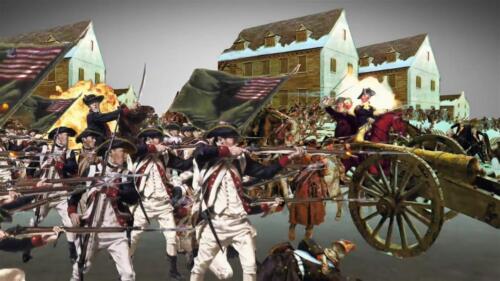

Start Here

Most famous for their role in the Boston Tea Party, the Sons of Liberty used grassroots activism to push back against British rule.

While the British were often better equipped and trained, these events proved critical in ultimately securing Americans' victory in the war.

They include a spy, a poet, a guerrilla fighter—and foot soldiers who fought on both sides of the war.

The Declaration of Independence played a critical role in unifying the colonies for the bloody struggle they faced.
Washington Commands the Continental Army
Washington Commands the Continental Army
At the time of the Revolution, America had no money, no military and barely a chance at success. Even George Washington was not immediately seen as a strong military commander, often making mistakes.

3 Events That Triggered the American Revolution


Explore All Related Topics

The Boston Tea Party was a political protest staged on December 16, 1773, when American colonists dumped British tea into Boston harbor.

Death tolls in the Revolutionary War were more than 25,000 people, a significant loss given the small population of the American colonies.

The Tea Act of 1773 was a British tax on tea imported into the American colonies. It led to the Boston Tea Party and the Revolutionary War.

The Townshend Acts were a series of measures passed by the British Parliament in 1767 that taxed goods imported to the American colonies.

The Boston Massacre was a deadly riot that occurred on March 5, 1770, in Boston, Mass., between American colonists and British soldiers.

A dispute over a small cannon in 1835 sparked the Texas Revolution and immortalized the battle cry “Come and Take It.”

The capsule, originally placed in the state house in 1795, was discovered by workers fixing a leak more than two centuries later.

The 1781 Battle of Yorktown was the last major battle of the American Revolution and resulted in an American victory over the British.
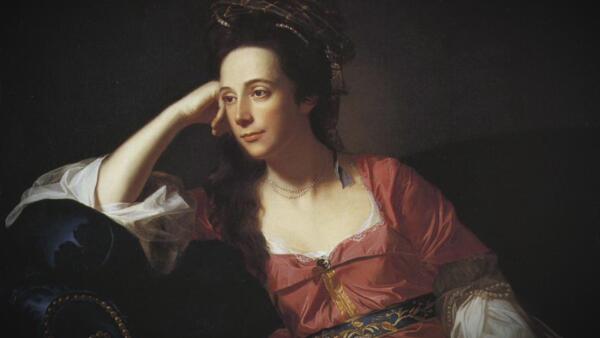

Most famous for their role in the Boston Tea Party, the Sons of Liberty used grassroots activism to push back against British rule.

Discover the intriguing history, enigmatic rituals and hidden knowledge of renowned secret societies such as the Knights Templar, Freemasons, Skull and Bones and, of course, the Illuminati.

Postal mail delivery became a vital communication line for the colonies—and then helped unite the newly independent United States.

From stagecoach to pneumatic tube, the post office finds a way to get Americans their mail.

Long considered a symbol of strength, the predatory bird first appeared on the national seal in 1782.

These banners stoked the fight for independence and influenced the design of the American flag. Some are still around today.

Betsy Ross (1752-1836) became a patriotic icon in the late 19th century when stories surfaced that she had sewn the first “stars and stripes” U.S. flag in 1776. Though that story is likely apocryphal, Ross is known to have sewn flags during the Revolutionary War. She is perhaps the best-known figure from the American Revolutionary era who wasn’t a president, general or statesman.


