This Day In History: 03/14/1879 - Albert Einstein Born
On this day in 1879, Albert Einstein is born, the son of a Jewish electrical engineer in Ulm, Germany. Einstein's theories of special and general relativity drastically altered man's view of the universe, and his work in particle and energy theory helped make possible quantum mechanics and, ultimately, the atomic bomb. After a childhood in Germany and Italy, Einstein studied physics and mathematics at the Federal Polytechnic Academy in Zurich, Switzerland. He became a Swiss citizen and in 1905 was awarded a Ph.D. from the University of Zyrich while working at the Swiss patent office in Bern. That year, which historians of Einstein's career call the annus mirabilis--the "miracle year"--he published five theoretical papers that were to have a profound effect on the development of modern physics. Although the public was not quick to embrace his revolutionary science, Einstein was welcomed into the circle of Europe's most eminent physicists and given professorships in Zyrich, Prague, and Berlin. As a world-renowned public figure, he became increasingly political, taking up the cause of Zionism and speaking out against militarism and rearmament. In his native Germany, this made him an unpopular figure, and after Nazi leader Adolf Hitler became chancellor of Germany in 1933 Einstein renounced his German citizenship and left the country. In 1939, despite his lifelong pacifist beliefs, he agreed to write to President Franklin D. Roosevelt on behalf of a group of scientists who were concerned with American inaction in the field of atomic-weapons research. Like the other scientists, he feared sole German possession of such a weapon. He played no role, however, in the subsequent Manhattan Project and later deplored the use of atomic bombs against Japan. Albert Einstein, one of the most creative minds in human history, died in Princeton in 1955.
Related Videos

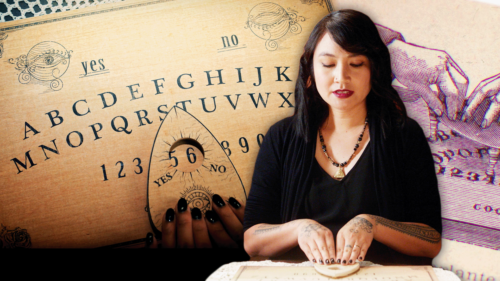
The Woman Who Named the Ouija Board and Later Feared Its Power
In 1890, medium Helen Peters helped give the Ouija board its name. But after the board accused a relative of theft and tore her family apart, she spent the rest of her life warning others that its answers might not be truthful.


